The etymology: why is it called craps?
The short answer: the game is named after its losing throw. In the old English dice game Hazard, a roll of two or three was called “crabs.” French-speaking players in colonial Louisiana pronounced that word closer to “crebs” or “creps,” and by the early 1800s American English had flattened it into “craps.” The word for the bad roll ended up becoming the word for the whole game, which is why a shooter who rolls 2, 3, or 12 on the opening throw is still said to have “crapped out.”
There’s a second, more colorful theory involving the French word for toad. Both stories are worth knowing, because they overlap more than they compete.
From French “crapaud” to American “craps”
The popular version says “craps” comes from crapaud, French for toad, because the game was played in the street by men crouched low over the pavement, knees bent, looking a bit like squatting toads. A related version points out that “Johnny Crapaud” was a nickname English speakers used for Frenchmen, so a French dice game could easily have picked up the label.
It’s a good story, and you’ll see it repeated constantly in gambling books. Etymological dictionaries generally give it less weight than the “crabs” route, treating the toad connection as folk etymology that grew up around a word that already existed.
The English “crabs” connection
Hazard, the medieval English dice game craps descends from, had its own vocabulary. The caster called a number, rolled, and certain throws lost instantly. The worst of them, the two, was “crabs.” Two ones on the dice are still called snake eyes today, and the losing come-out numbers 2, 3, and 12 are still collectively called “craps” numbers by dealers who have no idea they’re quoting fourteenth-century slang.
So the two theories can both be partly right: an English losing-roll term passed through French-speaking Louisiana, got a French pronunciation, and possibly picked up a toad joke on the way.
A brief history of craps
From Hazard to craps
Hazard was played in England for centuries before anything called craps existed. Chaucer refers to dice gambling of this kind in The Canterbury Tales, and by the 1700s Hazard was a fixture of English gaming houses. The rules were fussy by modern standards: the shooter (the “caster”) named a “main” number between five and nine, and whether a throw won, lost, or set a “chance” depended on which main had been called. Learning it took a while. Losing money on it did not.
How craps came to America
The usual account credits Bernard Xavier Philippe de Marigny de Mandeville, a wealthy young Louisiana Creole, with bringing Hazard to New Orleans in the first years of the 1800s and simplifying it. Fixing the main at seven cut out most of the complexity and produced a game recognizably like modern craps. From New Orleans it travelled up the Mississippi on riverboats and then across the country as a street game, where it became one of the most widely played forms of gambling in the United States.
One more name matters. In the early twentieth century, a dice maker named John H. Winn is credited with adding the don’t pass option, letting players bet against the shooter as well as with him. That change mattered for a practical reason: if you could bet either side, there was far less profit in slipping loaded dice into a street game. The modern casino layout, with its pass line, don’t pass bar, and rows of side bets, grew out of that idea. Craps then became a Las Vegas centerpiece, helped along by a generation of American servicemen who learned it on blankets and barracks floors during the Second World War.
Craps table layout: the basics
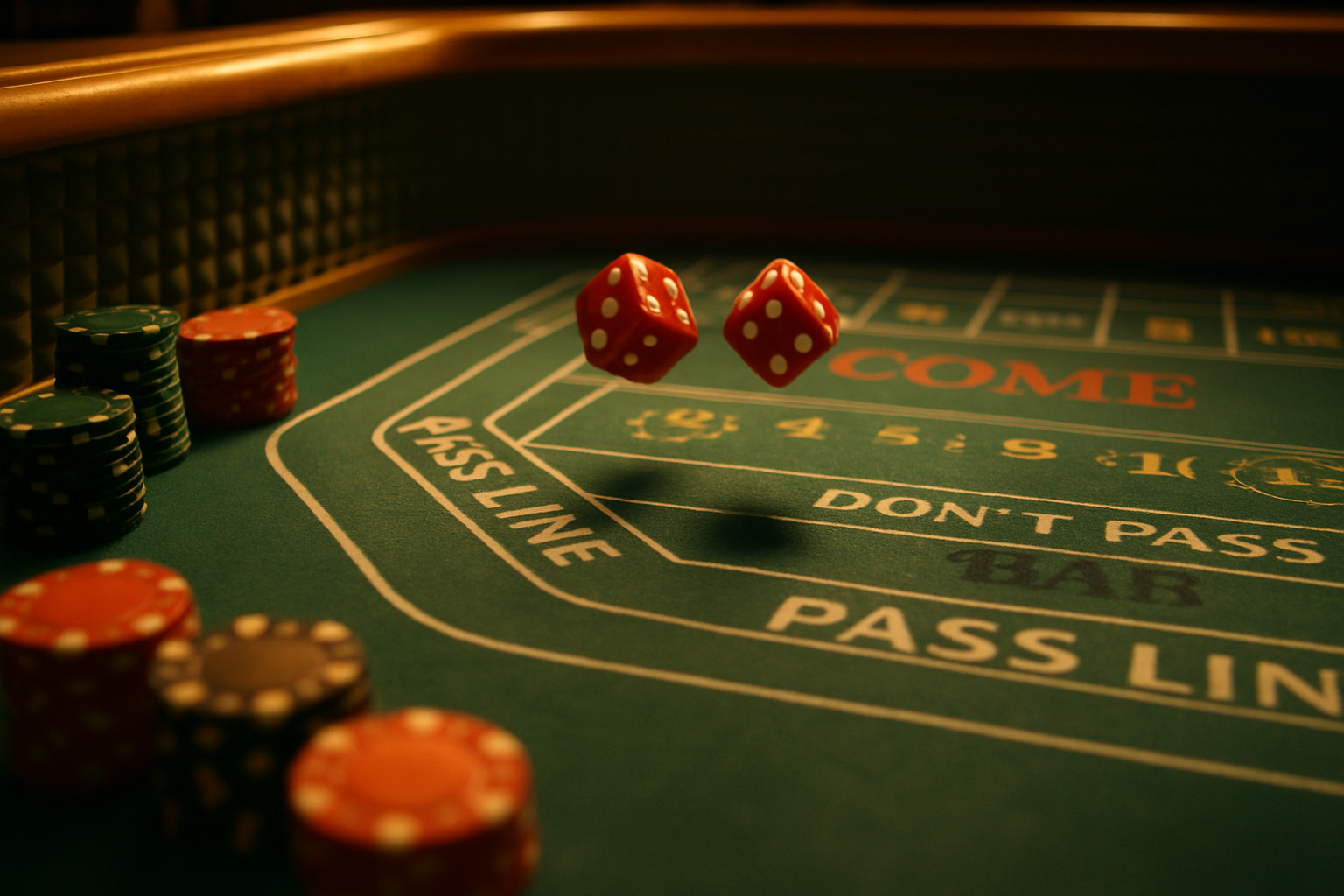
A casino craps table is shaped like a bathtub, with the layout mirrored on both ends so two groups of players can bet on the same dice. Once you know four areas, the table stops looking like hieroglyphics.
- Pass line — the long band curving around the outside edge, closest to you. This is where most players and nearly all beginners put their first chip.
- Don’t pass bar — a narrower strip just inside the pass line, usually printed with “Bar 12” or “Bar 2.” It’s the opposite wager.
- Field — a wide box marked 2, 3, 4, 9, 10, 11, 12. A one-roll bet: those numbers win, everything else loses. It looks friendly and carries a much bigger house edge than the pass line.
- Place boxes — the row of numbers 4, 5, 6, 8, 9, 10 across the top. When a point is established, the dealer marks it with a white puck reading “ON.”
- Center section — the proposition bets (hard ways, any seven, any craps) run by the stickman. Highest house edges on the table.
You place pass, don’t pass, come and field bets yourself. Place bets and center bets get handed to the crew: two base dealers, a stickman who pushes the dice and calls the rolls, and a boxman supervising the chips.
How to play craps: core bets for beginners
One player, the shooter, throws two dice down the table hard enough to hit the far wall. Everyone at the table bets on the outcome of those dice, not against each other. The betting happens in two phases.
The pass line bet
Put a chip on the pass line before the come out roll and you’re betting with the shooter. On that first roll: 7 or 11 wins immediately at even money, 2, 3 or 12 loses immediately. Any other number, 4, 5, 6, 8, 9 or 10, becomes the point, and now your bet needs that number to be rolled again before a 7 shows up.
Example: the come out roll is a 6. The puck flips to ON over the 6. If the shooter rolls another 6 first, your pass line bet pays 1:1. If a 7 comes first, the bet loses and the dice pass to the next shooter.
Don’t pass bet
The don’t pass bet is the mirror image. On the come out roll, 2 or 3 wins, 7 or 11 loses, and 12 is a push (that’s what “Bar 12” means — the casino keeps a tie there so the dark side isn’t a break-even proposition). Once a point is set, the don’t pass bettor wants a 7 before the point number.
Since a 7 is the single most common roll, that’s a genuine advantage after the point is established, which is why the bet is barred on one number up front. You can also take a don’t pass bet down after a point is set; a pass line bet, once the point is on, has to ride.
Come out roll vs point phase
The puck tells you which phase you’re in: OFF means the next roll is a come out, ON means a point is working. The table below shows the come out roll math, using the 36 possible combinations of two dice.
| Come out roll | Combinations (of 36) | Pass line | Don’t pass |
|---|---|---|---|
| 7 or 11 | 8 | Wins | Loses |
| 2 or 3 | 3 | Loses | Wins |
| 12 | 1 | Loses | Push (bar 12) |
| 4, 5, 6, 8, 9, 10 | 24 | Point set | Point set |
One etiquette note: during the point phase, don’t say the word “seven” out loud. Nobody believes it changes the dice, but the table will let you know how it feels about it.
What is the pass line bet?
The pass line bet is craps’ flat, even-money wager that the shooter will win: 7 or 11 on the come out, or the point repeated before a 7. Work through all 495 relevant outcome sequences and it wins 244 times and loses 251, roughly 49.29% to 50.71%. That gap is a house edge of 7/495, or about 1.41%.
The don’t pass bet is fractionally better at about 1.36%, because barring the 12 costs the dark side less than the come out advantage the pass line gives up. Both are among the lowest-edge bets you’ll find on any casino table game, and both are far kinder than the tempting one-roll bets in the middle of the layout.
Once a point is established you can also back a pass line bet with a free odds bet, paid at true odds: 2:1 on the 4 and 10, 3:2 on the 5 and 9, and 6:5 on the 6 and 8. The odds portion carries no house edge of its own, so it lowers the average edge across your total money at risk. It does not change the 1.41% on the flat bet, and it does not make craps a positive-expectation game. It just means more of your action is priced fairly.
Here’s how the common bets compare, assuming standard payouts (a field that pays double on 2 and 12):
| Bet | Payout | House edge |
|---|---|---|
| Don’t pass | 1:1 | ~1.36% |
| Pass line | 1:1 | ~1.41% |
| Place 6 or 8 | 7:6 | ~1.52% |
| Place 5 or 9 | 7:5 | 4.00% |
| Field (2 and 12 double) | 1:1 / 2:1 | 5.56% |
| Place 4 or 10 | 9:5 | 6.67% |
| Hard 6 or 8 | 9:1 | 9.09% |
| Any craps | 7:1 | 11.11% |
| Any seven | 4:1 | 16.67% |
House edge and responsible play
Craps is loud, social and fast, and it’s easy to forget that every bet on the table is priced in the casino’s favor. A 1.41% edge means that over a very long run, the house expects to keep about $1.41 of every $100 wagered on the pass line. Over a single session, anything can happen, which is the whole appeal of dice. Over thousands of rolls, the math doesn’t budge.
No betting pattern changes that. Progressions, “hot shooter” reads, and systems that promise to grind out profit all run into the same wall: each roll is independent, and the price of every bet is fixed. What you can control is which bets you make (the pass line and don’t pass are the cheapest seats in the house), how fast you play, and how much you’re willing to lose before you walk. Craps also moves quickly, and a table that gets you 100 or more rolls an hour puts a lot of money through a small edge.
Set a bankroll for the session, treat it as the cost of entertainment rather than money you expect back, and quit on the number you decided in advance. If gambling stops feeling like a game, most US casinos and licensed online operators offer deposit limits, cool-off periods and self-exclusion. Help is available through the National Council on Problem Gambling’s helpline, 1-800-GAMBLER. Craps is for adults of legal gambling age only.
FAQ
Why is the game called craps?
Because of its losing roll. “Crabs,” the term for a losing throw of two or three in the English game Hazard, passed through French-speaking Louisiana as “crebs” or “creps” and became “craps” in American English. A secondary theory links it to crapaud, French for toad, describing players crouched over a street game.
Where did craps originate?
It descends from Hazard, played in England from the medieval period onward. The simplified version we play today took shape in New Orleans in the early 1800s, spread along the Mississippi, and reached its modern casino form in the twentieth century after the don’t pass bet was introduced.
How do you play craps for beginners?
Put a chip on the pass line before the come out roll. If the shooter rolls 7 or 11 you win even money; 2, 3 or 12 loses. Any other number becomes the point, and you win if that number is rolled again before a 7. Ignore the center of the table until you’re comfortable.
What is the pass line bet?
An even-money bet that the shooter passes: an immediate win on 7 or 11, an immediate loss on 2, 3 or 12, and otherwise a bet that the point repeats before a 7. Its house edge is about 1.41%, one of the lowest on the casino floor.