
What does DAS mean in blackjack?
DAS stands for Double After Split, a blackjack table rule that lets you double down on one or both hands created by splitting a pair. If a table offers DAS, splitting a pair doesn’t lock you out of doubling later. If it doesn’t, each split hand can only be hit or stood on.
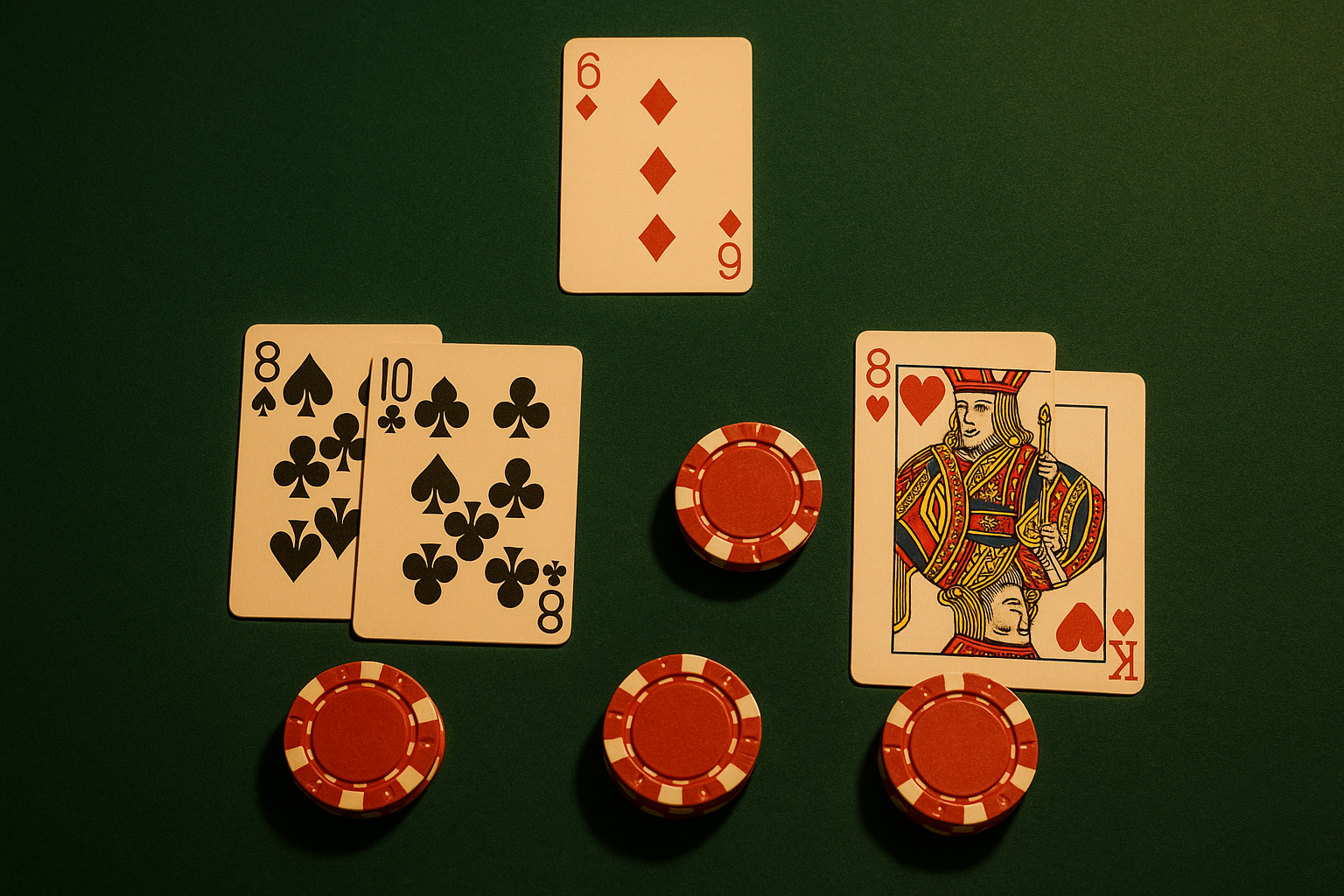
Here’s the mechanic in order, using a real hand. You bet $25 and are dealt 8-8 against a dealer 6.
- You split. You push out a second $25 chip, and the dealer separates the eights into two hands, dealing one card to each.
- Your first hand catches a 3. You now hold 8-3 for a total of 11 against a dealer 6, which is one of the strongest doubling spots in the game.
- With DAS, you place another $25 next to that hand, take exactly one card, and stand. Your total risk on the round is now $75 on what started as a $25 bet.
- Your second hand catches a 10 for 18. You stand, and the dealer plays out.
Without DAS, step three is off the table. You’d hit that 11, get whatever card comes, and play on with a single unit. Same cards, same dealer upcard, worse payoff on your best hand of the round.
One detail worth flagging: DAS applies to hands you draw to after splitting, and it usually follows the table’s normal doubling rule. If the table only allows doubling on totals of 9, 10 and 11, that restriction carries over to split hands too.
How DAS affects the house edge
DAS shifts the blackjack house edge in the player’s favor by roughly 0.14 percentage points. On a six-deck game where basic strategy already faces about a 0.5% edge, that’s a meaningful chunk of the total, and it costs you nothing to use since it’s an option rather than an obligation.
The reason is simple: every rule that gives you a decision the dealer doesn’t have is worth money. The dealer can’t split, can’t double, and can’t surrender. DAS adds one more spot where you can put extra money out only when the math says you’re the favorite. Options never hurt you, provided you use them correctly.
For context, here’s how DAS compares with other common rule variations. These are the widely published approximations used in standard blackjack rule-effect tables; the exact figures shift slightly with deck count and dealer rules (source citation to be added by editor).
| Rule variation | Approximate effect on house edge | Good or bad for the player |
|---|---|---|
| Double after split (DAS) allowed | −0.14% | Good |
| Resplitting aces allowed | −0.08% | Good |
| Late surrender offered | −0.07% | Good |
| Dealer hits soft 17 | +0.22% | Bad |
| Blackjack pays 6:5 instead of 3:2 | +1.4% | Very bad |
Notice the scale. DAS is a genuine plus, but a 6:5 blackjack payout wipes it out ten times over. A no-DAS table paying 3:2 is a far better game than a DAS table paying 6:5. And none of this makes blackjack a winning proposition: even with every player-friendly rule in place, the house keeps a small edge, and results over any single session are dominated by short-term swings.
Which split hands benefit most from DAS
DAS matters most for pairs whose split hands often draw into a 9, 10 or 11. Low pairs are the big winners, because a 2 or a 3 plus a face-card-adjacent draw lands squarely in doubling territory.
- 2-2 and 3-3: the pairs where DAS actually changes whether you split at all against weak dealer cards. A 3 catching an 8 makes 11; a 2 catching a 9 makes 11.
- 4-4: a hand you normally just hit. With DAS against a dealer 5 or 6, splitting becomes correct, largely because 4-7 (11) and 4-6 (10) are live doubling spots.
- 6-6: DAS is enough to make splitting correct against a dealer 2 as well as 3 through 6.
- 8-8: you split these regardless, but DAS makes the split more profitable, especially against weak upcards.
- 9-9: the split decision doesn’t change, but 9-2 for 11 is a hand you’d rather double than hit. If you want the full breakdown of that pair, see our guide to splitting 9s.
Splitting aces with DAS
Here the honest answer surprises people: at most casinos, DAS does nothing for aces. Standard rules deal exactly one card to each split ace and end the hand there, so there’s no opportunity to double even if the table allows DAS everywhere else. A-2 sits at soft 13 and stays there.
Where DAS does come into play is the minority of games that let you draw freely to split aces. In those, an ace catching a 9 or a 10 becomes a soft 20 or 21 you’d stand on anyway, but an ace with a low card can turn into a hand worth doubling. Either way, the decision itself never changes: always split aces, DAS or no DAS, because two hands starting with an ace beat one hard 12 by a wide margin.
Splitting 8s against dealer 5-6
You always split 8-8, since 16 is the worst total in blackjack and two hands starting with 8 are far more workable. Against a dealer 5 or 6, DAS makes that split noticeably more valuable, for two reasons.
First, the dealer is in trouble. A 5 or 6 upcard busts roughly 42% of the time in a typical multi-deck game, so extra money on the table against those cards is money placed at a favorable moment. Second, an 8 plus a 2 makes 10 and an 8 plus a 3 makes 11, so each split hand has around a 15% chance of drawing straight into a doubleable total on its first card. Combine both hands and you’ll get a DAS opportunity fairly often.
The trade-off is exposure. Splitting 8s against a 6 with DAS can mean three or four betting units in play on one round. That’s correct play in expectation, not a guarantee, and both halves can still lose. If you’re not comfortable with the swing, size your base bet smaller rather than skipping the split. For more on why 16 and other awkward totals cause so much trouble, read our breakdown of stiff hands strategy.
DAS vs no DAS: how to spot the difference
Blackjack table rules aren’t always printed, and DAS is one of the least likely to be spelled out on the felt. What the layout usually shows is the payout (“Blackjack pays 3 to 2”) and the soft 17 rule (“Dealer must draw to 16 and stand on all 17s”). Doubling and splitting restrictions often live in the digital limit sign or nowhere at all.
How to find out before you sit:
- Read the felt and the table sign first. Note the blackjack payout, the soft 17 rule, deck count, and any wording like “double on 9, 10, 11 only.”
- Ask the dealer directly: “Can I double after splitting here?” Dealers answer rule questions all shift and won’t blink at it. If the dealer is unsure, the floor supervisor will know.
- Watch a couple of rounds. If someone splits a low pair and the dealer takes an extra bet on one of the split hands, DAS is live.
- Online or on an app, open the rules or info tab in the game. Licensed casino games list splitting and doubling rules in full, including whether split aces can be drawn to or resplit.
General patterns help, but don’t rely on them. DAS is standard in most US multi-deck shoe games, while restricted doubling and no-DAS rules turn up more often in some single and double deck games, low-limit tables, and side-bet-heavy novelty layouts. Assume nothing and check, because the same casino can run different rules on tables 20 feet apart.
When DAS changes your splitting strategy
DAS changes a handful of specific basic strategy decisions, all of them involving low pairs against weak dealer upcards. Everything else, including splitting aces and 8s, stays the same. The table below covers a standard six-deck game where the dealer stands on soft 17.
| Your pair | With DAS | Without DAS |
|---|---|---|
| 2-2 | Split vs 2 through 7 | Split vs 4 through 7; hit vs 2 and 3 |
| 3-3 | Split vs 2 through 7 | Split vs 4 through 7; hit vs 2 and 3 |
| 4-4 | Split vs 5 and 6; otherwise hit | Never split; hit |
| 6-6 | Split vs 2 through 6 | Split vs 3 through 6; hit vs 2 |
| 8-8 | Always split | Always split |
| A-A | Always split | Always split |
Two before-and-after examples make the logic concrete.
4-4 against a dealer 6. Without DAS, you hit. Splitting leaves you with two mediocre hands and no way to press the advantage. With DAS, you split, because either hand catching a 6 or 7 gives you 10 or 11 against the dealer’s worst upcard, and you can put out a double there.
3-3 against a dealer 2. Without DAS, hitting 6 is better than splitting into two hands you can’t develop properly. With DAS, splitting wins out. A 3 catching an 8 makes 11, a 3 catching a 7 makes 10, and both are worth doubling against a 2.
Single and double deck games have their own charts with slightly different split lines, so if you play those, use a strategy card matched to the exact deck count and soft 17 rule. Our basic blackjack strategy overview walks through how to read those charts properly.
FAQ
What does DAS mean in blackjack?
DAS means Double After Split. It’s a table rule allowing you to double down on hands created by splitting a pair, subject to the table’s normal doubling restrictions.
How does double after split affect the house edge?
DAS lowers the house edge by roughly 0.14 percentage points. It’s one of the more valuable player-friendly rules, though far smaller than the damage done by a 6:5 blackjack payout.
When should you double after splitting?
In the same spots you’d double on any hand: mainly totals of 10 and 11 against weak dealer upcards, plus 9 against a dealer 3 through 6 in most multi-deck games. Follow your basic strategy chart for the specific rule set.
Is DAS good or bad for the player?
Good. It adds an option without adding an obligation, and options only have value when you can choose to skip them. It doesn’t remove the house edge, though, and it does increase how much money you can have on the table in a single round.
Does DAS apply to split aces?
Usually not. Most casinos deal one card to each split ace and end the hand, leaving no chance to double. Check the rules if you’re playing a game that allows drawing to split aces.
Blackjack rule variations like DAS are worth understanding because they change correct play, not because they turn the game profitable. Set a budget you’re comfortable losing before you sit down, treat the money as entertainment spending, and use deposit or session limits if you play online. If gambling stops feeling like a game, support is available through the National Council on Problem Gambling helpline at 1-800-GAMBLER.