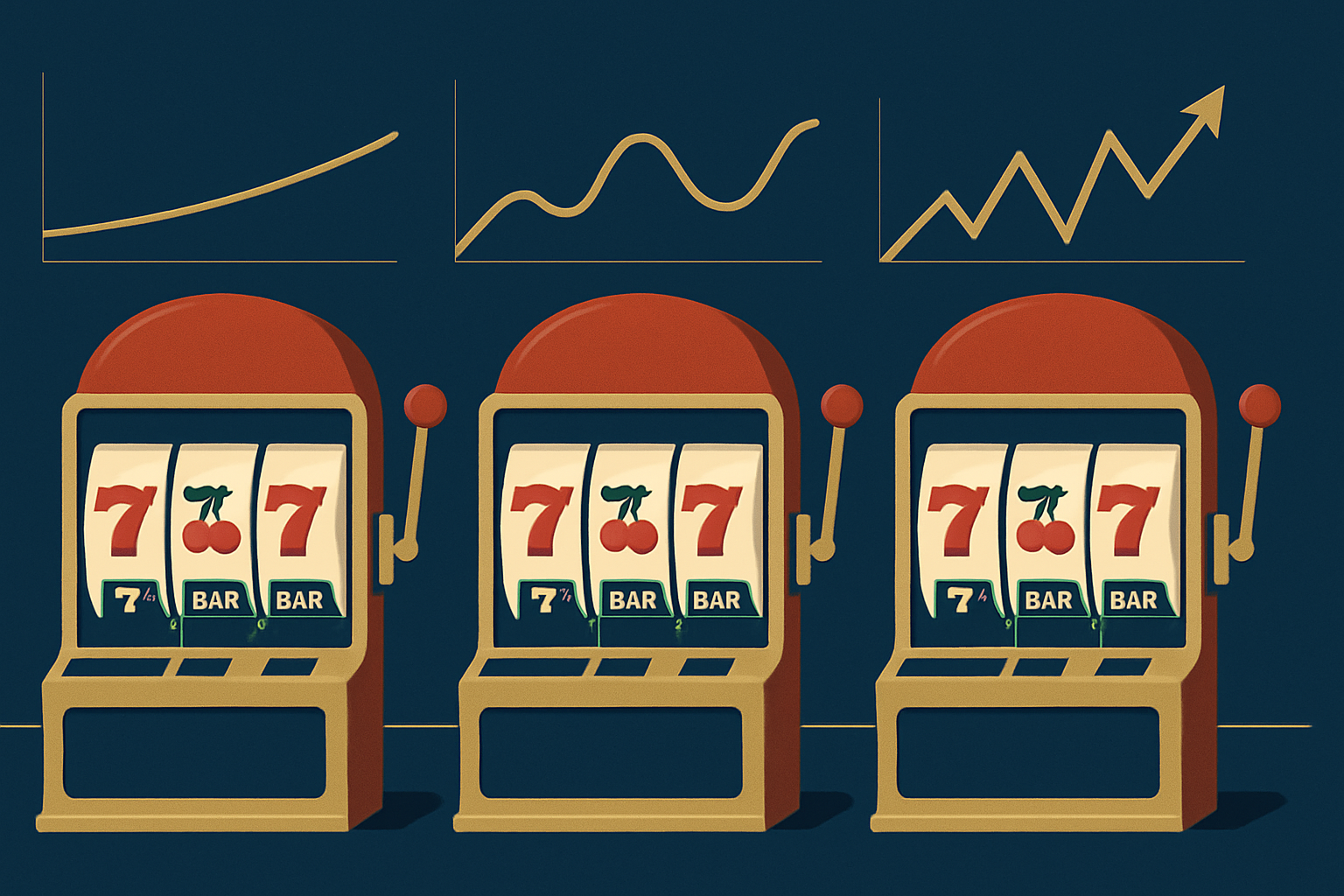
The difference comes down to where your money goes. Progressive jackpot slots skim a small percentage off every qualifying bet and add it to a prize pool that keeps climbing until someone wins it. Fixed jackpot slots pay a set top prize that never moves, funded straight out of the game’s normal payout math. That single design choice changes the base game RTP, the size of the swings, and the kind of bankroll you need to sit at the game comfortably.
Neither type is “better.” They’re built for different appetites. Below is how each one actually works, why progressives usually return less on ordinary spins, and how seed amounts, network size, and must-drop timers fit into the picture.
What are progressive jackpot slots?
A progressive jackpot slot is a game where the top prize grows over time because a fixed percentage of every qualifying wager is diverted into a shared pool instead of being paid out through the regular paytable. The pool grows until a player triggers the jackpot, then it resets to a preset seed amount and starts climbing again.
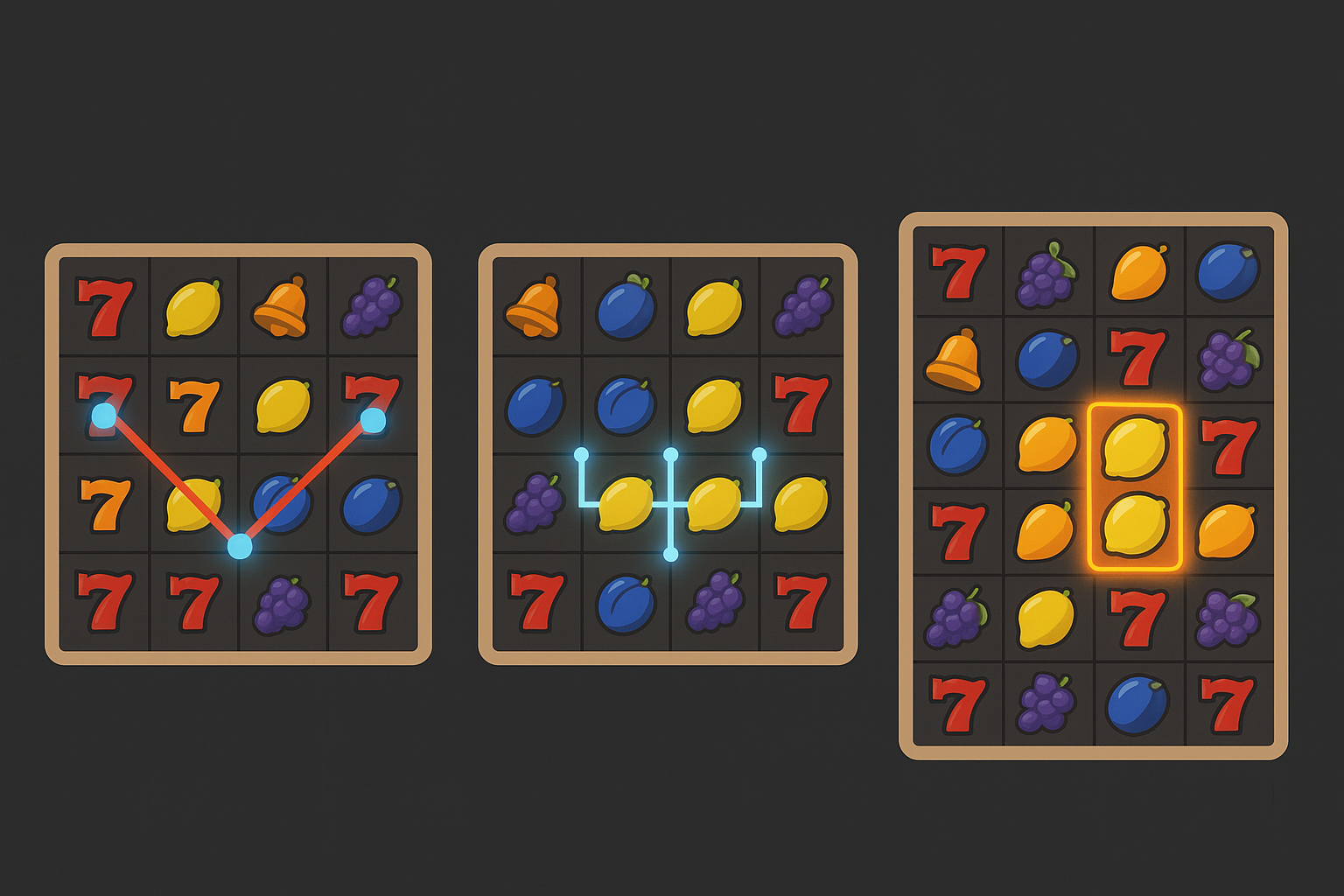
Triggering usually happens in one of three ways: a specific symbol combination on a payline, a bonus round (a wheel or a pick-me screen), or a purely random trigger that can hit on any spin. Some games also require a minimum bet, or the full number of coins, to be eligible at all. If you don’t meet that condition, you can hit the jackpot symbols and win nothing but a consolation prize. Read the info screen before you spin.
How the jackpot pool grows
The jackpot meter you see on screen is a live counter of contributions. Every eligible spin from every player on that game feeds it. On a single-machine game the meter creeps. On a game linked across dozens of casinos, thousands of players are contributing at the same moment, which is why those meters visibly tick upward in real time.
Most large progressives run several tiers at once, often labelled something like Mini, Minor, Major and Mega. Each tier gets its own slice of the contribution, so the small prizes drop frequently while the top tier can go months without being won.
Contribution rates explained
The contribution rate is the share of each bet routed to the jackpot. It’s commonly in the region of 1% to 5% of the stake, split across the jackpot tiers, and it’s set by the game maths rather than the individual casino.
Here’s what a 2% contribution looks like on a $1 spin, with a game whose total theoretical return is 96%:
| Where the $1 goes | Amount | Notes |
|---|---|---|
| Returned through the base game and features | $0.94 | Regular symbol wins, free spins, multipliers |
| Added to the jackpot pool | $0.02 | Paid out eventually, but only to one winner |
| Retained by the operator (house edge) | $0.04 | 4% edge in this example |
The important point: the jackpot contribution is still part of the game’s long-run return, but you only ever see it if you’re the one who triggers the prize. For everyone else, that 2% is simply gone. That’s the trade-off in one line.
Fixed vs progressive jackpot: what a fixed jackpot actually is
A fixed jackpot (sometimes called a flat or static jackpot) is a top prize with a set value that never changes, no matter how many people play. It’s usually expressed as a multiplier of your stake, for example 5,000x, so the dollar value scales with your bet size rather than with player activity.
Fixed jackpots are funded inside the game’s normal return, exactly like any other paytable win. Nothing is siphoned off to a pool, so the designer can keep the headline RTP in the typical modern slot range of roughly 94% to 97%. You’ll hit these prizes far more often than a networked progressive, and they’re far smaller.
| Progressive jackpot | Fixed jackpot | |
|---|---|---|
| Prize size | Variable, can reach seven figures on wide-area games | Set multiplier of stake, typically hundreds to a few thousand times bet |
| Funding | Contribution rate skimmed from every qualifying bet | Built into the base game paytable |
| Base game RTP | Usually lower | Usually the standard 94–97% range |
| Hit frequency of top prize | Very rare | Rare, but far more achievable |
| Bet requirement | Often a minimum or max bet to qualify | No special qualifying bet |
| Volatility profile | Extreme | Moderate to high |
Types of progressive jackpot networks
Progressives come in three sizes of network, and the network is what determines how fast the meter climbs and how big the prize can get.
Standalone progressive slots
A standalone progressive collects contributions from one machine or one game only. Nothing is shared. Meters grow slowly and top out modestly, but they also reset from a low seed and get won relatively often. If you like the idea of a growing prize without waiting for a once-a-year event, standalones are the least punishing version.
Local area progressives
Local area progressives link a bank of machines within a single casino, or all instances of a game within one online operator. More players means a faster meter and a bigger ceiling than a standalone, while the pool still recycles often enough that regulars see it drop.
Wide area network jackpots
A wide area progressive, sometimes called a networked jackpot, links the same game across many casinos, often across multiple states or countries where regulation allows. These are the games that produce the multimillion-dollar headlines. They’re also the ones with the steepest RTP trade-off, because a bigger pool has to be fed by a bigger slice of every bet.
| Network type | Contributing players | Meter growth | Typical prize scale |
|---|---|---|---|
| Standalone | One game or machine | Slow | Small, hit relatively often |
| Local area | One casino or operator | Moderate | Mid-sized |
| Wide area | Many casinos on one network | Fast | Largest, hit rarely |
The RTP trade-off: why progressives pay less in base games
Yes, progressive slots generally have a lower base game RTP than comparable fixed jackpot slots, often by a couple of percentage points and sometimes by a lot more. The money going to the jackpot pool is money not going into ordinary wins. There’s no way around that arithmetic.
Base game RTP comparison
Non-jackpot slots cluster around 94% to 97%. Many progressives sit a few points below that once the jackpot slice is removed, and wide-area games can go much lower on the base game. Microgaming’s long-running Mega Moolah, for example, is published with an RTP of 88.12%, a figure well below the modern slot average, because a large share of the return is locked in the four-tier jackpot. Always check the specific game’s info screen for its published figure, since the same game can be configured differently by operator. (Publisher note: attach the supplier’s official RTP page or the game’s help file as the citation here.)
One nuance worth understanding: the jackpot contribution is part of the theoretical return, so when a meter has grown far above its seed, the game’s overall expected return at that moment is higher than it was right after a reset. In extreme cases analysts have argued the total theoretical return can approach or briefly exceed 100%. That’s a maths curiosity, not a plan. The odds of any individual spin hitting a wide-area jackpot are astronomically long, the variance is brutal, and in practice virtually every player experiences the low base RTP and nothing else.
Where your bet money goes
Think of every wager on a progressive as being split three ways: regular payouts, the jackpot pool, and the house edge. Cutting the first slice to grow the second is the entire design. If you want to understand how that arithmetic shapes your session, our guide to RTP and house edge breaks down the long-run maths, and the slot machine basics explainer covers paylines, volatility and hit frequency.
Seed amounts and reset mechanics
When a progressive is won, the meter resets to a seed amount (also called the reset value) rather than to zero. The seed is pre-funded from earlier contributions, which is why Mega Moolah’s top tier always restarts at $1,000,000 rather than at nothing. Smaller tiers might seed at a few dollars.
Two practical consequences:
- Effective return varies with the meter. A jackpot sitting just above its seed represents a smaller share of eventual returns than the same jackpot at three times that size. Same game, same house edge on the base spins, different value in the jackpot component.
- It doesn’t make the game “due.” Outcomes are produced by an RNG and every spin is independent. A jackpot that hasn’t dropped in eight months is no likelier to drop on your next spin than it was on day one. There is no timing edge here, only a difference in what the prize is worth if the improbable happens.
What is a must-drop jackpot?
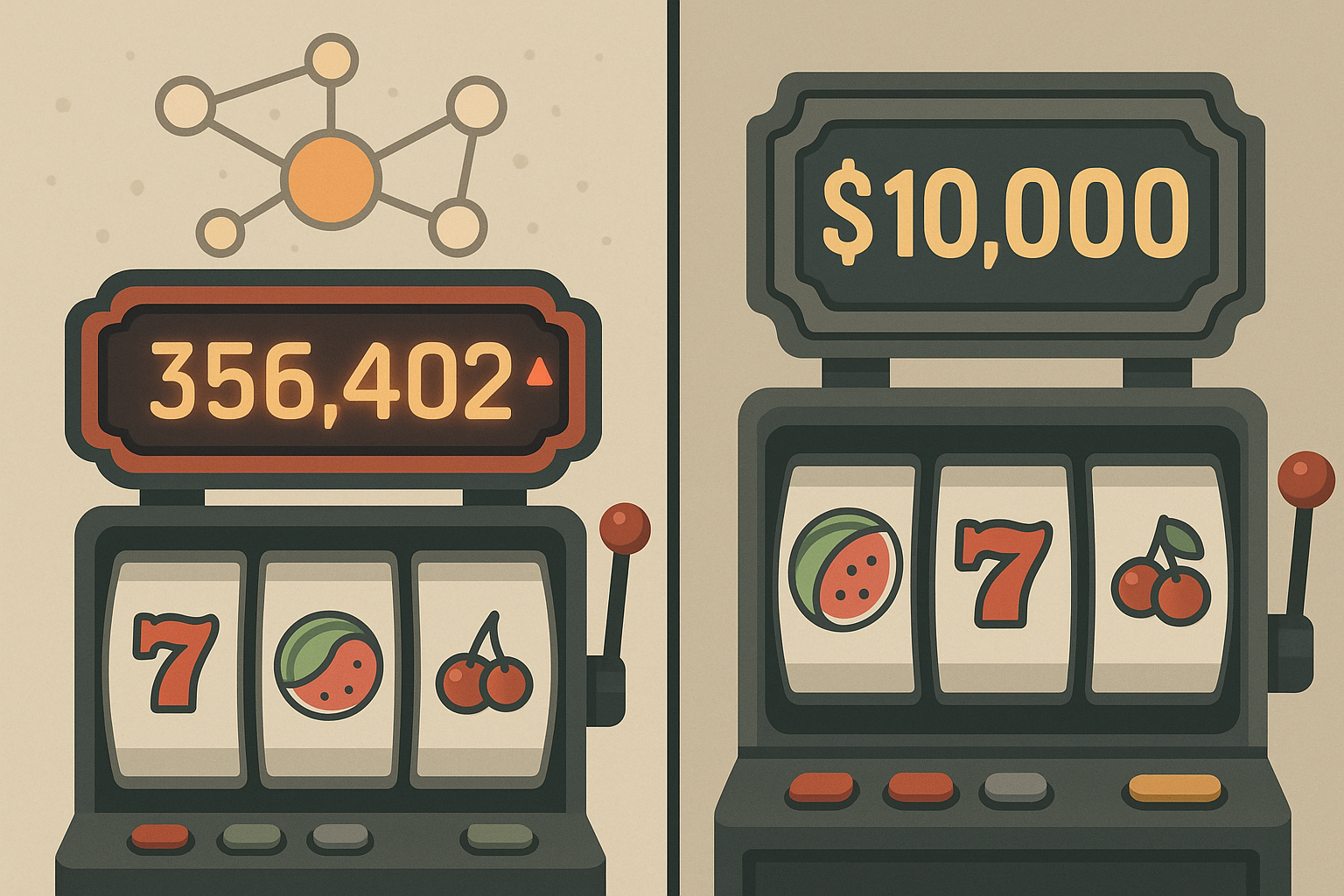
A must-drop jackpot is a progressive that is guaranteed to be paid out before a deadline or before the meter passes a stated ceiling. Instead of an open-ended climb, the game commits publicly: this prize must be won by 11:59pm, or before it reaches $10,000. The trigger is then randomised within that window, so the winner is still chosen by chance, just inside a bounded period.
Daily and hourly must-drop jackpots
Time-based must-drops carry a countdown clock on screen: hourly, daily, sometimes weekly tiers running side by side. The prizes are modest by progressive standards, often in the hundreds or low thousands, but they land constantly. Players like them because the wait is measured in hours instead of months, and because the clock makes the mechanic transparent.
Amount-based must-drops
Amount-based must-drops publish a range: the jackpot will pay out somewhere between the seed and a stated maximum. Once the meter approaches that cap, a drop is imminent. Note the obvious catch, though. Everyone can see the same number, more players pile in as the ceiling nears, and your individual chance of being the one who triggers it doesn’t improve just because the pool is near the top. Competition rises with the meter.
Progressive vs fixed jackpots: which should you choose?
Choose based on how you want your money to behave over a session, not on the size of the headline number.
For high-roller players
If you’re comfortable with deep, long losing stretches and you can meet the qualifying bet on a wide-area game without stretching, progressives give you exposure to prizes that fixed jackpots physically cannot offer. Budget for the volatility rather than the dream: set a session loss limit first, and treat the jackpot as a lottery ticket attached to a slot machine. Our bankroll management guide covers sizing sessions around games this swingy.
For casual players
Smaller bankrolls generally get more entertainment per dollar from fixed jackpot slots or from must-drop and standalone progressives. Play time is the real currency here, and a higher base RTP with a moderate top prize keeps you spinning longer. Chasing a wide-area meter on a small budget is the fastest way to end a session early.
For RTP-focused players
If you optimise for published return, fixed jackpot slots win outright. You can find plenty of non-jackpot games at 96% or above, versus base returns well below that on the biggest progressives. The only caveat is the one already covered: on a progressive, part of the theoretical return is parked in a pool you almost certainly won’t collect, so treat the base game number as the figure that describes your actual experience.
Whatever you pick, both types keep a house edge and both have negative expected value over time. Decide your budget before you open the game, use deposit and loss limits, and stop when you hit them. If play stops feeling like entertainment, take a break or use your operator’s self-exclusion tools. In the US, the National Council on Problem Gambling helpline (1-800-522-4700) is available 24/7.
FAQ
How is a progressive jackpot funded?
By a contribution rate, commonly around 1% to 5% of each qualifying bet, taken from every player on the game and pooled into the jackpot meter. The seed amount for the next round is also pre-funded from those contributions.
Do progressive slots have lower RTP?
Their base game RTP is usually lower, because the jackpot contribution is removed from regular payouts. The total theoretical return including the jackpot can be comparable to a standard slot, but only the eventual jackpot winner realises that portion.
What’s the difference between fixed and progressive jackpots?
A fixed jackpot is a set prize, usually a multiplier of your stake, paid from the normal paytable. A progressive jackpot grows from pooled bet contributions and resets to a seed amount when won.
Does a jackpot become due if it hasn’t dropped in months?
No. Every spin is an independent RNG outcome, so a long gap since the last win doesn’t raise your chance on the next spin. Must-drop jackpots are the only exception in the sense that they have a stated deadline, but the winning spin inside that window is still random.