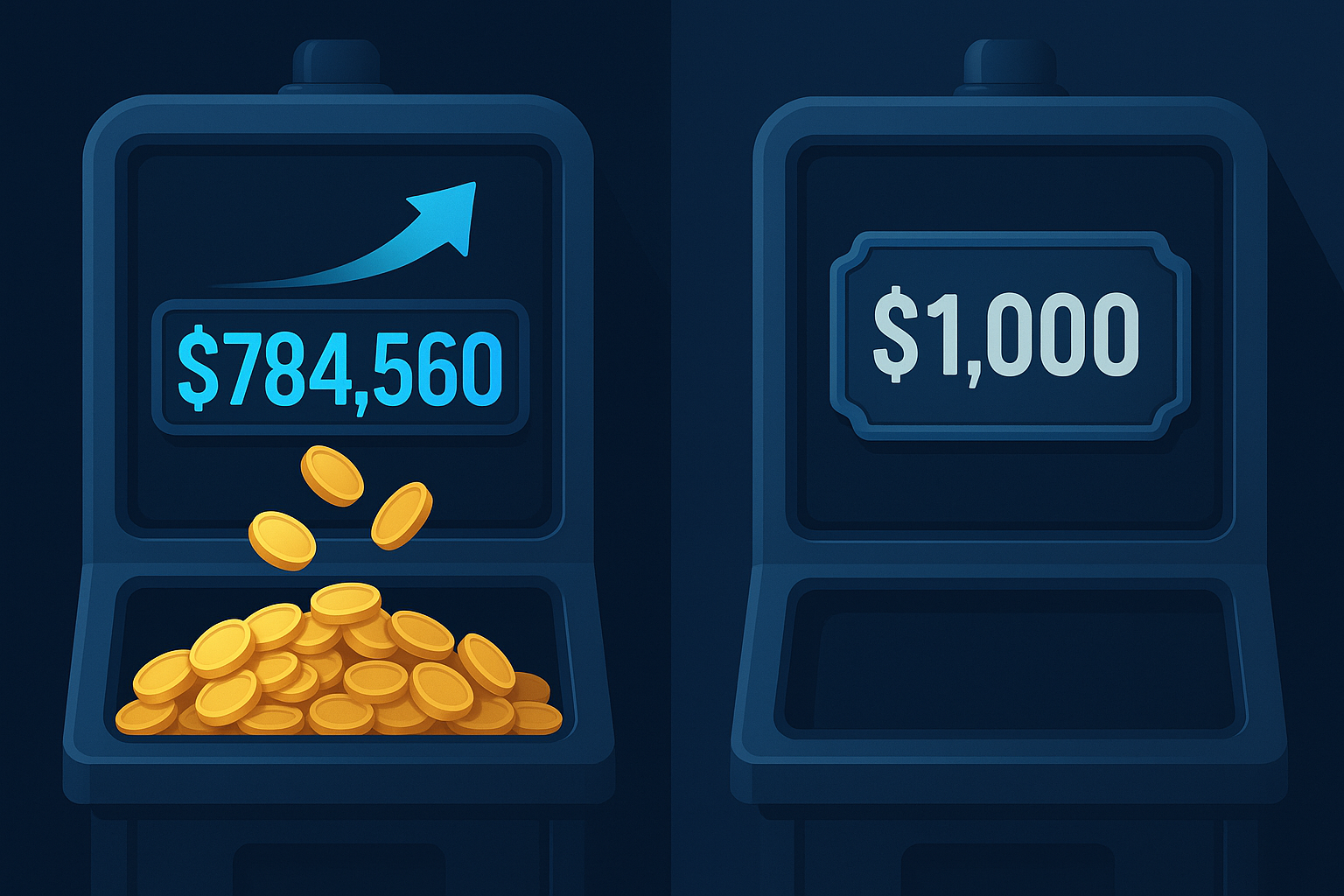
Progressive jackpot slots grow their top prize by taking a small cut of every bet placed on the game, then paying that pool out to one player who triggers it. Fixed jackpot slots pay a set amount that never changes, written straight into the paytable. That single difference in funding drives everything else: base game RTP, hit frequency, prize size, and how much variance you should expect to sit through.
Below is how each type is built, where your money actually goes, and which one makes sense for different bankrolls.
What are progressive jackpot slots?
A progressive jackpot slot is a game where the top prize increases as people play. A small percentage of each qualifying wager, usually somewhere between roughly 1% and 3%, is diverted from normal payouts into a jackpot pool. The pool climbs until a player hits the trigger condition, then resets to a preset seed amount and starts building again.
The trigger varies by game. Some progressives require a specific symbol combination on a payline. Some use a bonus wheel (Mega Moolah’s wheel is the classic example). Many modern games use a random trigger, where any spin can open the jackpot round, with your bet size affecting the odds of qualifying.
How the jackpot pool grows
Every qualifying spin from every player on that game feeds the same meter. That is why the number you see ticking upward on screen moves even when you are not spinning: you are watching contributions from other players on the same network arrive in real time.
Most modern progressives run several tiers rather than one prize. A typical setup is Mini, Minor, Major and Grand (or Mega). The contribution is split across the tiers, with the small ones hitting often enough to feel alive and the Grand hitting rarely. Because the small tiers pay frequently, they behave more like ordinary bonus wins; the headline number is the one that takes months or years to build.
Contribution rates explained
The contribution rate is the slice of your stake that goes to the jackpot instead of the regular paytable. Providers publish this in the game’s help screen, often as part of the RTP breakdown.
Some math with round numbers. Say the contribution rate is 2% and 10,000 spins of $1 are played on the game across all players. That is $10,000 wagered and $200 added to the jackpot meter. On a wide area network with thousands of players spinning at once, that same 2% can add tens of thousands of dollars a day, which is how those eight-figure prizes get built.
One detail most players miss: the contribution is often split in two. Part goes to the visible meter, and part goes to a reserve that funds the seed for the next jackpot cycle after a win. So not every cent of your contribution is sitting in the prize you can see.
What are fixed jackpot slots?
A fixed jackpot slot has a top prize set in advance, usually expressed as a multiple of your bet, for example 5,000x stake, or as a coin figure that scales with your bet level. It does not grow, it does not reset, and it is not shared with anyone else.
Fixed jackpots are funded by the base game math. The top prize is just the highest line on the paytable, priced into the same RTP calculation as every other win. Nothing is skimmed off to fill a separate pool, which is exactly why fixed jackpot games tend to hold onto a higher base game RTP.
The fixed vs progressive jackpot trade-off in one line: fixed pays smaller ceilings more often, progressive pays a life-changing ceiling almost never.
Types of progressive jackpot networks
Progressives come in three shapes, and the shape tells you roughly how big the prize gets and how long you will wait.
Standalone progressive slots
A standalone progressive builds only from bets placed on that one game at that one casino, sometimes literally on one machine in a land-based venue. Pools are modest, often in the hundreds or low thousands, but they hit far more frequently than networked prizes.
Local area progressives
A local area progressive links several games or several machines inside a single casino or a single operator. More players feed the meter, so it climbs faster and peaks higher than a standalone, while still resolving on a reasonably human timescale. Online, this is the “in-house” jackpot an operator advertises on its own lobby.
Wide area network jackpots
A wide area progressive (a networked jackpot) pools contributions from many casinos that all license the same game from the same provider. This is where the record-breaking prizes come from, because thousands of players across dozens of sites are all filling the same meter. The flip side is brutal odds on the top tier and the lowest base game RTP of the three.
| Network type | Pool fed by | Typical prize scale | Growth speed | Top-tier hit frequency |
|---|---|---|---|---|
| Standalone | One game or machine | Hundreds to low thousands | Slow | Relatively often |
| Local area | Multiple games at one casino/operator | Thousands to low six figures | Moderate | Occasional |
| Wide area | Many casinos on one provider network | Six to eight figures | Fast | Extremely rare |
The RTP trade-off: why progressives pay less in base games
Yes, progressive slots generally have lower base game RTP than comparable fixed jackpot slots. The money in the jackpot pool has to come from somewhere, and it comes out of the payouts you would otherwise receive on ordinary spins.
Base game RTP comparison
Published RTP for a progressive is usually quoted two ways: base game RTP (what the reels return without the jackpot) and total RTP (base plus the theoretical jackpot return). The total can look respectable, but that jackpot slice is only “returned” to the one player who wins it. For everyone else, the base figure is what their session actually runs on.
Typical published ranges look roughly like this. Always confirm the exact figures on the game’s info screen, since providers and operators can configure different RTP versions of the same title.
| Game type | Typical published base game RTP | What the top prize looks like |
|---|---|---|
| Non-jackpot / fixed jackpot slot | Around 95%–97% | Set multiple of stake (e.g. 5,000x) |
| In-house or local progressive | Roughly 92%–95% | Thousands to six figures |
| Wide area progressive | Often 88%–93% | Six to eight figures |
Mega Moolah is the well-known extreme: its base game RTP has long been published in the high 80s, with the remainder of the theoretical return locked up in the four-tier jackpot. Editorial note for publisher: attach the provider’s official RTP disclosure or the game info screen as the citation for these ranges.
Where your bet money goes
Here is a $1 spin on a hypothetical progressive with 91% base RTP and a 2% jackpot contribution, in the long run and averaged over millions of spins:
| Destination | Share of a $1 bet |
|---|---|
| Regular paytable wins (base game RTP) | $0.91 |
| Jackpot pool contribution | $0.02 |
| House edge (operator/provider retention) | $0.07 |
Total theoretical return is 93%, a 7% house edge, but only 91% reaches you through normal wins. If you are the type who cares more about session length than lottery-style upside, that gap matters. Our guide to RTP and house edge goes deeper on how these figures are calculated and why they only describe long-run averages, never your next 200 spins.
Seed amounts and reset mechanics
When a progressive is won, the meter does not go to zero. It drops to a seed amount (also called the reset value), funded by the reserve built up from earlier contributions. A wide area Grand jackpot might seed at $1 million; a local progressive might reset to $5,000.
This is where the maths gets interesting. At the seed, the jackpot is worth less than the total contributions that will be paid in before it is won again, so the effective RTP of the game is at its lowest point. As the meter climbs, the value of that jackpot slice rises relative to the money going in, so the effective RTP creeps upward. In theory a jackpot can grow large enough that the game’s total expected return approaches or even exceeds 100%.
Two honest caveats before anyone gets ideas. First, the base game is still paying you well under 100%, so you are funding an enormous variance bet on an outcome with odds that can run into the tens of millions to one. Second, that theoretical edge is spread across every player on the network, not reserved for you. Waiting for a big meter changes the maths on paper; it does not change the fact that almost everyone loses money doing it. Treat jackpot size as a preference, not a strategy.
What is a must-drop jackpot?
A must-drop jackpot is a progressive with a guaranteed drop condition: it has to be paid out before a certain time or before it exceeds a certain amount. Instead of an open-ended climb, the game commits in advance to awarding the prize inside a defined window.
Daily and hourly must-drop jackpots
Time-based must-drops pay before a deadline, typically every hour or before midnight. Prizes are small compared with wide area progressives, often a few hundred to a few thousand, and the winner is usually selected randomly from qualifying spins in that window. Red Tiger’s daily drop jackpots popularised this format online.
Amount-based must-drops
These carry a stated ceiling, for example “must drop before it reaches $10,000”. The meter climbs normally, but once it approaches the cap, the game awards it. Players often gravitate toward these when the meter is near the top, since the drop becomes imminent by design.
The appeal is simple: certainty of timing rather than certainty of winning. A must-drop tells you the prize will be awarded soon. It tells you nothing about who wins it, and your individual chance still comes down to your share of qualifying wagers.
Progressive vs fixed jackpots: which should you choose?
There is no universally better option. The right pick depends on bankroll, patience and what you actually want out of a session.
For high-roller players
Larger bankrolls absorb the deep losing stretches progressives produce, and many progressives require a maximum bet or a specific bet level to qualify for the top tier. If you are betting near max anyway, check the qualification rules carefully; playing a progressive below the qualifying stake means paying the lower RTP without any shot at the prize you are funding. Wide area networks make sense here if the size of the ceiling is the point.
For casual players
Local progressives and must-drop jackpots are the friendlier middle ground. Smaller prizes, far shorter odds, lower qualifying bets, and much less time spent in drawdown. Fixed jackpot slots at 96% base RTP will generally give you more spins per dollar than an 89% wide area game, which matters most when your entertainment budget is modest. A little bankroll management planning goes further here than jackpot hunting.
For RTP-focused players
If you optimise for return per spin, fixed jackpot and non-jackpot slots win on paper. You keep the 2%–5% that would otherwise go into a pool you will almost certainly never claim, and the payouts arrive through the regular paytable where you can actually access them. Compare base game RTP, not total RTP, when you are making that call, and check the figure in the game’s info panel rather than assuming a title runs the same version everywhere.
Whichever you play, the house edge applies to both, every spin is independent, and no jackpot is ever “due”. Set a deposit or loss limit before you start, treat the spend as entertainment, and use the operator’s limit and time-out tools if play stops feeling like a choice. In the US, the 1-800-GAMBLER helpline offers free, confidential support.
Frequently asked questions
How do progressive jackpots work?
A set percentage of each qualifying bet, commonly 1%–3%, is added to a shared prize pool instead of the normal paytable. The pool grows until a player triggers the jackpot, then resets to a seed amount and builds again.
What’s the difference between fixed and progressive jackpots?
A fixed jackpot is a set amount defined in the paytable and funded by the game’s base math. A progressive jackpot grows from player contributions across a game, casino or provider network, and resets after it is won.
Do progressive slots have lower RTP?
Their base game RTP is usually 2%–5% lower than comparable fixed jackpot slots, because part of each bet funds the jackpot pool. Total RTP including the jackpot can look similar, but that portion only reaches whoever wins the prize.
What is a must-drop jackpot?
A progressive that must be awarded before a set time (hourly, daily) or before it exceeds a stated amount. The drop is guaranteed within that window; the winner is not.
How is a progressive jackpot funded?
By player wagers. The contribution rate is taken from each qualifying bet and split between the visible jackpot meter and a reserve that pays the seed amount for the next cycle.