What are slot paylines?
Slot paylines are fixed patterns of symbol positions across the reels. If enough matching symbols land on one of those patterns, usually starting from the leftmost reel, the game pays according to its paytable. Everything else on screen is ignored. A three-of-a-kind sitting in the corners does nothing if the corners aren’t on a line.
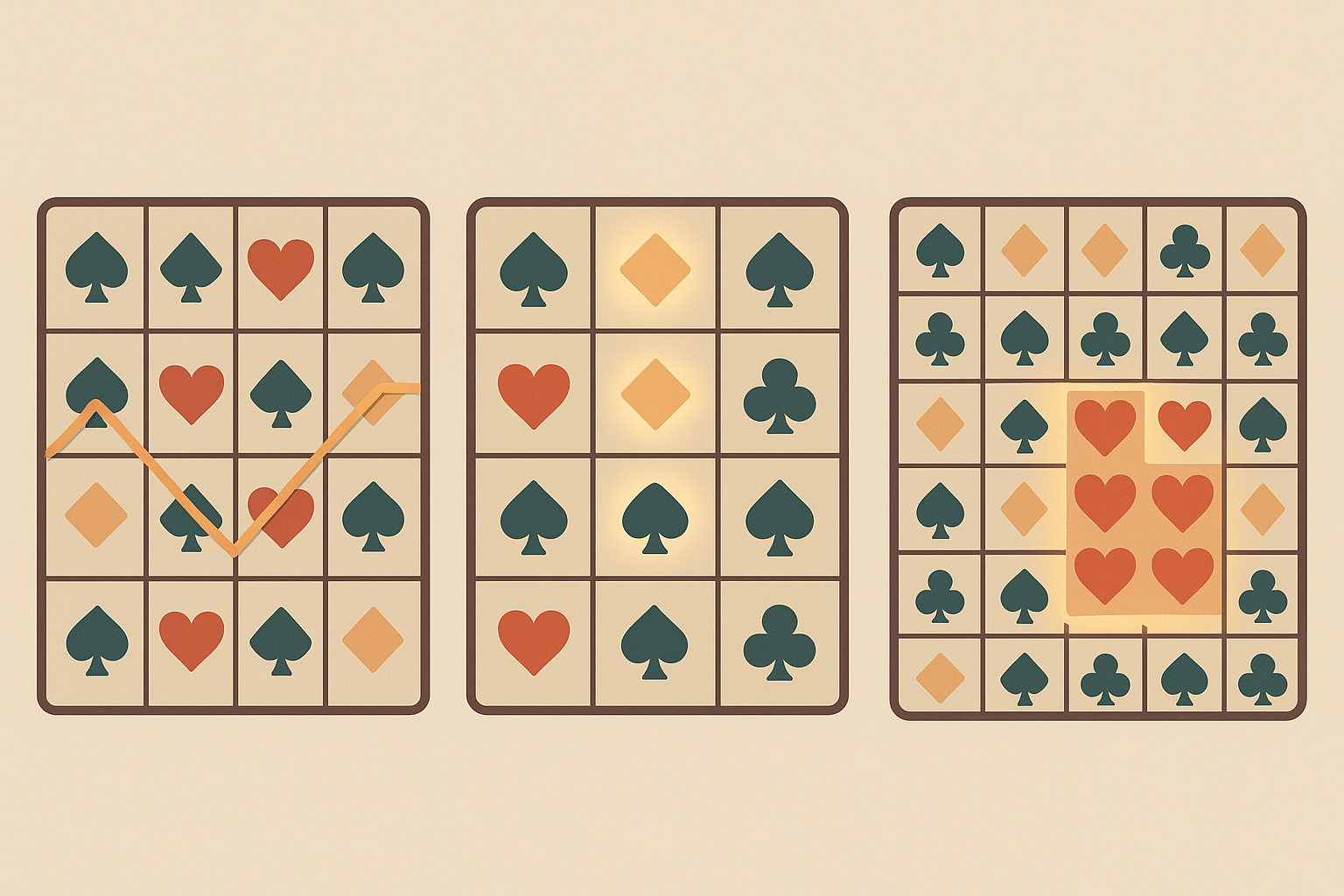
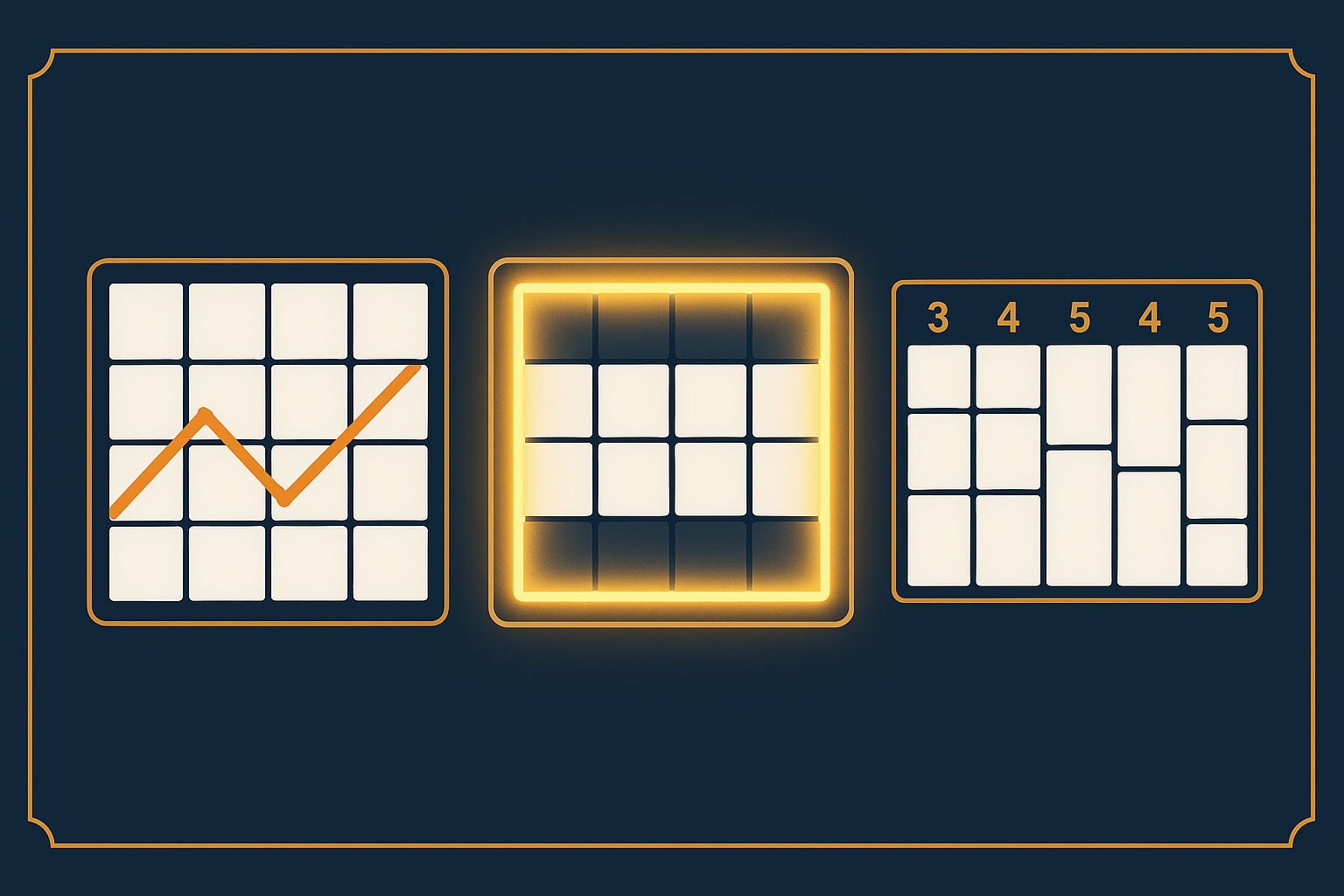
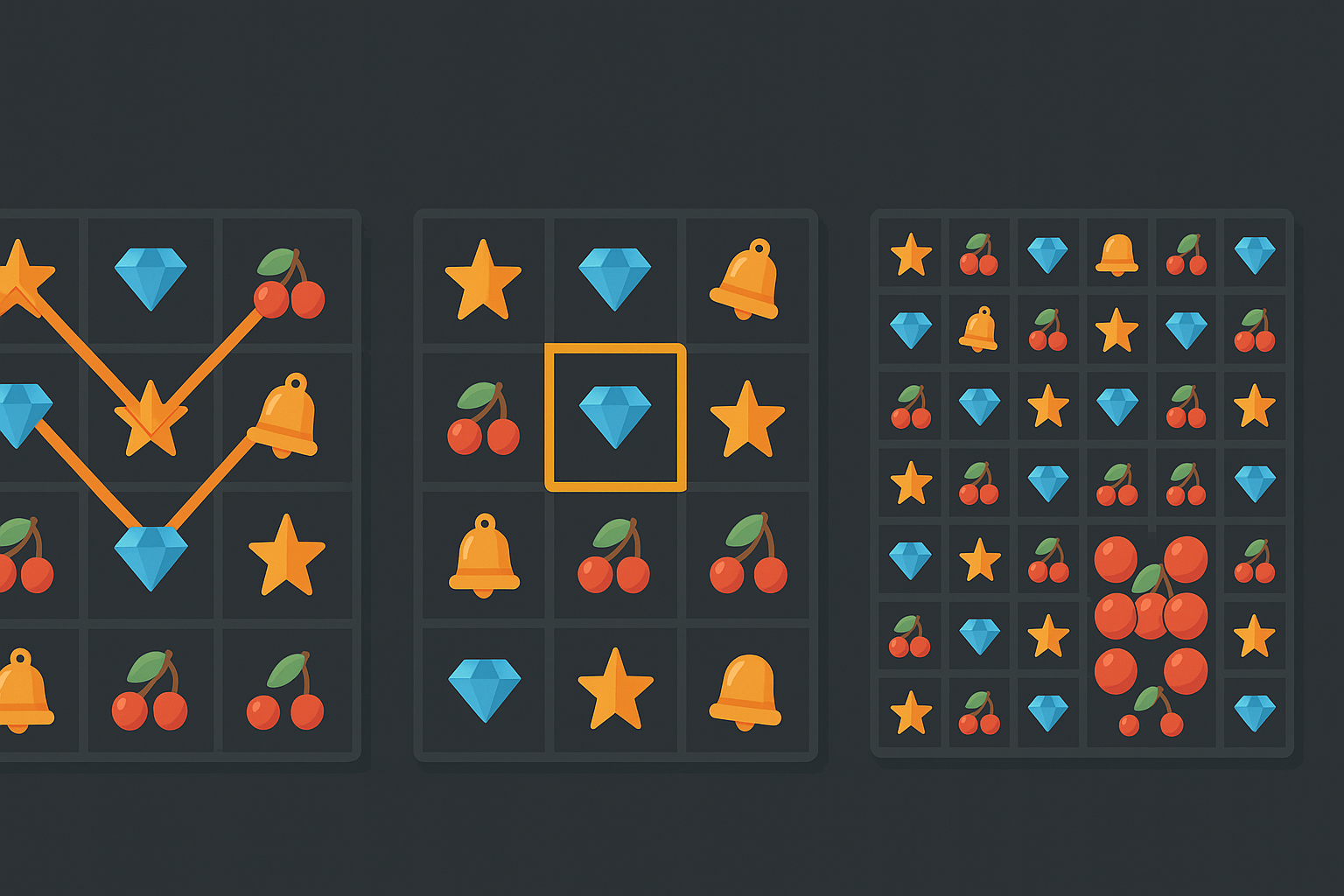
The classic layout is five reels by three rows with 20 or 25 lines. Some lines run straight across, some zigzag, some form V shapes. A 5-line slot only checks five of those patterns per spin. A 25-line slot checks 25. Same reels, same symbols, more patterns being evaluated.
Direction matters too. Most games pay left to right only. A few pay both ways, meaning a combination starting from reel 5 also counts. Starburst is the well-known example of a 10-line game that pays in both directions, which is effectively 20 chances per spin from 10 line patterns.
Fixed vs adjustable paylines
Fixed paylines are always active. You bet a total amount, all lines are in play, and there’s no way to switch any off. Almost every modern slot works this way, which is simpler and prevents the classic beginner mistake of playing one line and missing a five-symbol hit on line 17.
Adjustable paylines, more common in older games and some land-based machines, let you choose how many lines to activate. The catch is that your stake is per line. Playing 5 lines at $0.10 costs $0.50 a spin; playing all 25 costs $2.50. Turning lines off doesn’t make the game cheaper in any meaningful sense, it just shrinks both your stake and the number of ways the spin can pay. It also doesn’t change the game’s RTP, since RTP is a property of the game’s math, not your line selection.
Reading a paytable
The paytable is the only place that tells you what the game actually does. Open it before your first spin and check five things:
- Symbol values and whether they’re shown as a multiple of your line bet or your total bet. This is the number one source of confusion when a win looks smaller than expected.
- How many symbols are needed to pay. Some games pay from two of a kind on premium symbols, most need three.
- Payline diagrams, so you can see which patterns exist and whether wins run both ways.
- Wilds and scatters. Wilds substitute for regular symbols; scatters pay or trigger features regardless of position.
- Feature triggers and the stated RTP, which most licensed games publish in the help screens.
Ways-to-win: beyond traditional lines
Ways-to-win slots drop the line patterns entirely. Instead, they count matching symbols on adjacent reels regardless of which row those symbols land in. If a matching symbol appears anywhere on reel 1, anywhere on reel 2 and anywhere on reel 3, that’s a win. Position within the reel is irrelevant, only the unbroken run of reels from the left matters.
This is why you’ll see “243 ways to win” or “1,024 ways” printed on the game instead of a line count. Those numbers aren’t marketing invention, they’re arithmetic.
How 243 ways-to-win works
Take a standard grid of 5 reels with 3 symbol positions each. Any symbol on reel 1 can pair with any of 3 on reel 2, then any of 3 on reel 3, and so on. That’s 3 × 3 × 3 × 3 × 3 = 3⁵ = 243 possible symbol paths across the whole grid.
Practically, it means you stop hunting for patterns. Three matching symbols on the first three reels always pay something, and if two of them land on the same reel, that counts as two separate ways, so the win multiplies. Land two matching symbols on reel 1 and one each on reels 2 and 3 and you’ve collected two three-of-a-kind wins from one spin.
1024 ways and higher variants
Add a fourth row to each of the five reels and the count becomes 4⁵ = 1,024. Six reels of four rows gives 4⁶ = 4,096. The pattern is straightforward: symbols per reel raised to the number of reels.
Bigger numbers look dramatic, but they don’t mean bigger payouts by themselves. When a game offers 1,024 ways instead of 243, the designers usually cut the individual symbol values to compensate. More frequent small wins, smaller per-win amounts, same overall return. Ways-to-win games are also generally sold at a flat total stake rather than per line, so a “1,024 ways” slot isn’t 1,024 bets.
Megaways: variable ways-to-win
Megaways, a mechanic licensed from Big Time Gaming and first used in Bonanza in 2016, is ways-to-win with one change: the reel heights are random on every spin. Instead of a fixed 3 or 4 rows, each reel can show anywhere from 2 to 7 symbols, so the number of ways changes constantly.
Megaways mechanics explained
The standard setup is six reels, each showing 2 to 7 symbol positions. Wins are still counted the same way as any ways-to-win game: matching symbols on consecutive reels starting from the left, position irrelevant. Most Megaways titles also add a horizontal reel above the grid that feeds extra symbols into reels 2 to 5, plus cascading reels that remove winning symbols so new ones can drop in.
The headline number, 117,649, is simply 7⁶: all six reels landing at their maximum height of seven symbols. That’s the ceiling, and it’s rare. When one reel shows only two symbols, the maximum collapses fast, because it’s a multiplication, not an addition.
Why the number changes each spin
Here’s a concrete example. Reels showing 4, 6, 7, 3, 5 and 2 symbols produce 4 × 6 × 7 × 3 × 5 × 2 = 5,040 ways. A single short reel drags the whole total down. That’s why the counter on screen jumps from a few hundred to tens of thousands between spins.
Big way counts feel exciting, and that’s part of the design. But a spin with 100,000 ways and no matching symbols on the first two reels pays exactly the same as a spin with 500 ways and no matches: nothing. Megaways games tend to be high volatility for this reason. Long dry stretches, then a cascade that hits several times over.
Cluster pays: winning without lines
Cluster pays slots ignore reels and lines and look at the grid as a whole. A win happens when a group of identical symbols touch each other, usually horizontally and vertically, in a group of a minimum size the paytable specifies. Grids are typically larger than normal, 6×5, 7×7 or 8×8, because clusters need space to form.
How clusters form
Touching means sharing an edge. Diagonal contact usually doesn’t count, so check the rules screen. Minimum cluster sizes vary by game, commonly 5 or more symbols, and some games require larger groups before anything pays. The bigger the cluster, the more the paytable pays, and payouts often climb steeply once you pass a threshold such as 15 or 20 symbols.
The practical difference from lines is that shape matters, not order. An L-shaped blob of nine matching symbols in the middle of the grid is a solid win in a cluster game and worth nothing on a payline game unless it happens to sit on a line pattern.
Cascading wins and multipliers
Nearly every cluster game uses cascading reels, also called tumbling or avalanche. Winning symbols are removed, the ones above drop down, new symbols fill the gaps, and any new cluster pays again. That chain continues until no cluster forms. One paid spin can produce several wins.
Many of these games stack a multiplier onto the cascade sequence: the first win pays at 1×, the second at 2×, the third at 3×, and so on, or a multiplier symbol sticks to a position and grows. This structure is where cluster slots get their large maximum wins, and also why the average spin returns nothing. The math has to fund those rare long chains from somewhere.
Do more paylines mean better odds?
No. More paylines, more ways to win or a bigger grid do not improve your odds or your expected return. RTP is decided by the game’s math model, and the payout structure is just the way that model is presented. A 10-line slot and a 117,649-way Megaways slot can both run at 96% RTP, which means a 4% house edge on every dollar wagered over the long run.
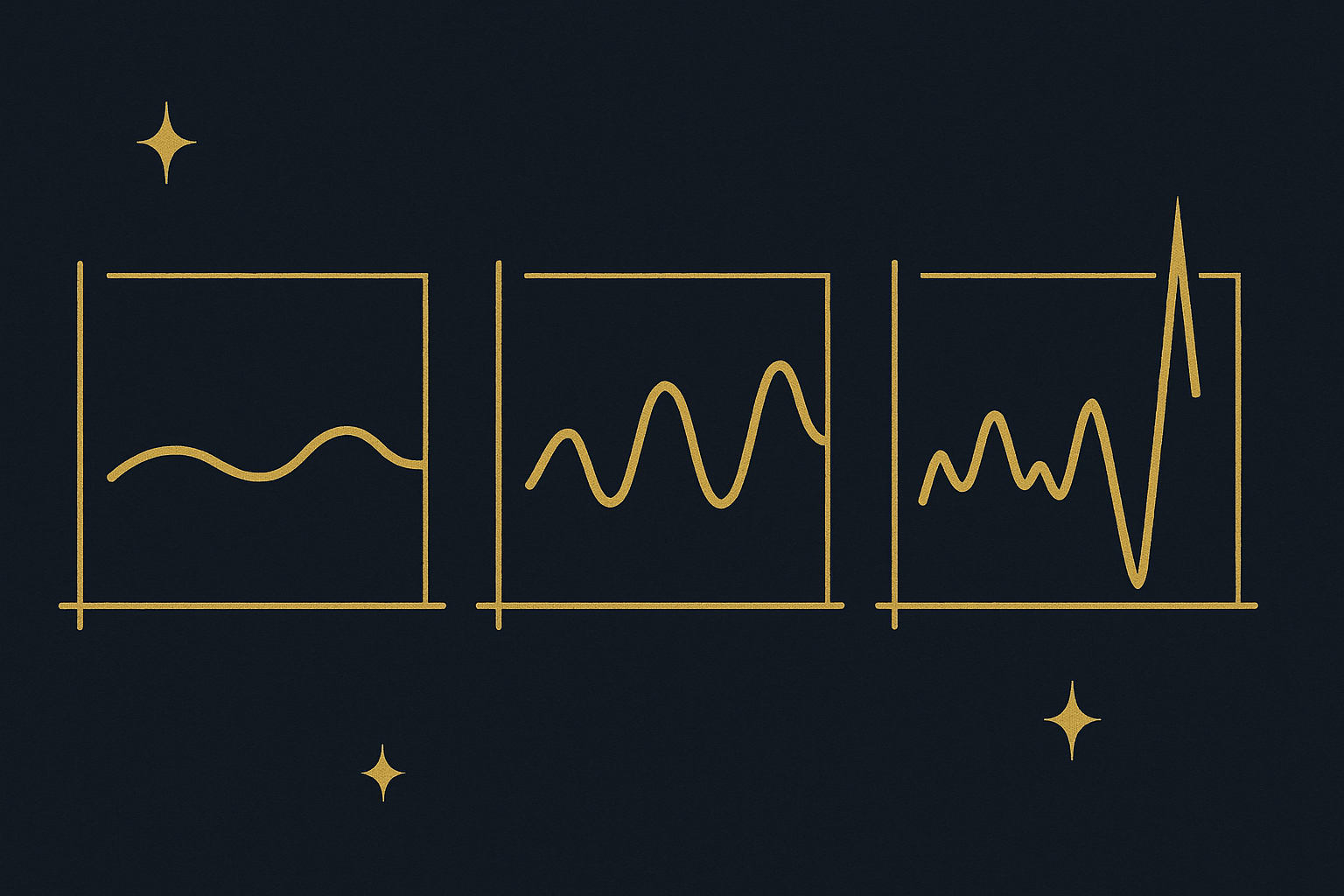
What the structure does change is the shape of your results. More ways to win generally means higher hit frequency, more spins returning something, but smaller amounts per hit, often less than your stake. Fewer, more restrictive lines usually mean fewer hits with larger payouts when they land. Volatility and hit frequency move around; RTP stays where the designer set it.
Two related myths worth killing while we’re here. Playing more lines on an adjustable-payline slot doesn’t raise your RTP, it raises your stake proportionally. And every spin is produced by an RNG, independently of what came before, so there are no hot or cold games and no structure you can pick to get ahead of the house edge.
Which payout system is best?
There’s no best system, only systems that suit different tastes. Since all four can share the same RTP, the honest way to choose is by how you want a session to feel.
| System | How a win forms | Typical grid | Usual feel |
|---|---|---|---|
| Paylines | Matching symbols on a preset line pattern, usually left to right | 5×3, 10 to 25 lines | Simple to read, moderate volatility, easy to see why you won |
| Ways-to-win | Matching symbols on adjacent reels, any row | 5×3 (243 ways) or 5×4 (1,024 ways) | Higher hit frequency, smaller individual wins |
| Megaways | Same as ways-to-win, but reel heights change each spin | 6 reels, 2 to 7 symbols each (up to 117,649 ways) | High volatility, swingy, cascades and big max wins |
| Cluster pays | Groups of touching identical symbols, minimum size set by paytable | 6×5, 7×7 or 8×8 | Chain reactions and multipliers, often high volatility |
If you want to understand every win at a glance and keep swings modest, classic paylines are hard to beat for clarity. If you like frequent small returns and don’t want to memorize line diagrams, 243 or 1,024 ways games fit. If you’re happy with long stretches of nothing in exchange for the chance of a big cascade, Megaways and cluster games are built for that, and you should size your bets accordingly, because high volatility burns through a bankroll faster than the RTP figure suggests.
Whatever you pick, the 4% or so the house keeps applies to every wager, and the sensible approach is to treat slot play as paid entertainment with a fixed budget. Set deposit and loss limits before you start, use session reminders if your casino offers them, and take a break rather than chasing a losing run. If gambling stops feeling like a game, responsible gambling tools and support services are free and confidential.
Frequently asked questions
What are slot paylines?
Slot paylines are preset patterns of positions across the reels. Matching symbols must land on one of those patterns, usually starting from the leftmost reel, for the spin to pay. Symbols outside the pattern don’t count.
What does 243 ways to win mean?
It means the game pays for matching symbols on adjacent reels regardless of row, on a 5-reel, 3-row grid. There are 3⁵ = 243 possible symbol paths, so 243 ways to combine.
How do Megaways slots work?
Each of the six reels randomly shows 2 to 7 symbols per spin, and wins are counted across adjacent reels. Multiply the reel heights together to get that spin’s number of ways, up to 7⁶ = 117,649.
What are cluster pays?
Cluster pays award wins for groups of identical symbols touching each other on the grid, rather than along lines. The paytable sets the minimum cluster size, and most of these games use cascading reels so one spin can pay several times.
Do more paylines mean better odds?
No. Payout structure doesn’t change RTP or the house edge. It changes how often you win and how much each win is worth, which is volatility and hit frequency, not odds in your favor.