What are slot bonus wagering requirements?
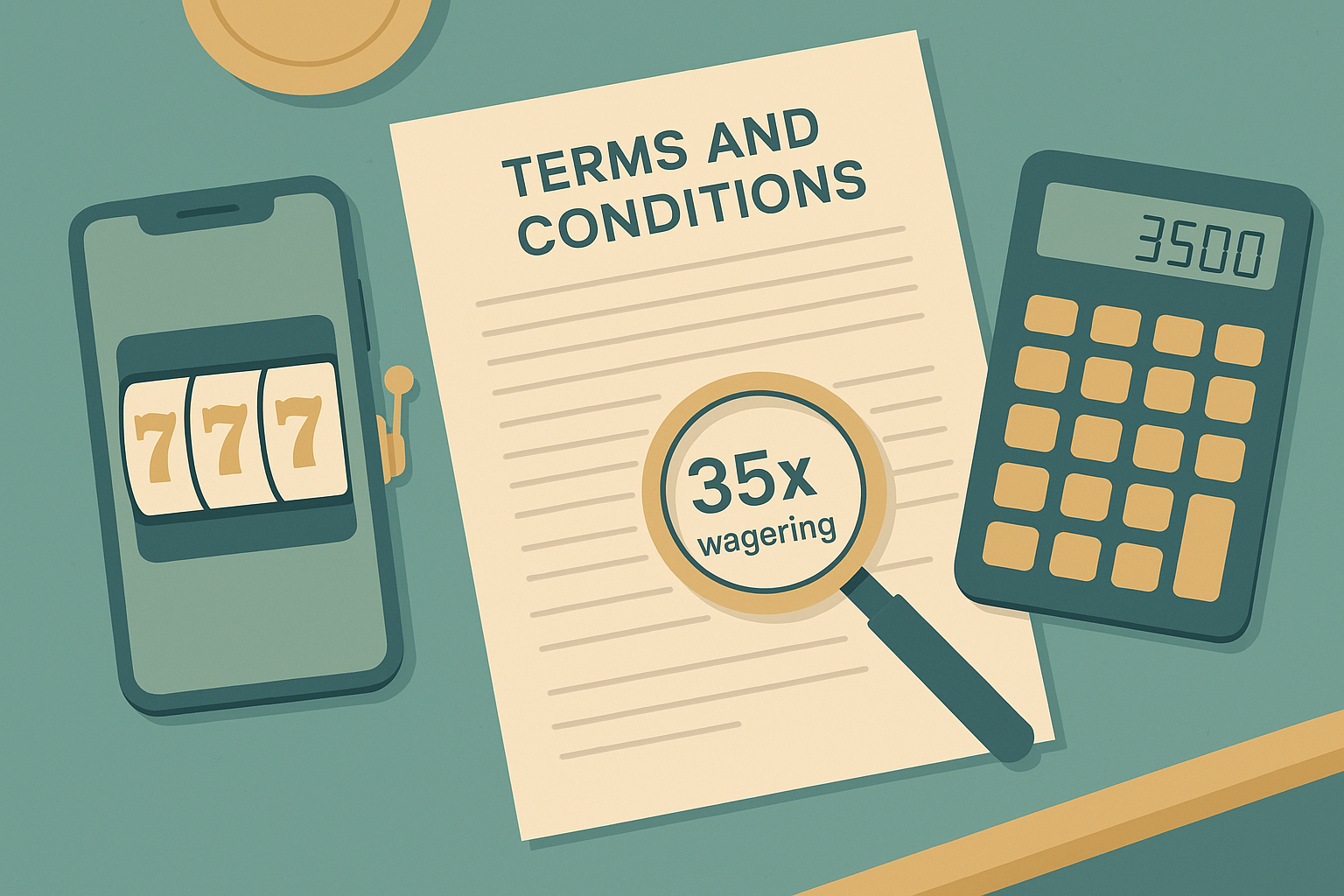
Slot bonus wagering requirements are the number of times you must bet a bonus amount before the casino lets you withdraw anything from it. They’re written as a multiplier: 35x, 40x, 50x. A $100 bonus with 35x wagering means $3,500 in total bets must go through eligible games before the balance becomes cash you can actually take out.
That number surprises a lot of first-time bonus players. $100 sounds small, $3,500 in turnover does not. And turnover is what it means: the same dollar can be wagered many times as it cycles through wins and losses, so you’re not depositing $3,500, you’re spinning through it.
What does 35x wagering mean?
It means bonus × 35 = the playthrough requirement. On a $50 bonus that’s $1,750. On a $200 bonus that’s $7,000. Some casinos apply the multiplier to the deposit as well, which doubles the figure on a 100% match, so always check whether the terms say “35x bonus” or “35x bonus + deposit.”
Casinos use wagering requirements for a simple reason: without them, players would deposit, claim, and withdraw immediately, and the promotion would just be a giveaway. The requirement keeps the money in play long enough for the house edge to do its work. On a slot with 96% RTP, the house edge is 4%, which means every $100 of turnover costs about $4 in theoretical loss over the long run. Push $3,500 through that slot and the expected cost is roughly $140. That’s the honest arithmetic behind a “free” $100.
How to calculate your total wagering (step-by-step)
Three numbers decide everything: the bonus amount, the multiplier, and whether the deposit is included. Work through them in that order.
- Find the bonus amount you’ll actually receive (a 100% match up to $200 on a $75 deposit gives you a $75 bonus, not $200).
- Find the multiplier in the terms, not the banner. Banners advertise the match; the T&Cs hold the rollover.
- Check the wording: “bonus” or “bonus + deposit.”
- Multiply. That’s your playthrough requirement in dollars of turnover.
- Divide by your planned spin size to see how many spins it takes.
Bonus-only vs. bonus + deposit wagering
This one clause can double your workload. Same $100 deposit, same 100% match, same 35x multiplier:
| Terms wording | Amount wagered against | Total wagering | Spins at $1 |
|---|---|---|---|
| 35x bonus | $100 bonus | $3,500 | 3,500 |
| 35x bonus + deposit | $100 + $100 = $200 | $7,000 | 7,000 |
A 25x bonus + deposit offer ($5,000 on the same deposit) is tougher than a 40x bonus-only offer ($4,000). The multiplier alone tells you nothing until you know what it multiplies.
Free spins wagering calculation
With free spins, the multiplier is usually applied to your winnings from the spins, not to a bonus credit. Say you get 50 free spins at $0.20, they produce $24 in winnings, and the terms say 30x. Your requirement is $24 × 30 = $720 in wagering. Win more from the spins and the requirement grows with it, which is a strange feature of these offers that catches people out.
Game weighting: why slots count 100% (and what doesn’t)
Game weighting (also called the contribution rate) is the percentage of each bet that counts toward your wagering requirement. Slots almost always count 100%, which is exactly why bonuses are marketed to slot players. Table games count far less, and some games count nothing at all.
Typical contribution rates look like this, though every casino sets its own and you should confirm in the terms:
| Game type | Typical contribution | $10 bet counts as |
|---|---|---|
| Video slots (eligible titles) | 100% | $10 |
| Video poker | 10–20% | $1–$2 |
| Roulette | 10–20% (or excluded) | $1–$2 |
| Blackjack, baccarat | 0–10% | $0–$1 |
| Live dealer tables | 0–10% | $0–$1 |
| Progressive jackpot slots | Often 0% (excluded) | $0 |
How does game weighting affect slot bonuses?
It changes how long clearing takes by an order of magnitude. On a $3,500 requirement, slots at 100% need $3,500 of bets. Blackjack at 10% needs $35,000 of bets to satisfy the same requirement. That’s why grinding a bonus on low-edge table games isn’t the clever workaround it looks like on paper.
Also read the excluded games list, not just the weighting chart. Casinos routinely bar high-RTP or jackpot slots from bonus play, and bets placed on an excluded title may count for nothing while still draining your balance. Check the eligible games list inside your account before your first spin.
Max bet rules: the hidden trap in bonus terms
A max bet rule caps the size of a single bet while a bonus is active, usually somewhere between $5 and $10 per spin. Some offers set it lower, or express it as a percentage of the bonus (for example, 10% of the bonus amount per spin).
What is a max bet rule on a bonus?
It exists to stop players from taking one or two huge swings with bonus funds and cashing out. The penalty is harsh and usually automatic: exceed the cap even once and the casino can void the bonus and any winnings derived from it. Not reduce, not warn. Void. That includes accidental breaches, and it includes bet levels reached through a feature buy or a doubled stake after a big win.
Practical handling:
- Set your spin size once, below the cap, and leave it alone for the whole bonus.
- Watch autoplay settings that can escalate stakes.
- Remember that some terms count bonus buys or “double chance” side bets toward the bet total.
- If the cap is expressed per spin, a $5 cap on a $3,500 requirement means at least 700 spins. Plan your session length accordingly.
Time limits and expiry: when bonuses disappear
Most slot bonuses expire in 7 to 30 days; free spins often expire faster, sometimes within 24 to 72 hours of being credited. When the clock runs out with wagering incomplete, the standard outcome is that the bonus and any winnings tied to it are removed. Your own remaining real-money balance stays, but the bonus upside is gone.
Do the division before you claim. A $7,000 requirement over 7 days at $1 spins is 1,000 spins a day, which is a lot of screen time for most people. If the pace only works by betting bigger than you’re comfortable with, or playing longer than you planned, the offer isn’t a good fit. Declining a bonus is a perfectly normal decision, and playing without one keeps your balance withdrawable at any time.
Free spins wagering: a different beast
Do free spins have wagering requirements?
Usually yes. Winnings from free spins typically carry their own multiplier, commonly in the 20x to 40x range, and often come with terms that differ from the cash bonus attached to the same promotion. Genuinely wager-free spins exist, but they’re the exception and the terms will say so plainly.
Three details matter more than the multiplier here:
- Max cashout. Free spins frequently cap withdrawals at a fixed figure such as $50 or $100, regardless of what you won. Anything above the cap is forfeited when you withdraw.
- Game restriction. Spins are usually locked to one specific slot, and the wagering may have to be completed on that same title or a short approved list.
- Spin value. 50 spins at $0.10 is $5 of stake value. Compare offers on total spin value, not spin count.
Because the requirement scales with your winnings, a lucky free spins round can hand you a $1,200 rollover on a $40 win at 30x, with a $100 cap on what you could ever withdraw. Read the cap first; it tells you the realistic ceiling of the offer.
Red flags: bonus terms that signal poor value
None of these are illegal or hidden wrongdoing. They’re just expensive, and once you can spot them you can skip them.
- Wagering of 50x or higher, especially on bonus + deposit. A 60x bonus + deposit term on a $100 deposit is $12,000 of turnover.
- Expiry inside 24 to 48 hours on a four-figure requirement. The math forces a pace most players shouldn’t set.
- Low max cashout relative to the bonus, such as a $500 bonus with a $100 withdrawal cap.
- Long exclusion lists that remove most decent slots, or weighting where slots contribute less than 100%.
- Max bet under $1, which stretches a large requirement across thousands of spins.
- Vague wording like “irregular play may void winnings” with no definition of irregular.
- No stated multiplier at all in the promotional page and no accessible full terms. Walk away.
Quick bonus evaluation checklist
Five questions, two minutes, before you click claim:
- What’s the real number? Multiply the bonus (and the deposit, if included) by the multiplier. Write the dollar figure down.
- What does it cost in expected loss? Multiply that turnover by the house edge of the slot you’ll play (100% − RTP). It’s an estimate, not a prediction, but it frames the offer honestly.
- Can I finish in time at a stake I’m comfortable with? Turnover ÷ spin size ÷ days remaining = spins per day.
- What are the caps? Max bet per spin and max cashout. Both can quietly decide the outcome.
- Which games actually count? Confirm the eligible list and the contribution rates before the first spin.
If four of the five answers look reasonable and one doesn’t, the one that doesn’t is the one that will bite. A modest 100% bonus up to $200 at 30x bonus-only with 30 days and a $5 max bet is a far more workable offer than a headline-grabbing 300% match at 60x bonus + deposit with a 7 day clock.
Last thing, and it matters more than any multiplier: a bonus is a marketing cost for the casino, not a way to make money. Slots carry a permanent mathematical edge for the house, and wagering requirements are designed with that edge in mind. Set a deposit limit you’d be fine losing, treat the play as entertainment spend, and use the site’s limit and cool-off tools if a session stops feeling like a game. If gambling is causing you problems, the National Council on Problem Gambling offers free, confidential help. You can also read our responsible gambling guide and our explainer on how slot RTP and volatility work before choosing which game to clear a bonus on.