
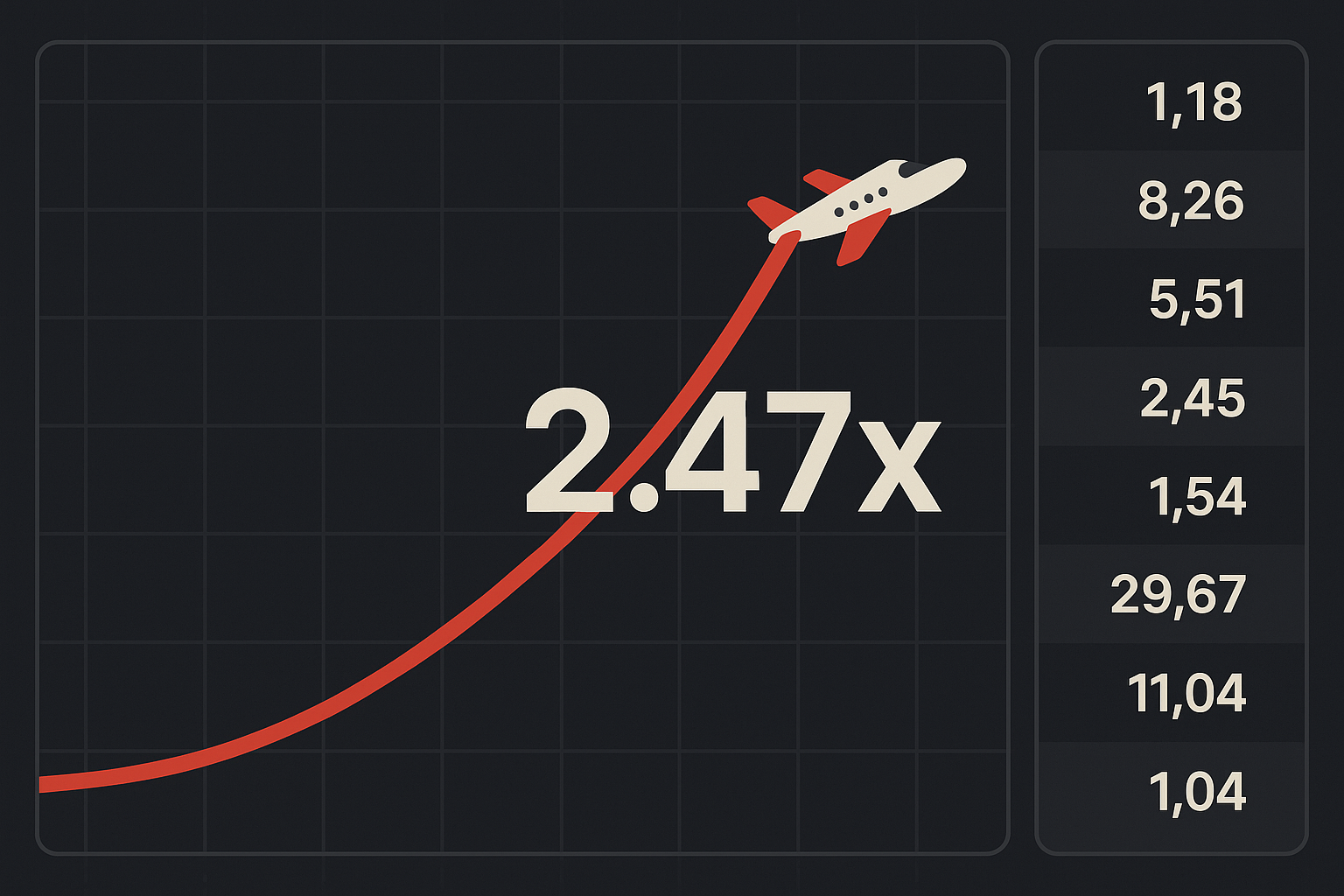
Aviator is a crash game: you place a bet, a plane takes off, a multiplier climbs from 1.00x, and you have to cash out before the plane flies away. If you cash out at 2.40x, your stake is returned multiplied by 2.40. If the plane disappears first, the bet is lost. That’s the whole game. Understanding how the Aviator game works under the hood, though, means understanding three things: the random number generator that picks the crash point, the provably fair system that lets you check it, and the timing mechanics of cashing out.
What is Aviator? The crash game format explained
Aviator is a single-outcome betting round built around a rising coefficient instead of reels or cards. It was developed by Spribe and became the reference point for the whole crash genre, which is why “Aviator” is often used loosely to mean any crash game.
The interface is deliberately minimal. A graph area with the plane, a large multiplier readout in the centre, a bet panel with stake and cash-out buttons, a strip of previous round results, and usually a live list of other players’ bets and cash-outs. Rounds are short, typically a handful of seconds, with a brief betting window between them.
The rising multiplier graph
The graph is a display, not a mechanism. The plane traces a curve upward while the coefficient increases, slowly at first and then faster as it climbs. Nothing about the plane’s position, speed or angle influences where the round ends. The crash point is already fixed before the round begins; the animation is just the game reading that number out loud.
When the plane crashes
At the predetermined coefficient, the plane leaves the screen and the round closes. Every bet still open at that instant loses. Every bet cashed out before it pays stake × the multiplier at the moment of cash-out. Some rounds crash almost immediately at 1.00x, which is normal behaviour in crash maths rather than a glitch, and some run into double or triple digits. Both come from the same distribution.
How does the Aviator game work? Step-by-step mechanics
One complete round looks like this:
- The betting window opens for a few seconds. You set a stake and confirm it, optionally placing two bets in parallel (most versions allow a dual bet panel).
- Betting closes and the round starts. The plane takes off and the coefficient begins rising from 1.00x.
- You cash out manually at any point, or an auto cash-out you set earlier triggers at your chosen coefficient.
- The plane flies away at the crash point. Winning cash-outs are credited, open bets are lost.
- The result is added to the round history and the next betting window opens.
Placing your bet
Stakes are locked in before take-off. Once the round is live you cannot add to a bet, reduce it, or join late. If you place a bet while a round is already running, it queues for the next round. This is worth knowing because new players often think they missed a cash-out when in fact their bet had not yet entered play.
The cash-out decision
Cashing out is the only decision in the game, and it is a decision about a number you cannot see. Your payout is stake × coefficient at the confirmed cash-out moment. Cash out at 1.20x on ₹100 and you get ₹120 back. Wait for 8.00x and you would get ₹800 — if the round gets there, which most rounds don’t.
Under the standard crash model, the chance of a round reaching any given coefficient falls roughly in proportion to that coefficient. Aviator’s published RTP is 97%, which implies a 3% house edge. Using that, the approximate probability of a round reaching a target looks like this:
| Target coefficient | Approx. chance of reaching it | Payout on ₹100 |
|---|---|---|
| 1.20x | ~81% | ₹120 |
| 1.50x | ~65% | ₹150 |
| 2.00x | ~48.5% | ₹200 |
| 5.00x | ~19% | ₹500 |
| 10.00x | ~9.7% | ₹1,000 |
| 100.00x | ~1% | ₹10,000 |
These are modelled figures based on a 97% RTP and the usual crash distribution, not a guarantee for any individual round. The important point: low targets hit often and pay little, high targets pay well and rarely land, and the expected value is the same negative 3% either way. There is no cash-out point that flips the maths in your favour.
What happens when you miss the crash
Nothing dramatic — the bet is simply lost in full. There is no partial refund, no consolation multiplier, and no way to reverse a missed cash-out. This is also where latency matters, covered further down.
How is the Aviator multiplier generated? RNG explained
The crash coefficient is produced by a random number generator before the round starts, then revealed gradually by the animation. The server does not watch how much money is in play and then decide when to end the round; the number exists first, and the round is the playback.
Random number generation in crash games
In broad terms, the generator produces a random value, and that value is mapped onto the crash distribution by a formula weighted so that low coefficients are common and high ones are rare. The weighting is what produces the house edge: a small share of rounds are set to crash at 1.00x, and the rest are spread across the curve so that the long-run return lands on the game’s stated RTP.
Each round is generated independently. The RNG has no memory of the previous result, no target for the day, and no per-player adjustment. That’s the same principle behind slot outcomes — see our explainer on how RNG and game fairness work for the wider picture.
The house edge factor
At 97% RTP, the game returns about ₹97 for every ₹100 wagered across millions of rounds, keeping ₹3. That figure is an average over an enormous sample, not a session forecast. Your own results will swing far above and far below it, because crash games are high volatility by design: long dry stretches punctuated by occasional big coefficients are exactly what the distribution predicts. Over time, the edge does not go away, which is why crash games should be treated as paid entertainment rather than a way to make money.
What is provably fair? Verifying Aviator’s randomness
Provably fair is a cryptographic system that lets you check, after the fact, that a round’s result was fixed before betting closed and was not altered afterwards. Instead of trusting the operator’s word, you verify a hash.
How provably fair works
The standard implementation works with seeds and hashing:
- The server generates a secret seed for the round and publishes its hash (a one-way fingerprint) before the round starts. The hash proves the seed exists without revealing it.
- Player seeds are contributed too. Aviator’s system combines the server seed with seeds taken from participants in the round, so neither side can dictate the outcome alone.
- The combined seeds are hashed with a cryptographic function (SHA-based), and the resulting hex value is converted into the round’s crash coefficient by a published formula.
- After the round, the server seed is revealed so anyone can re-run the calculation.
Because changing the seed would change the hash, an operator cannot swap the number after seeing what players bet without breaking the published fingerprint.
Verifying a round yourself
The exact interface varies, but the process is consistent:
- Open the round history and select a past round.
- Copy the round’s data: the revealed server seed, the player seeds used, and the resulting coefficient.
- Hash the combined seeds using the algorithm the provider documents (Aviator’s fairness page specifies it).
- Confirm the hash matches the one published before the round started.
- Apply the documented conversion to the hash output and check the coefficient you get matches the coefficient the round actually produced.
Third-party hash calculators exist for step three, and the provider’s own fairness panel usually does the whole check in one click. Separately from provably fair, reputable providers submit their RNG to independent testing laboratories such as GLI, iTech Labs or eCOGRA, and licensed operators must display that certification.
Aviator cash-out mechanics: manual vs auto
There are two ways to close a bet, and the difference is mostly about who is doing the timing — you, or the server.
Manual cash-out timing
You press the cash-out button and the client sends the request to the server, which timestamps it and settles at the coefficient current at that moment. On a slow connection or a congested mobile network, the coefficient on your screen can be marginally behind the server’s. In a fast-rising round that gap is the difference between a successful cash-out and a lost bet. Manual cash-out is also where reaction time genuinely limits what’s realistic: chasing a crash by hundredths of a second is not a plan.
Auto cash-out settings
Auto cash-out lets you pre-set a coefficient — say 1.80x — and the cash-out executes automatically when the round reaches it. Because the trigger is evaluated server-side, it removes your reaction time and your connection lag from the equation. If the round crashes below your target, nothing triggers and the bet is lost as normal. Some versions also offer an auto-bet toggle that re-places the same stake every round; useful for consistency, easy to misuse if you stop paying attention to how much you have wagered.
Neither method changes the odds. Auto cash-out is a precision tool, not an advantage.
Is Aviator rigged? Addressing common myths
On a licensed platform running a certified, provably fair build, no — the results are random and independently verifiable. What people usually call “rigged” is the house edge doing its ordinary work, or the mind finding patterns in noise.
The common misconceptions worth clearing up:
- “Three low rounds mean a big one is due.” Each round is generated independently. The distribution has no memory, so a run of 1.0x results changes nothing about the next coefficient.
- “The game is hot/cold right now.” Streaks are a normal feature of a high volatility distribution. Looking at the history strip and extrapolating is pattern-matching, not information.
- “It crashes early when I bet big.” The crash point is set before the betting window closes and does not read your stake.
- “Predictor apps and signal groups work.” They can’t. The outcome is generated server-side from seeds that are secret until the round ends, and anything claiming to forecast it is selling you a story.
Spotting a legitimate game is more useful than debating the maths. Check that the operator holds a verifiable licence, that the game is credited to the actual provider (Spribe for Aviator) rather than an unnamed clone, that a provably fair panel exists and actually returns verifiable round data, and that the stated RTP is published. Cloned crash games on unlicensed sites are the real risk here, not the original mechanic.
FAQ
How does the Aviator game work?
You bet during a short window, a plane takes off and a multiplier rises from 1.00x, and you cash out before the plane flies away at a randomly predetermined coefficient. Cash out in time and you receive stake × multiplier; miss it and the stake is lost.
What is a provably fair crash game?
One where the round’s result is committed to a published hash before betting closes and the seeds are revealed afterwards, so any player can recalculate the coefficient and confirm it was not changed.
How is the Aviator multiplier generated?
By an RNG, before the round begins. The random value is mapped onto a weighted distribution where low coefficients are frequent and high ones rare, calibrated to the game’s 97% RTP.
Is Aviator based on RNG or is it rigged?
RNG, and on licensed platforms it is verifiable through the provably fair system and independent RNG testing. The house edge of about 3% is built into the maths and disclosed, which is different from rigging.
Crash games are fast, and speed is what makes them easy to overspend on. Set a deposit or loss limit before you play, treat every round as an independent coin flip weighted against you, and use the session limits and cool-off tools your operator provides. If it stops being entertainment, our responsible gambling resources list support options. Anyone under 18 should not be gambling at all.