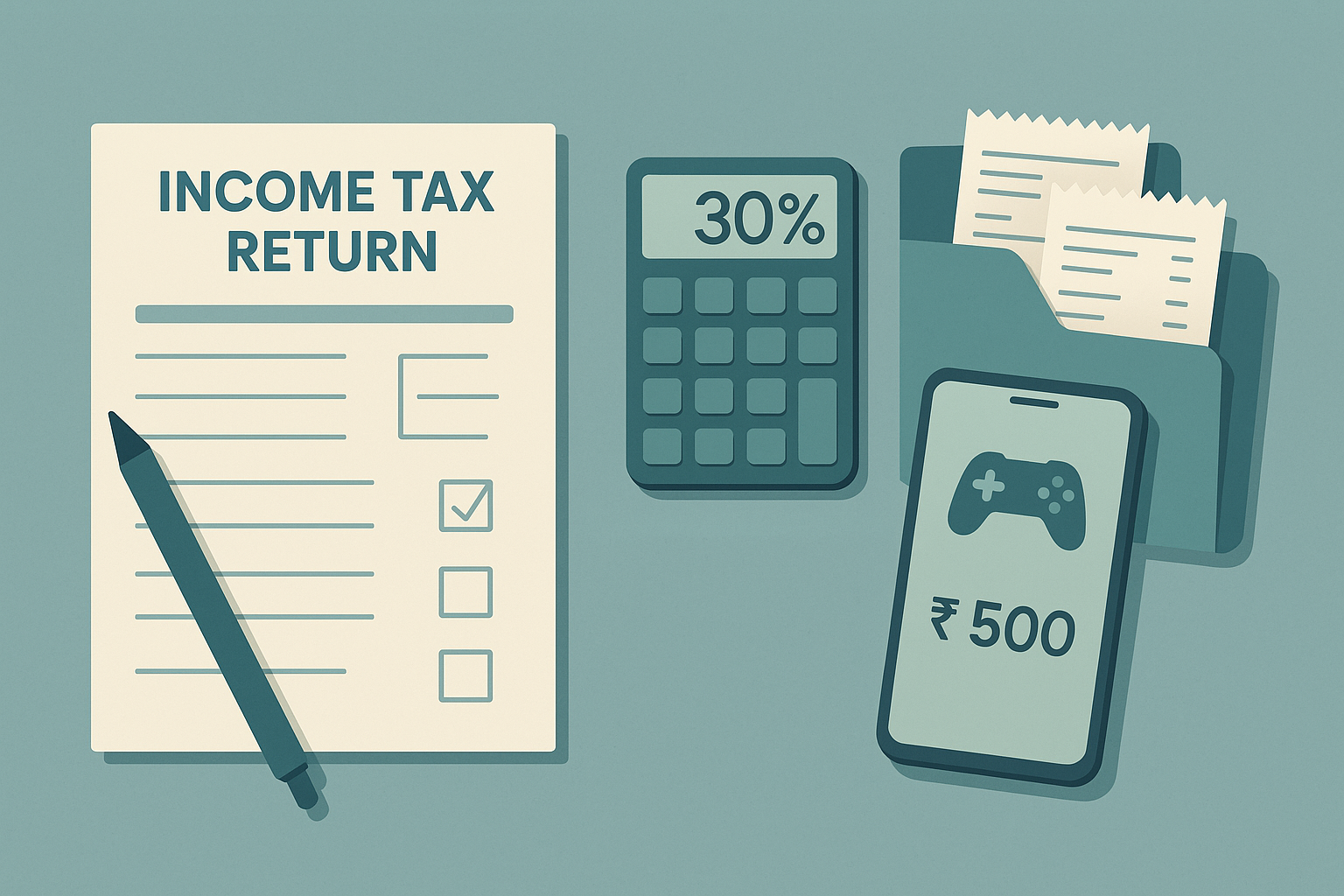
In India, tax on casino winnings is charged at a flat 30%, plus health and education cess, and you cannot reduce it with deductions, expenses or losses. That rate applies whether you win ₹5,000 or ₹5 lakh, and whether your total annual income is above or below the basic exemption limit. For online play, the platform is also required to deduct tax at source before you withdraw, so a chunk of the money never reaches your bank account in the first place.
This guide explains the mechanics in plain language: the rate, how TDS works, what Section 194BA actually says, why “small” wins still get reported, and what records you should keep. It is general information for educational purposes, not tax or legal advice. For your own position, speak to a chartered accountant and check the current provisions on the Income Tax Department’s website.
How casino winnings are taxed in India
Winnings from gambling, betting, card games, lotteries and crossword puzzles are taxed under a special provision of the Income Tax Act at a flat 30% rate. On top of that sits the 4% health and education cess, which takes the effective rate to 31.2% for most individual taxpayers, with surcharge added on top if your total income is high enough to trigger it.
Three features make this category unusual compared with salary or business income:
- No slab benefit. The 30% rate is not your slab rate. Even if the rest of your income is nil, winnings are still taxed at 30% — the basic exemption limit cannot be applied to shelter them.
- No deductions. Chapter VI-A deductions (80C, 80D and the rest) cannot be set against this income, and no expenditure or allowance is deductible from the winnings themselves.
- No loss set-off. A losing month does not cancel out a taxable win. You cannot offset gambling losses against gambling winnings from a different source, and you certainly cannot offset them against salary or capital gains.
Winnings versus stakes: what’s actually taxed
“Winnings” means the amount you receive as a prize or payout, not your profit after months of play. This is where most players get it wrong. If you deposit ₹40,000 over a year, lose most of it, then hit a ₹1,00,000 payout, the tax law does not treat you as being ₹60,000 up and tax that. Under the general gambling provision, the payout is what gets taxed.
Online gaming platforms are the exception, and an important one. For winnings from online games, the law taxes net winnings computed in a prescribed way (Rule 133 of the Income Tax Rules), which does take your own deposits and balances into account for that user account. Deposits you funded yourself are not treated as winnings. But that netting happens within a single platform’s user account — it does not let you pool wins on one site against losses on another.
What is TDS on gambling winnings?
TDS stands for Tax Deducted at Source. It is a withholding tax: the payer (the casino, gaming platform or lottery operator) deducts tax before paying you and deposits it with the government against your PAN. You then get credit for that amount when you file your return.
Two different sections cover gambling-type income, and knowing which one applies to you matters because the thresholds differ.
| Provision | Applies to | Rate | Threshold |
|---|---|---|---|
| Section 194B | Lottery, crossword puzzles, card games and other games (offline/other than online games) | 30% | ₹10,000 (the basis for applying this limit has been amended in recent Finance Acts — check the current provision) |
| Section 194BB | Winnings from horse racing | 30% | Statutory threshold applies |
| Section 194BA | Net winnings from online games | 30% | No minimum threshold |
| Section 115BB / 115BBJ | Your final tax liability on winnings (charging provisions, not TDS) | 30% + cess (+ surcharge if applicable) | Not applicable |
When TDS is deducted
For online gaming accounts, tax is deducted at two points: when you withdraw money from your user account during the year, and again at the end of the financial year on whatever net winnings remain in the account balance. So a player who keeps rolling the balance over without withdrawing is not escaping deduction; the year-end computation catches it.
The Central Board of Direct Taxes has issued guidance easing very small withdrawals — broadly, deduction can be deferred where a withdrawal of net winnings in a month is within ₹100, provided the tax is accounted for later in the year or at withdrawal of the balance. That is an administrative convenience for operators, not an exemption for the player.
For prizes in kind (a car, a holiday, a gadget), tax still has to be accounted for on the value of the prize before it is released. In practice the operator either recovers the cash from the winner or ensures the tax is paid.
TDS certificate and Form 16A
Where TDS is deducted on your winnings, the deductor issues Form 16A, the quarterly TDS certificate for non-salary payments. It shows the amount paid, the tax deducted and the deposit details. Keep every certificate you receive.
You should also cross-check against your Form 26AS and Annual Information Statement (AIS) in the income tax e-filing portal. These pull together the TDS reported against your PAN. If a platform deducted tax but it does not appear there, the credit will not flow into your return — chase it with the operator, because you cannot claim credit for tax the department has no record of.
Understanding Section 194BA of the Income Tax Act
Section 194BA is the TDS provision for winnings from online games, introduced by the Finance Act 2023 and effective from 1 April 2023. It requires any person responsible for paying winnings from an online game to a user to deduct 30% of the user’s net winnings at the time of withdrawal, and on the remaining balance at the end of the financial year.
The features that distinguish it from Section 194B:
- No threshold at all. The old ₹10,000 comfort zone does not exist here. Net winnings of ₹500 are within scope.
- Account-based, not transaction-based. Tax is computed on the user account as a whole, using the Rule 133 formula, rather than on each individual winning bet.
- Deposits are recognised. Money you put in is not taxed as winnings, which is the fair part of the design.
The Rule 133 logic, simplified: net winnings on withdrawal = amounts withdrawn − (your non-taxable deposits + opening balance), with a year-end computation that also brings in the closing balance. A worked example makes it concrete.
| Item | Amount |
|---|---|
| Opening balance (1 April) | ₹0 |
| Deposits during the year | ₹20,000 |
| Withdrawals during the year | ₹50,000 |
| Closing balance (31 March) | ₹5,000 |
| Net winnings for the year | ₹35,000 |
| TDS at 30% | ₹10,500 |
The corresponding charging section, 115BBJ, taxes those net winnings from online games at 30% in your hands. In other words, 194BA collects the tax and 115BBJ imposes it. If the correct amount was withheld, filing simply reconciles the two; if not enough was withheld, you pay the balance with your return.
Do you need to declare small winnings?
Yes. There is no de minimis exemption for gambling or gaming winnings in your income tax return. A TDS threshold is not the same thing as a tax exemption. If Section 194B’s ₹10,000 limit means no tax was deducted on a ₹6,000 win, that ₹6,000 is still taxable income and still has to be reported.
The common misconceptions worth clearing up:
- “No TDS means no tax.” Wrong. TDS is a collection mechanism. The liability arises from the charging section, not from whether someone withheld.
- “I ended the year down, so there’s nothing to declare.” Losses do not create a right of set-off against winnings from other sources or against other income heads.
- “It was only a bonus, not real money.” Bonus-derived winnings that you can actually withdraw are winnings once credited to your withdrawable balance. If you are unclear on how a promotion converts to real balance, read the operator’s terms — the same wagering conditions that govern bonus withdrawals also determine when money becomes yours.
- “The site is offshore, so it doesn’t count.” Residency drives your Indian tax liability on global income. Where the operator sits does not remove your reporting obligation.
Tax filing and record keeping for players
The practical burden here is admin, not arithmetic. Get the records right and the return is straightforward.
Maintaining gambling records
Keep, for each platform you use, at minimum:
- Account statements showing deposits, withdrawals, and opening and closing balances for the financial year.
- Bank or UPI transaction records matching those deposits and withdrawals. If you use several methods, our guide to casino payment methods in India is a useful reference for tracking which rail each transfer went through.
- Every Form 16A or TDS certificate issued to you.
- Screenshots or emails confirming large single payouts and any prizes in kind.
Download statements before the year closes. Accounts get restricted, promotions expire and operators change platforms — historic statements are not always retrievable a year later.
Including winnings in your tax return
Winnings are reported under “Income from other sources”, in the schedule that specifically lists income taxable at special rates, including winnings from lotteries, crossword puzzles and online games. Because this income sits outside the normal slab computation, ITR-1 is generally not the right form for a taxpayer with such winnings; ITR-2 (or ITR-3 if you also have business income) is typically used. Confirm the correct form for the assessment year before you file.
The order of work that saves rework: reconcile your platform statements to your bank account, match the TDS in your AIS and Form 26AS to your Form 16A certificates, then enter the gross winnings figure and claim the TDS credit against it. If the withheld tax is less than 31.2% of the taxable winnings — which is normal, since resident TDS is generally taken at 30% without cess — you settle the shortfall as self-assessment tax.
Recent changes in online gaming tax rules
The 2023 Finance Act was the turning point. It added Section 115BBJ and Section 194BA specifically for online games, replacing the earlier situation where operators leaned on the ₹10,000 threshold in Section 194B and many small winnings passed without any withholding. Since 1 April 2023, online gaming winnings face deduction with no threshold, computed on a net winnings basis across the user account.
On the indirect tax side, the GST Council’s 2023 decisions brought online money gaming into the 28% bracket on the full value of amounts deposited by players, effective 1 October 2023, rather than on the operator’s platform fee or gross gaming revenue. Casinos are similarly taxed on the face value of chips purchased. This is a tax on the supply, payable by the operator, not something deducted from your winnings — but it changed pricing and bonus structures across the market, so players felt it indirectly.
The legal framework itself has continued to move: Parliament passed online gaming legislation in 2025 that restricts online money gaming in India. Regulatory status and tax treatment are separate questions, and tax obligations on winnings you have already received do not disappear because rules change afterwards. Check the current legal position for your state and for the type of game before you play.
FAQs
How much tax do I pay on casino winnings in India?
A flat 30% on the winnings, plus 4% health and education cess, giving an effective 31.2% for most individuals, with surcharge on top for higher total incomes. No deductions, no slab benefit, no loss set-off.
Is TDS deducted on online gaming winnings?
Yes. Under Section 194BA, platforms deduct 30% of net winnings when you withdraw and again on the year-end balance. There is no minimum threshold, so even small net winnings are within scope.
What is Section 194BA?
The TDS provision for winnings from online games, in force since 1 April 2023. It requires 30% deduction on net winnings from a user account, computed under Rule 133, with no exemption limit.
Do I need to declare small winnings?
Yes. Reporting is required regardless of amount. TDS thresholds only decide whether the payer withholds tax; they do not make the income tax free.
Can I deduct my losses from my winnings?
No. Gambling losses are not deductible and cannot be set off against winnings from other sources or against any other head of income. The net winnings formula under Rule 133 accounts for your deposits within a single online gaming account, which is a different thing from loss relief.
A word on playing within your means
Tax is calculated on winnings, never adjusted for losses, which is a blunt reminder that the house holds a mathematical edge on every game — the RTP and house edge do not change because you had a good week. Set deposit and loss limits before you play, treat the money as entertainment spend rather than income, and use the cool-off and self-exclusion tools operators are required to offer. Our responsible gambling guide covers those tools in detail, and new players may want to start with the beginner’s casino guide, which now includes tax awareness as part of basic bankroll planning.
This article is general educational information based on India’s income tax provisions for winnings and is not tax, legal or financial advice. Rates, thresholds and forms change with each Finance Act. Verify current provisions and consult a qualified tax professional before filing.