How online slot outcomes are determined
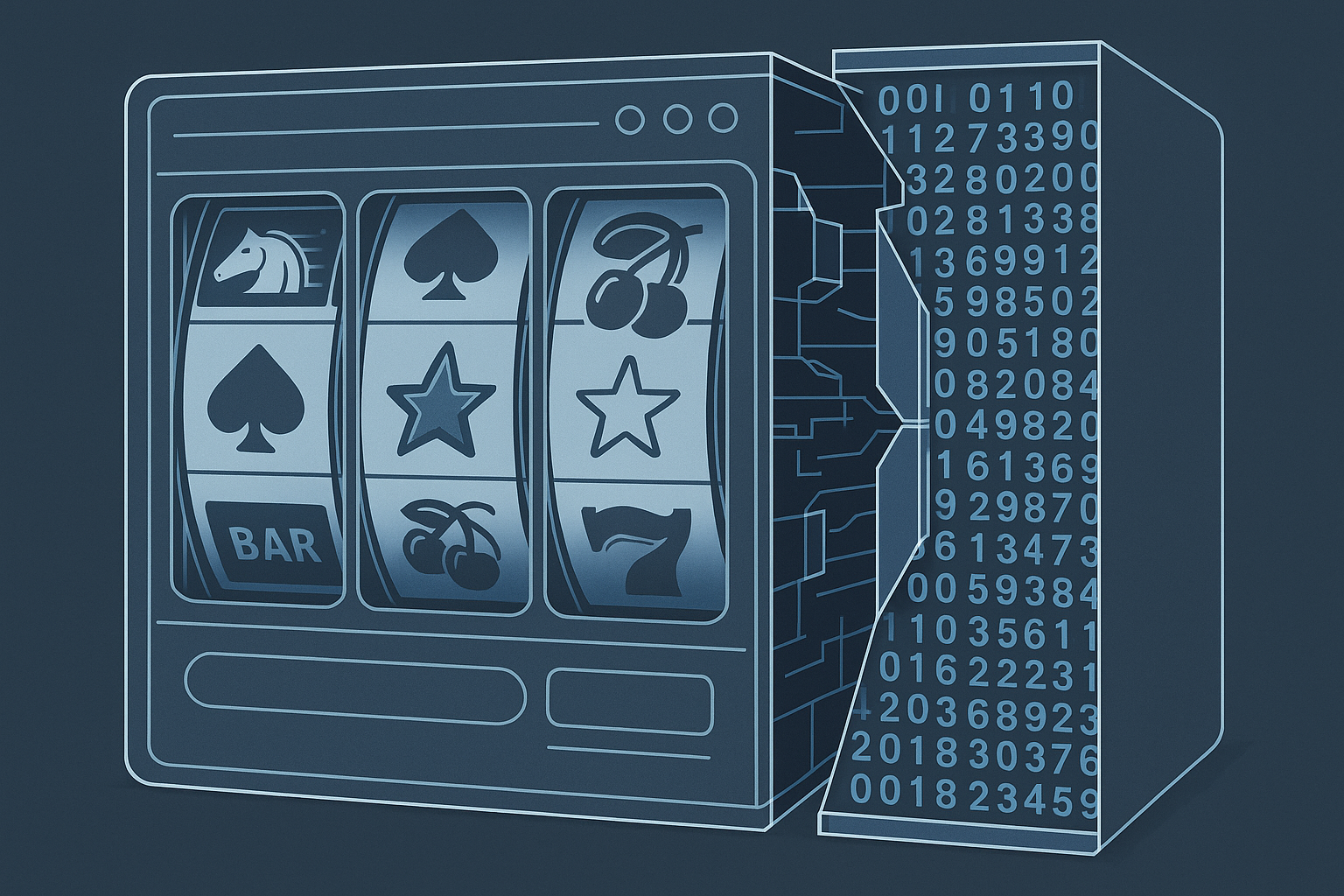
Here is the short version of how online slots work: a random number generator (RNG) inside the game is producing new numbers constantly, thousands of times per second, whether anyone is playing or not. The moment you press spin, the game grabs the value the RNG is on, converts it into a stop position for each reel, and then draws the animation to show you a result that was already decided. The spinning reels are presentation. The math happened in a fraction of a second.
That single fact kills most slot myths on contact. You cannot time the button. You cannot feel a machine warming up. And the reels are not deciding anything as they spin.
The random number generator explained
The RNG is a piece of software that outputs a long stream of numbers with no detectable pattern. In a certified online slot, it runs continuously in the background. If you sat and watched a game for ten seconds without touching it, the generator would have cycled through an enormous number of values in that time.
People sometimes hear that and conclude the opposite of the truth: “so if I press at exactly the right millisecond, I can catch a good number.” In practice, the values change faster than any human reaction, the mapping from number to symbols is not visible to you, and there is no way to know which number would produce a paying combination. Two players clicking a fraction of a second apart get completely unrelated results.
From number to reel position
Each reel in the game has a defined list of symbol positions, called a reel strip. The game takes the raw RNG output and scales it down to fit the length of that strip, then reads which symbol landed on the payline.
A simplified version: say reel one has 32 positions. The game takes a huge random integer, divides it by 32, keeps the remainder (0 to 31), and that remainder is the stop position. Repeat for each reel. On a five-reel slot, that is five independent draws happening in the same instant. Then the game checks the resulting grid against the paytable and pays anything it finds.
What is an RNG in slots?
An RNG in slots is a pseudorandom number generator: an algorithm that produces a sequence of numbers which passes statistical tests for randomness but is generated deterministically from a starting value. “Pseudorandom” is not a weakness or a loophole. It means the randomness comes from math rather than from a physical process like radioactive decay, and casino-grade implementations are built and tested so the output is unpredictable in practice.
How RNG algorithms work
The algorithm takes its current internal state, runs it through a set of operations, and outputs a number while updating the state for the next call. Repeat millions of times and you get a stream with no usable pattern: no repeating cycles a player could ride, no correlation between one value and the next.
The same principle underpins other RNG-driven casino products. If you have read our explainer on how Aviator’s RNG decides each crash point, the mechanics will feel familiar. Different game, same idea: the outcome is generated by software, not by momentum.
Seeding and number generation
A generator needs a starting point, called the seed. If you seeded the same algorithm with the same value twice, you would get the same sequence twice, which is exactly why serious implementations draw seed material from unpredictable sources and reseed regularly. Testing labs specifically look at whether seeding can be predicted or forced, because that is the one place a badly built RNG could become exploitable.
A stripped-down mapping example, using a fake three-symbol reel: values 0 to 15 return a low-paying symbol, 16 to 27 return a mid symbol, 28 to 31 return the top symbol. Same reel, unequal odds, because the top symbol occupies fewer slots. That weighting, repeated across five reels, is how a game hits a target return to player without anyone touching the randomness itself.
Why each spin is independent (debunking hot and cold slots)
Every spin on a certified online slot is a fresh, independent event. The game does not store what happened on your last spin, the last hundred spins, or what the player before you did. There is no counter filling up, no heat, no cooldown. A slot that has paid nothing for 300 spins has exactly the same odds on spin 301 as it did on spin 1.
The independence principle
Think of a fair coin. Flip it nine times and get nine heads. What is the chance the tenth flip is tails? Still 50%. The coin has no memory of the previous nine. Slots work the same way, just with far more possible outcomes per event.
Put numbers on it. Suppose a particular five-symbol combination has a probability of 1 in 500,000 on any given spin. After 499,999 spins without hitting it, the probability on the next spin is still 1 in 500,000. What does change is the chance of seeing it at least once across a batch of spins: for n spins that is 1 − (1 − p)n. Over 500,000 spins, that works out to roughly 63%. Notice what that formula does and does not say. It describes a set of future spins before they happen. It says nothing about your next single spin becoming more likely because of past misses.
Why slots can’t be ‘due’ for payouts
“It’s due” is the gambler’s fallacy, the belief that independent random events self-correct in the short term. They do not. Long-run averages emerge because huge numbers of results pile up, not because the game tracks a deficit and repays it.
The same logic applies to a game that has just paid out big. It is not “emptied” and it is not “cold”. It resets to the same probabilities it always had. Any strategy built on switching games after a dry spell, raising bets to chase a supposed correction, or leaving a machine you think has just paid out is built on a pattern that does not exist in the software.
Are online slots rigged or fair?
Licensed, lab-tested online slots are not rigged, but they are not fair in the sense of giving you an even chance either. Those are two different things, and conflating them is why the question keeps coming up. A rigged game would produce outcomes outside its published rules or change your odds based on who you are, what you have won, or how much is in your balance. A legitimate slot has a fixed, disclosed mathematical advantage and applies it identically to everyone.
House edge vs rigging
RTP (return to player) is the percentage of all money wagered that a game returns over the long run, averaged across millions of spins. The house edge is what is left: 100% minus the RTP. It is disclosed, it is designed in, and it is the reason the operator profits over time.
| RTP | House edge | Long-run average return per $100 wagered |
|---|---|---|
| 97% | 3% | $97 |
| 96% | 4% | $96 |
| 94% | 6% | $94 |
Two things to be clear about. First, those figures are long-run averages over enormous numbers of spins, not a session forecast. A 96% RTP game can take your whole balance in twenty spins or pay a large multiple of it, and both are normal. Second, RTP and volatility are separate. A high volatility slot pays less often but bigger; a low volatility slot pays smaller amounts more frequently. Volatility changes how a session feels, not the built-in edge.
Regulatory testing and certification
In regulated US markets, online slots have to be approved before they go live. State regulators, including the New Jersey Division of Gaming Enforcement, the Pennsylvania Gaming Control Board and the Michigan Gaming Control Board, require game submissions to be tested by an accredited independent laboratory and then hold the operator to the approved version of the game. That is the practical answer to “are online slots rigged”: the game code you play is the code that passed testing, and changing it quietly is a licence-threatening offence.
Reels, paylines and win registration
What you see on screen is a window onto something longer. The reel strip behind each visible column can hold dozens of positions, and the display simply shows the few that stopped in view, usually three or four rows.
Virtual vs physical reels
On old mechanical machines, the reel had a fixed number of physical stops, so the odds were limited by the hardware. Online slots have no such constraint. The reel strip is a list in software, and symbols can be weighted freely: a top-paying symbol might occupy one position out of 60 on reel five while a low-paying symbol occupies eight. That is how designers tune a game’s hit frequency and RTP without ever biasing the RNG.
How paylines determine wins
Once the stops are set, the game evaluates each active payline in turn. A payline is a defined path across the grid, and on most slots it pays when matching symbols land on consecutive reels starting from reel one on the left.
A concrete example on a 5×3 grid with 20 paylines and a $1 total bet, so $0.05 per line: line 1 is the middle row. If reels one, two and three all show the same mid-value symbol on that row and the paytable pays 10x the line bet for three of them, that line returns $0.50. The game checks the other 19 lines, adds up every winning line, adds any scatter pays (scatters pay from anywhere on the grid, not along a line), then credits the total. Cluster and “ways to win” games use the same idea with different geometry.
What does provably fair mean?
Provably fair means the outcome of a round can be independently verified by the player using cryptography, rather than taken on trust from a lab certificate. It is standard in crypto-native games, particularly crash titles and in-house dice or mines games, and it is uncommon in slots from the large studios.
Provably fair vs standard RNG
| Certified standard RNG | Provably fair | |
|---|---|---|
| Who checks fairness | Accredited testing lab and regulator | The player, per round |
| What you can verify | That the game was approved and audited | That this specific result was not altered |
| When you can check | Before you play (certificate, licence) | After each round |
| Typical games | Slots, live dealer, video poker | Crash, dice, mines, some in-house slots |
| Does it change the house edge | No | No |
That last row matters. Provably fair proves nobody tampered with the result. It does not remove the edge, and it does not make a game a better bet.
How to verify provably fair results
- Before the round, the site publishes a hash of its secret server seed. A hash is a one-way fingerprint, so you learn nothing about the seed but the site is locked into it.
- You contribute a client seed, either randomly generated for you or chosen manually.
- The round runs. The outcome is derived from the combination of server seed, client seed and usually a nonce (the round number).
- Afterwards, the site reveals the server seed. You hash it yourself and check it matches the fingerprint published in step 1.
- You re-run the same combination through the published algorithm and confirm it produces the result you were given.
If either check fails, something was changed. Most sites offering this build a verification page in, and third-party verifiers exist for the common algorithms.
How regulators verify slot fairness
Independent laboratories do the technical work, and regulators enforce it. Names you will see on certificates include Gaming Laboratories International (GLI), BMM Testlabs, eCOGRA and iTech Labs. A game submission typically goes through:
- RNG statistical testing. Millions of outputs are run through randomness tests looking for bias in distribution, repeating cycles and correlation between successive values.
- Unpredictability and seeding review. Whether the seed or internal state could be predicted, reproduced or influenced from outside.
- RTP verification. The lab simulates the game over an extremely large number of spins and confirms the measured return matches the mathematical model the studio submitted and the figure shown in the game’s help screen.
- Paytable and rules accuracy. That wins are calculated as the rules describe, that features trigger as documented, and that nothing behaves differently in real-money mode than in demo mode.
- Code integrity. The approved build is fingerprinted so regulators can confirm the live version matches what was certified.
Many licensed operators also submit to periodic RTP audits, where actual gameplay data is compared against the theoretical figures. Small variances over shorter periods are expected and mathematically normal; sustained deviation is what triggers questions.
So the practical checklist for a player worried about fairness is short: play games from studios that publish RTP, on sites licensed by a regulator in your state, and check for a testing lab certificate in the footer. That is the verifiable part. Everything else, the hot machine, the cold machine, the spin that was “due”, is not something the software can do.
FAQ
How does an online slot decide the outcome?
An RNG running continuously in the game produces a stream of random numbers. When you press spin, the current values are mapped to a stop position on each reel strip, the grid is set, and the game compares it to the paytable. The result is fixed before the reels finish spinning.
What is an RNG in slots?
A pseudorandom number generator: an algorithm that outputs an unpredictable sequence of numbers from a seed value. In certified slots it is tested by an independent lab for statistical randomness and for whether its seeding could be predicted.
Are online slots rigged or fair?
Slots from licensed operators and tested studios are fair in the sense that outcomes are random and rules are applied identically to every player. They still carry a house edge, typically around 3% to 6% depending on the game’s RTP, which is disclosed rather than hidden.
Can a slot be due for a payout?
No. Each spin is independent, so a long losing streak does not raise the odds on the next spin. Believing otherwise is the gambler’s fallacy, and it is the most expensive misconception in slots.
Do provably fair slots have better odds?
No. Provably fair verification proves a specific result was not manipulated. The RTP and house edge are set by the game’s design and are unaffected by whether the fairness proof is cryptographic or lab-certified.
A note on playing this stuff
Understanding the mechanics makes you a better-informed player, not a winning one. Because every slot carries a house edge, the expected result of continued play is a loss, and no knowledge of RNG behaviour changes that. Set a deposit or loss limit before you start, use the session reminders your casino offers, and treat the money as entertainment spend. If it stops feeling that way, cool-off and self-exclusion tools are in your account settings, and free confidential help is available in the US through the National Council on Problem Gambling helpline (1-800-522-4700). Our responsible gambling resources page has more on the tools worth switching on.