
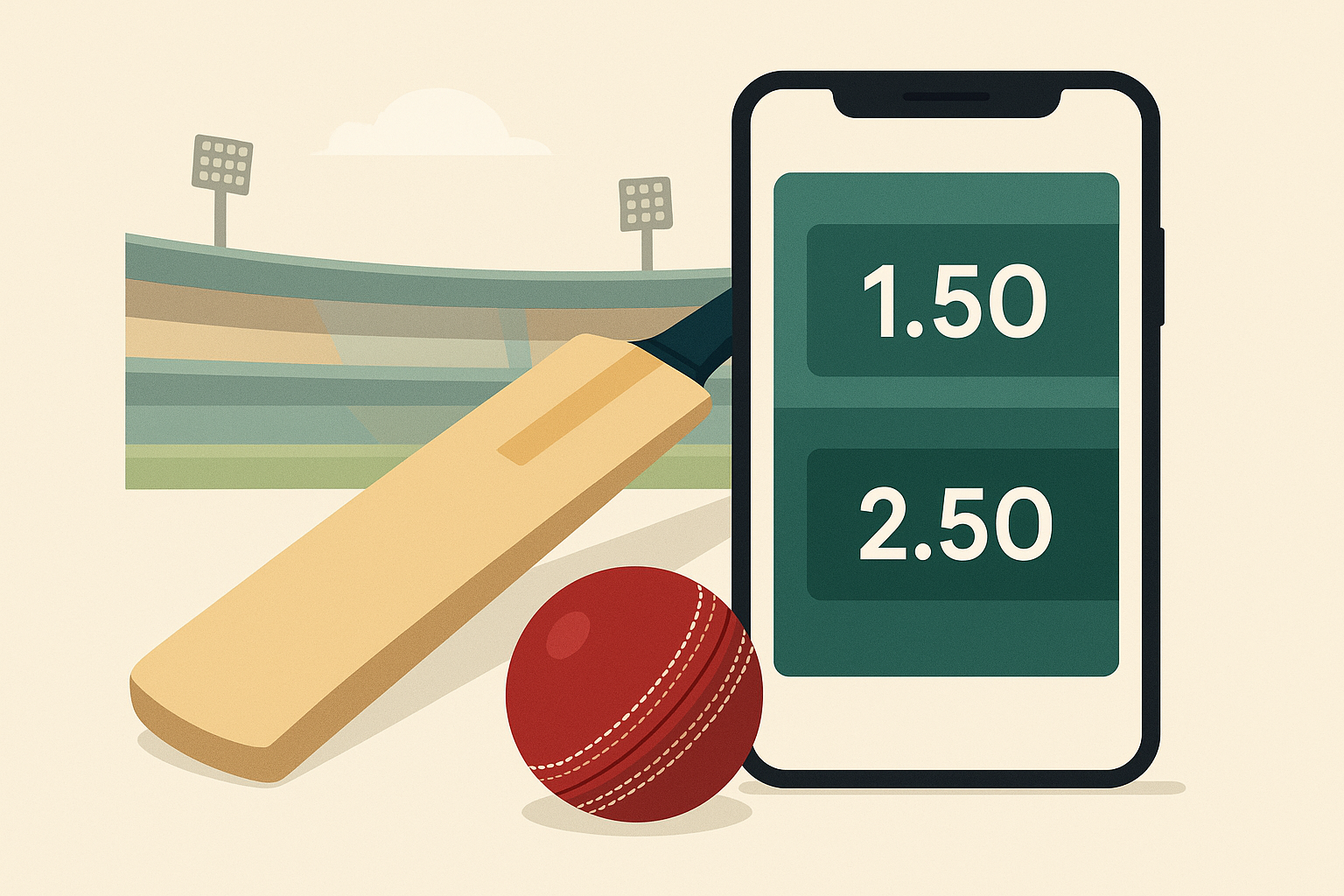
Cricket betting odds are two things at once: a bookmaker’s estimate of how likely something is to happen, and the price they’ll pay you if it does. Read them properly and a number like 1.50 stops being random — it tells you the bookmaker thinks that outcome happens roughly two times in three, and that a winning ₹1,000 bet returns ₹1,500 in total.
This guide is cricket betting odds explained from scratch, for fans who know a googly from a doosra but have never worked out what “3.20” or “session 42-44” means. No predictions, no tips, no operator recommendations — just how the numbers and markets actually work, plus the honest maths behind them.
How cricket betting odds work
Odds do two jobs. They convert a probability into a price, and they build in the bookmaker’s margin so the book makes money over time regardless of who wins. Every set of odds you see has that margin baked in, which is why betting has a negative expected return over the long run.
What odds numbers mean
Take a simple T20 match. India are priced at 1.50, the opposition at 2.50. The lower number is the favourite — the outcome the bookmaker considers more likely, and therefore the one that pays less. The higher number is the underdog: less likely in the bookmaker’s view, so it pays more.
To turn decimal odds into a probability, divide 1 by the odds:
- 1 ÷ 1.50 = 0.667, so about a 66.7% implied chance
- 1 ÷ 2.50 = 0.400, so a 40% implied chance
Add those up and you get 106.7%, not 100%. That extra 6.7% is the bookmaker’s margin, usually called the overround. It’s the sports betting equivalent of the house edge in a casino game: the built-in advantage that means the operator profits across thousands of bets even if individual results go the punter’s way.
Calculating potential winnings
With decimal odds the sum is simple: stake × odds = total return, including your stake back.
- ₹1,000 at 1.50 → ₹1,500 returned (₹500 profit)
- ₹1,000 at 2.50 → ₹2,500 returned (₹1,500 profit)
- ₹500 at 3.40 → ₹1,700 returned (₹1,200 profit)
If the bet loses, the stake is gone. That’s the part beginners underweight when they look at a tempting 5.00 price: those odds exist precisely because the outcome is unlikely.
Understanding decimal odds format
Decimal odds are the standard format shown on almost every betting site available to Indian users, and they’re the easiest to learn because one multiplication gives you the whole answer.
Reading decimal odds
Anything under 2.00 means the outcome is a favourite (implied chance above 50%). Exactly 2.00 is an even-money proposition — a coin flip in the bookmaker’s eyes. Above 2.00 you’re on an underdog. The table below shows how the same odds translate into probability and payout on a ₹1,000 stake.
| Decimal odds | Implied probability | Total return on ₹1,000 | Profit |
|---|---|---|---|
| 1.20 | 83.3% | ₹1,200 | ₹200 |
| 1.50 | 66.7% | ₹1,500 | ₹500 |
| 1.80 | 55.6% | ₹1,800 | ₹800 |
| 2.00 | 50.0% | ₹2,000 | ₹1,000 |
| 2.50 | 40.0% | ₹2,500 | ₹1,500 |
| 3.00 | 33.3% | ₹3,000 | ₹2,000 |
| 5.00 | 20.0% | ₹5,000 | ₹4,000 |
One habit worth building early: convert odds to a percentage before you decide anything. “3.00” sounds exciting. “The bookmaker thinks this happens one time in three” is the same information, described honestly.
Decimal vs fractional odds
Fractional odds are the older British format and you’ll still see them in cricket commentary and UK-facing coverage. A fraction shows profit relative to stake, not total return. So 1/2 (read “two to one on”) means ₹500 profit on a ₹1,000 stake, which is the same as decimal 1.50. And 3/1 means ₹3,000 profit on ₹1,000 — decimal 4.00.
The conversion is straightforward: divide the fraction and add 1. 3/2 = 1.5, plus 1 = 2.50. Some sites also show American odds (+150, −200), but in India decimal is the default and there’s no real reason to switch away from it.
Main cricket betting markets explained
A single IPL match can carry dozens of cricket betting markets. Beginners realistically only need to understand four families of them.
Match winner markets
The match odds market is the simplest bet in cricket: which team wins this game. In T20 and ODI cricket there are usually two selections, occasionally with a separate “tie” or “no result” outcome depending on how the operator handles abandoned matches. In Test cricket there are three: Team A, Team B, and the draw — which is why Test match odds often look strange to newcomers, with a draw sometimes shorter than either team.
Always check the rules on rain and reduced overs. Different books settle no-result matches differently, and that detail decides whether your stake is returned or lost.
Session and innings betting
Session betting is deeply associated with cricket in India. Instead of the full result, you’re betting on how many runs are scored in a defined block of overs — a T20 powerplay, the first 10 overs of an ODI innings, or a specified stretch of a Test day.
Sessions are usually quoted as a runs line rather than as classic odds: a market might sit at 41–43 runs for the first six overs, and you decide whether the actual total finishes above or below that band. Innings markets work the same way over a longer span, such as total runs in a full T20 innings. Because sessions are short, one over can swing them completely.
Player performance markets
These cover individual output rather than team results. Common examples:
- Top batsman — highest run scorer for a team or the whole match
- Top bowler — most wickets, with tie-break rules that vary by operator
- Player runs or wickets over/under — will a named batter pass 24.5 runs, for instance
- Method of dismissal or “will a player be dismissed for a duck”
Player markets carry a larger bookmaker margin than match odds, because outcomes are harder to model and the field of possible winners is wide. They also die instantly to a toss decision or a batting-order change.
Total runs over/under
An over/under market sets a line — say 168.5 total runs in a T20 innings — and prices both sides of it, often at similar odds like 1.90 each. The half-run in the line exists to prevent an exact tie. Over/under lines also appear for total sixes, total wides, total wickets in a match, and total fours.
Match odds vs session betting
The practical difference is time frame and how the bet is expressed. Match odds settle once on the final result; session betting settles repeatedly, over and over, within the same match.
| Match odds | Session betting | |
|---|---|---|
| What you’re betting on | Final result of the match | Runs scored in a defined block of overs |
| How it’s quoted | Decimal odds (e.g. 1.75) | A runs line or band (e.g. 41–43) |
| Settlement | Once, at the end | Multiple times during the match |
| Typical example | Mumbai to beat Chennai | Over/under runs in a Test session or an ODI’s first 10 overs |
| Beginner risk | One decision per match | Frequent bets, faster losses, easier to lose track of spend |
That last row matters more than the mechanics. Session markets invite a bet every few overs, and high frequency betting is where beginners overspend fastest without noticing.
How odds change and why
Odds are not fixed forecasts. They’re live prices that a bookmaker adjusts to keep its liability balanced and its margin intact.
Pre-match vs live odds
Pre-match (or ante-post) odds open days or hours before play and move as information arrives — the pitch report, the playing XI, the weather forecast, and the weight of money coming in on each side. Once the first ball is bowled, live (in-play) odds take over and update continuously, sometimes ball by ball.
Two more things separate live from pre-match betting. Live prices move fast enough that markets get suspended after wickets and boundaries, and your bet may be rejected if the price changes while you’re confirming it. Live betting is also the most fast-paced form of the product, which makes it the easiest place to lose control of stake size.
Factors that move odds
- Team news: injuries, rested players, a key spinner missing
- The toss and pitch conditions, especially in day-night games and on dry surfaces
- Weather and rain interruptions, which change target chases and DLS scenarios
- Betting volume: if heavy money lands on one side, the bookmaker shortens that price and lengthens the other to rebalance
- In-play events: a collapse, a partnership, or a required run rate drifting out of reach
Notice that only some of these are cricket facts. Others are purely commercial. A shortening price does not prove a team has improved — it may simply mean the bookmaker has taken too much money on them.
Cricket betting in India: legal and responsible approach
The legal picture in India is fragmented. Gambling is largely a state subject, and the colonial-era Public Gambling Act of 1867 predates the internet entirely, so there is no single national framework for online sports betting. Several states have passed their own restrictions on online gaming and betting, and the rules differ meaningfully between them. Most betting sites accessible to Indian users are licensed offshore rather than in India, which puts them in a grey area rather than a regulated domestic market. If you’re unsure where your state stands, check the current law for your state before doing anything.
Winnings are taxable in India, with tax deducted at source on winnings from online games and from betting under the Income Tax Act. Rates and thresholds change, so treat this as general information and speak to a qualified tax professional about your own position.
The responsible-gambling basics are short and boring, which is why people skip them:
- Betting is entertainment with a built-in bookmaker margin. It is not a source of income, and no amount of cricket knowledge removes that margin.
- Decide a deposit and loss limit before you start, and use the operator’s own limit tools to enforce it rather than relying on willpower.
- Never chase losses. Increasing stakes after a bad run doesn’t improve your odds — each bet is priced independently.
- Only stake money you can lose without affecting rent, EMIs, or family expenses. Never borrow to bet.
- Betting is strictly for adults aged 18 or over.
- If it stops feeling like entertainment, use cool-off or self-exclusion, and talk to someone. Free, confidential help is available from professional support services.
For more on limits and self-exclusion tools, see our responsible gambling guide.
Frequently asked questions
How do cricket betting odds work?
They express a bookmaker’s estimated probability as a price. Divide 1 by the decimal odds to get the implied chance, and multiply your stake by the odds to get the total return if the bet wins. The implied probabilities across a market add up to more than 100%, and that surplus is the bookmaker’s margin.
What are the main cricket betting markets?
Match winner (match odds), session and innings runs, total runs over/under, and player performance markets such as top batsman or top bowler. Beginners usually start with match odds because there’s a single, easily understood outcome.
What is a match-odds market?
The market on which team wins the match. T20s and ODIs typically have two selections plus rules for a no result; Test matches have three, since a draw is possible.
How are decimal odds calculated?
From a probability plus a margin. A 50% chance is 1 ÷ 0.50 = 2.00 before margin; the bookmaker then shortens it slightly, to around 1.90, to build in its edge. To go the other way, implied probability = 1 ÷ decimal odds.
Are decimal and fractional odds different bets?
No, only different notation. Decimal 1.50 and fractional 1/2 pay identically. Decimal includes your stake in the figure; fractional shows profit only.