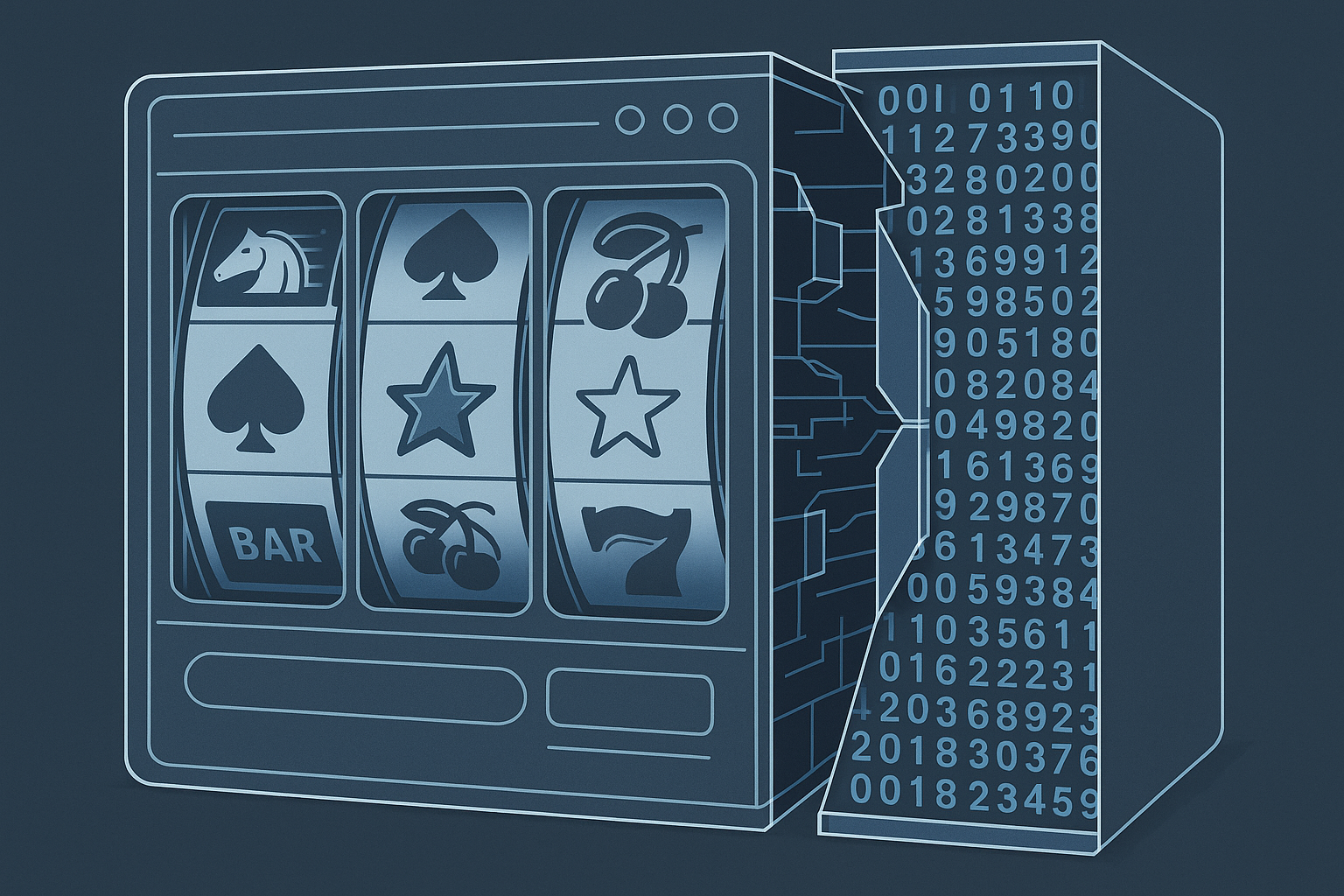

A slot RNG (random number generator) is a piece of software that produces a constant stream of unpredictable numbers, and the moment you hit spin, one of those numbers gets mapped to a reel outcome. That’s the whole mechanism. It has no memory, no mood, and no awareness of what happened on your last spin, which is why “hot” and “cold” machines don’t exist in any technical sense. They exist only in the way our brains read randomness.
If you’ve ever walked away from a machine convinced it had “gone cold,” you’re in good company. The belief is nearly universal among players. It’s also wrong, and the reasons why are worth understanding, because they change how you think about bankroll, session length, and what a slot can and can’t do for you.
What is a slot RNG and how does it work?
A random number generator is an algorithm that outputs numbers with no discernible pattern and no relationship to the numbers before them. Every regulated slot machine, online or in a casino floor, uses one to decide results. There is no physical wheel weighting, no hidden payout schedule that fills up, no lever pressure that matters.
The algorithm behind every spin
Technically, slots use a pseudorandom number generator (PRNG). “Pseudo” because a computer running deterministic instructions can’t produce true randomness on its own the way radioactive decay or atmospheric noise can. What it can do is produce sequences so long and so statistically flat that they are indistinguishable from random by any practical test, including the batteries of statistical tests used by independent labs.
The output number is then mapped onto reel positions. On a modern video slot with, say, five reels and dozens of virtual stops per reel, the software translates the raw number into a specific stop for each reel. The animation you watch afterward is theater. The result was decided before the reels visibly started moving.
Seed values and number generation
A PRNG starts from a seed value, an initial input that sets the sequence in motion. Good implementations draw entropy from unpredictable sources (system clock at microsecond resolution, hardware noise, event timings) so an attacker can’t guess the seed and predict the sequence.
In a land-based machine, the RNG typically cycles continuously, generating numbers thousands of times per second even when nobody is playing. Pressing spin captures whatever value is current at that microsecond. In an online slot, the outcome is usually generated on the game server the instant your spin request arrives. Either way the practical consequence is identical: the timing of your click is effectively arbitrary at that resolution. You cannot time a spin. Human reaction time is measured in tenths of a second; the RNG is moving through values thousands of times faster than that.
Why every spin is completely independent
Spins are independent events. That’s a formal term from probability, and it means the outcome of one spin gives you zero information about the next. The RNG doesn’t store your history. It doesn’t know whether the last spin paid 500× or nothing at all.
The gambler’s fallacy in slots
The gambler’s fallacy is the belief that a random process “self-corrects” in the short run. Flip a fair coin five times and get five heads, and it feels like tails is overdue. It isn’t. The coin’s probability of tails on flip six is still 50%, because the coin has no memory of the previous five flips.
Slots work the same way, with worse intuition-breaking odds because the outcome space is enormous. Common versions of the fallacy on the casino floor:
- “Someone just hit the jackpot on that machine, so it won’t pay again for ages.”
- “This one hasn’t paid a bonus in 200 spins, it’s ready.”
- “I lost 40 spins in a row, so my chances are better now.”
- “Play after midnight, the machines loosen up.”
Every one of these assumes the game tracks something. It doesn’t. The probability of triggering a bonus round is the same on spin 1 as on spin 2,000.
Why your last 100 spins don’t matter
Suppose a slot has a bonus trigger probability of 1 in 250 spins. After 249 losing spins, the chance on your next spin is still 1 in 250. Not better. The reason the average works out over time isn’t that the game corrects itself, it’s that as the sample grows, the results of billions of independent spins converge toward the expected rate. That convergence happens across all players and all sessions, not inside your afternoon at the machine.
Debunking the ‘hot’ and ‘cold’ slots myth
Streaks are not evidence of machine states. They are what randomness actually looks like. A truly random sequence produces clusters and droughts far more often than people expect, and a sequence that lacked them would look suspiciously engineered.
Why streaks happen in random systems
Take a slot with a hit frequency of roughly 25%, meaning about one in four spins returns something. The chance of any given spin returning nothing is 0.75. Chain those together and dry streaks stop looking unusual:
| Consecutive non-winning spins | Probability (25% hit frequency) | Roughly |
|---|---|---|
| 5 | 0.75⁵ = 0.2373 | 1 in 4 |
| 10 | 0.75¹⁰ = 0.0563 | 1 in 18 |
| 15 | 0.75¹⁵ = 0.0134 | 1 in 75 |
| 20 | 0.75²⁰ = 0.0032 | 1 in 317 |
A 15-spin dry run sounds like a “cold machine.” Run the numbers across a 500-spin session, though, and you’d expect a streak that long to show up once or twice on average. Nothing changed inside the game. You simply played long enough for an unlikely-looking sequence to become likely.
High volatility games make this far more pronounced. Volatility describes how payouts are distributed, not how much a game returns. A high volatility slot pays rarely and larger, so long dead stretches punctuated by a big hit is its normal behavior, not a malfunction or a mood.
The psychology behind pattern recognition
Humans are pattern-detection machines, and that instinct is usually useful. It’s terrible at randomness. We remember the session where three bonuses landed in twenty spins and forget the four sessions that were flat. We label a machine after the fact, which is exactly backwards: the label describes the past, then gets used as a prediction.
Slot design leans into this. Near misses, where two jackpot symbols land and the third stops just above the payline, feel like “almost.” Mathematically they’re just losing spins. The reel animation is chosen to be watchable, and stopping one position short reads as tension rather than a plain loss.
Are slots rigged? The certification process
At a licensed operator running games from licensed studios, no. The RNG is tested by independent laboratories before the game goes live, and the operator’s platform is audited on an ongoing basis under the terms of its licence. At an unlicensed site, you have no such assurance, and that distinction is the one that actually matters.
Third-party testing labs
Independent test houses evaluate RNG output and game math on behalf of regulators. The most commonly cited names in regulated markets are Gaming Laboratories International (GLI), eCOGRA, and iTech Labs. Their work generally covers:
- Statistical testing of large RNG output samples for uniform distribution and absence of patterns or correlation.
- Verification that the game’s actual payout behavior matches the declared RTP over very large simulated volumes.
- Source code and build review, so the version deployed matches the version approved.
- Checks that the RNG is seeded and scaled correctly and can’t be manipulated by timing or bet size.
Certification is a snapshot of a specific game build plus ongoing monitoring, not a permanent blanket guarantee, which is why regulators require re-testing when games change. Publishers should link to the current certification and audit statements published by the labs and the relevant state regulator for the most up-to-date scope of testing.
What ‘provably fair’ actually means
“Provably fair” is a specific cryptographic method, most common in crash and dice games at crypto casinos, not a synonym for “certified.” It combines a hashed server seed with a client seed so that after the round you can verify the result was fixed in advance and not altered once you placed your bet.
Most conventional video slots are not provably fair in that technical sense, because their outcome logic is proprietary and server side. They rely on lab-certified RNGs plus regulator oversight instead. Both models can be trustworthy; they just prove trust differently. What you should never accept is a third option: no licence, no certification, and no verifiable mechanism at all.
Why slots are never ‘due’ to pay out
A slot cannot be due, because nothing in the game is counting. There’s no ledger tracking what it owes you, no threshold it crosses, no compensation logic. Each spin is priced by the same fixed probabilities every single time.
Understanding RTP vs individual sessions
RTP is the long-run percentage of all wagers a game returns, averaged over millions of rounds across every player. A 96% RTP slot has a 4% house edge. Over an enormous sample, roughly $96 of every $100 wagered comes back as prizes.
That figure says almost nothing about your next hour. At $1 per spin and 500 spins, you’d wager $500 and your mathematically expected loss is $20 (4% of $500). Real outcomes scatter widely around that: you might finish up $300 or down $400, and neither result tells you anything about whether the RNG is behaving. It just means the sample is tiny. If you want the fuller breakdown, see our guide to RTP and house edge.
Two more myths worth retiring: RTP doesn’t change based on how much you’ve lost, and a machine that just paid a jackpot isn’t reset to a stingy mode. “Loose” and “tight” machines can differ in configured RTP where regulations allow operators to select from certified variants, but that’s a fixed setting on the game, not a live reaction to your session.
Why casinos don’t need to cheat
This is the part players tend to find most convincing. The house edge already guarantees profit over volume. A 4% edge applied to millions of spins a day is a reliable, boring, entirely legal business. Rigging a certified game would risk the operating licence, the supplier relationships, and the whole revenue stream, to obtain an advantage the operator already has by design. The maths does the work; tampering would be a poor trade.
Understanding slot fairness doesn’t give you an edge, and no article honestly can. What it does give you is a clean-eyed view of what you’re buying: entertainment with a known cost per spin and results that will swing hard in both directions. Set a budget before you start, treat losses as the price of play rather than something to chase, and use deposit, loss and session limits if your operator offers them. If gambling stops feeling like entertainment, take a break and use the self-exclusion and support tools available. Our bankroll management guide and responsible gambling resources cover the practical side.
FAQ
How does a slot RNG work?
It’s an algorithm that generates unpredictable numbers continuously or on request, starting from an unguessable seed value. When a spin is initiated, one number is taken and mapped to reel stop positions, which determines the result before the reels finish animating.
Do slot machines get hot or cold?
No. There’s no state or memory in the game that makes it pay more or less at different times. Winning and losing streaks are ordinary clustering in random data, and high volatility slots produce longer dry runs by design.
Are online slots rigged?
Games from licensed studios at licensed operators run lab-tested RNGs and are subject to regulator oversight. Unlicensed sites offer no such verification, which is the real risk. Check the licence and the certification before depositing.
Is a slot ever due to pay out?
Never. Each spin’s probabilities are identical regardless of history. A game that hasn’t paid in 300 spins has exactly the same chance on spin 301 as it did on spin one.
How is RNG fairness tested?
Independent laboratories such as GLI, eCOGRA and iTech Labs run large-scale statistical tests on RNG output, verify that real payout behavior matches the declared RTP, and review the game code and build to confirm the approved version is the one in play.