
What is iGaming? (quick definition)
iGaming is gambling that happens over the internet: wagering real money on games of chance or skill through a website or app instead of a physical venue. The “i” is simply short for internet, the same way “e” once got bolted onto email and e-commerce.
So the short version of the iGaming meaning is this: it is gambling. Not a softer cousin of it, not a video game category, not a legal loophole. When someone in the industry says iGaming, they mean online casino games, sports betting, poker, lottery products and similar real money activity delivered digitally.
The term exists mostly because operators, regulators and job listings needed a word for the online side of a business that used to be entirely physical. Casinos in Las Vegas and a betting app on your phone follow the same math and the same risk, but they involve very different technology, licensing and marketing. Hence a separate label.
Is iGaming gambling?
Yes. iGaming is gambling — it is a subset of it, defined by the channel rather than the activity. Every form of iGaming meets the standard three-part test for gambling: you stake something of value, the outcome depends at least partly on chance, and there is a prize if you win.
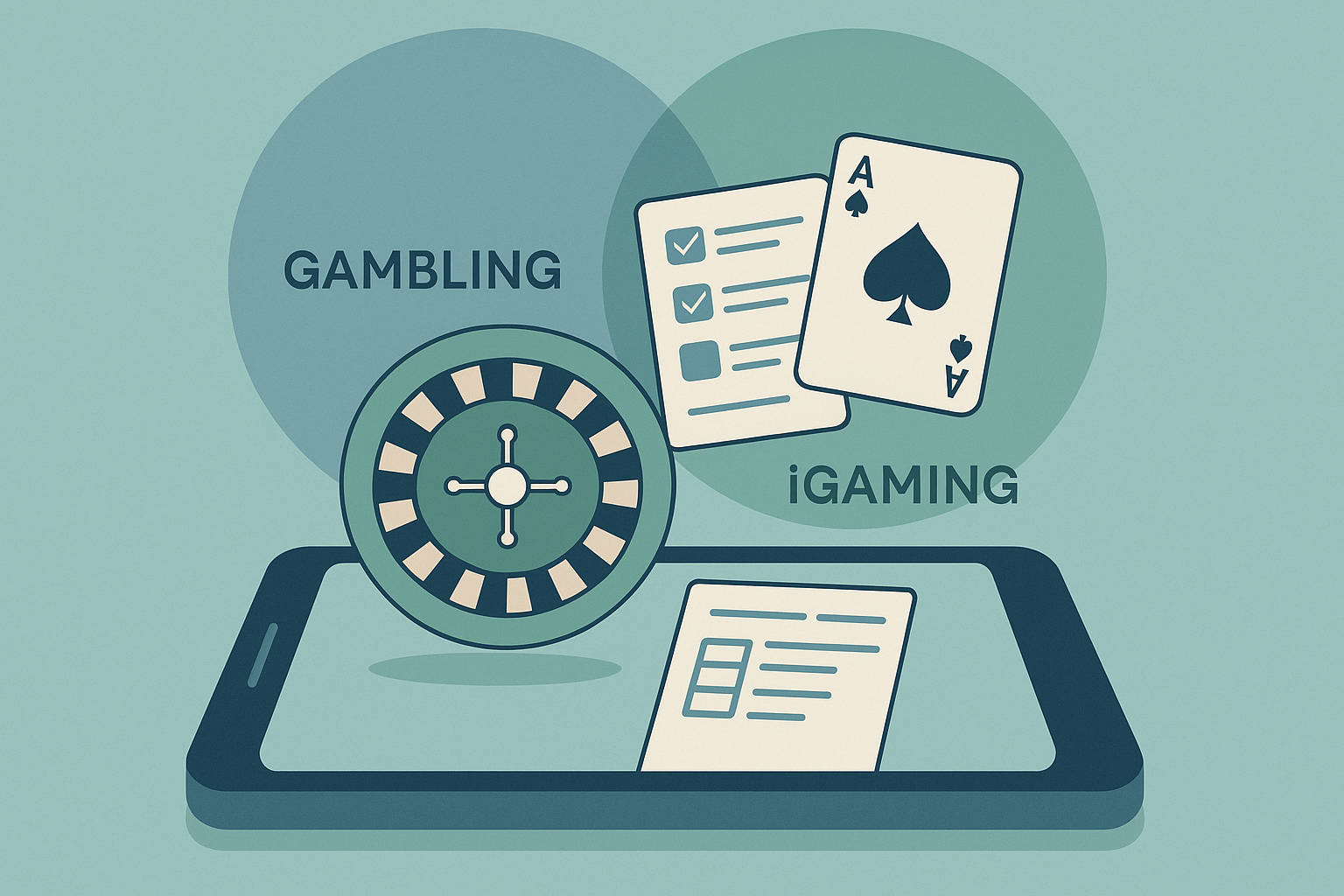
Picture two circles. The big one is gambling: horse racing at a track, slot machines in a casino, a scratch card from a gas station, a poker night with cash on the table. Inside that big circle sits a smaller one labelled iGaming, containing everything from the big circle that runs over the internet. Nothing sits in the iGaming circle that isn’t also gambling.
The confusion usually comes from the word “gaming.” In everyday speech, gaming means video games. In this industry, gaming has been a polite synonym for gambling for decades — Nevada’s regulator is called the Gaming Control Board, not the Gambling Control Board. That single word doing two jobs is the source of most misunderstandings about what iGaming actually is.
One more distinction worth knowing: in some US regulatory language, “iGaming” is used narrowly to mean online casino games specifically, with online sports betting treated as a separate licensed category. Broadly, though, iGaming covers all real money online gambling. If you want the fuller background, see our what is iGaming primer.
iGaming vs other types of online gaming
The dividing line in iGaming vs gambling debates is not the game itself. It is whether real money is staked on an uncertain outcome and can be won or lost. A blackjack app with no cash involved is a card game. The same blackjack table with a $10 bet on it is gambling.
What counts as iGaming (real money examples)
- Spinning an online slot for $0.50 a spin at a licensed online casino.
- Placing a $20 moneyline bet on an NFL game through a sportsbook app.
- Buying into a $50 online poker tournament where the prize pool is cash.
- Buying a state lottery ticket or digital scratch card through an official lottery app.
- Entering a paid daily fantasy sports contest with a cash prize.
- Playing live dealer roulette or baccarat streamed from a studio, with real stakes.
What doesn’t count as iGaming (common confusions)
- Free-to-play casino apps. Slots that use virtual coins you can’t cash out are entertainment products, not gambling — though they mimic the mechanics closely enough to be worth treating with care.
- Social casino games on Facebook or mobile stores. You may pay for more coins, but coins don’t convert back to money.
- Esports as a competitive activity. Playing in a tournament is competing. Betting money on who wins that tournament is iGaming.
- Video games generally, including ones with loot boxes. Loot boxes are debated by regulators in several countries precisely because they share features with gambling, but in most US jurisdictions they aren’t licensed as it.
- Stock or crypto trading. Risky, sometimes speculative, but regulated as financial activity rather than gambling.
Here’s the test applied to a few borderline cases:
| Activity | Real money staked? | Cash-out possible? | iGaming? |
|---|---|---|---|
| Online slot at a licensed casino | Yes | Yes | Yes |
| Free social casino slot | No (coins only) | No | No |
| Paid daily fantasy contest | Yes | Yes | Yes |
| Video game loot box | Yes (for items) | Usually no | Generally no |
| Play-money online poker | No | No | No |
| Sports bet through a licensed app | Yes | Yes | Yes |
Main types of iGaming
Four categories cover most of the market, with daily fantasy sports and esports betting sitting alongside them as newer additions.
Online casino games
Slots, roulette, blackjack, baccarat, video poker and live dealer tables. Slots dominate by volume and typically return somewhere around 94% to 97% RTP (return to player) over the long run, meaning a house edge of roughly 3% to 6%. Table games are often built on fixed, published odds: European roulette carries a 2.7% house edge, American roulette 5.26% thanks to the extra double-zero pocket. Outcomes come from a random number generator (RNG) or, in live games, from a real dealer and physical equipment.
Sports betting
Wagering on the outcome of real sporting events: point spreads, moneylines, totals, parlays and in-play bets placed while the game runs. The bookmaker’s edge here is baked into the prices as a margin, or overround. Two evenly matched sides priced at -110 each in American odds is the classic example: the implied probabilities add up to more than 100%, and that gap is the operator’s cut.
Online poker
Cash games and tournaments where players compete against each other rather than the house. The operator takes a rake, a small cut of each pot or tournament entry, so the room profits regardless of who wins the hand. Poker involves genuine skill, but the rake plus variance means most recreational players lose over time.
Digital lottery and scratch cards
Official state lottery draws sold online, plus instant-win digital scratch cards and keno-style games. These generally have the lowest returns of any category, with a large share of ticket revenue directed to prize pools and state programs rather than back to players.
Common iGaming examples you might recognize
Concrete iGaming examples, grouped by category, without recommending any particular place to play:
- Slots: branded video slots and Megaways titles, where the number of ways to win changes each spin.
- Live dealer: streamed blackjack, roulette and game-show formats like money-wheel games, dealt by a human on camera in real time.
- Crash games: a multiplier climbs from 1.00× and can crash at any moment; you cash out before it does or lose the stake. Aviator is the best known example.
- Sports betting: NFL spreads, NBA player props, March Madness brackets with money attached, in-play soccer markets.
- Poker: online Texas Hold’em cash tables and multi-table tournaments.
- Lottery and instant win: Powerball and Mega Millions tickets bought through authorized state platforms, plus digital scratchers.
- Daily fantasy sports: paid contests where you draft a lineup and finish in the money or don’t.
In the US, all of this is state-by-state. Online sports betting is live in a large number of states, while full online casino play is legal in a much smaller group, including New Jersey, Pennsylvania, Michigan, West Virginia, Connecticut, Delaware and Rhode Island. Legality changes as legislatures act, so check your own state’s current rules rather than assuming.
Key differences: iGaming vs traditional gambling
The core bargain is identical. You stake money, chance decides, and the operator holds a mathematical edge that plays out over enough rounds. What differs is everything around that bargain.
| Factor | iGaming (online) | Traditional gambling (land-based) |
|---|---|---|
| Access | Any time, from a phone, within licensed borders | Requires travelling to a venue during opening hours |
| Speed of play | Very fast; hundreds of slot spins per hour possible | Slower, limited by dealers, machines and queues |
| Verification | Digital KYC, geolocation checks, age verification at signup | ID checked at the door or cage |
| Stakes | Often very low minimums, sometimes cents per round | Higher table minimums in most venues |
| Game information | RTP, rules and paytables usually published in-game | Rarely displayed on slot machines |
| Safety tools | Deposit, loss and session limits; self-exclusion; reality checks | Mostly venue-level exclusion programs |
| House edge | Same principle, sometimes slightly lower on tables | Same principle |
Two of those differences cut both ways. Published RTPs and built-in limit tools give online players more information and more control than a slot floor ever did. But speed and constant availability also remove the natural friction of having to drive somewhere, and that friction used to do a lot of quiet work in keeping sessions short.
A note on risk
Because iGaming is gambling, it carries gambling’s outcome: over time, the house edge means the average player loses money. No system, staking pattern or “hot streak” changes that, because RNG results are independent — a slot has no memory of the last spin. Treat any money you stake as the cost of entertainment, set deposit and time limits before you start, and use the self-exclusion and cool-off tools every licensed operator is required to offer. Our responsible gambling guide covers those tools in detail. If gambling stops feeling like a choice, the National Problem Gambling Helpline is available in the US at 1-800-GAMBLER. Nothing here is aimed at anyone under the legal gambling age in their state.
FAQ
Is iGaming the same as gambling?
iGaming is gambling, but not all gambling is iGaming. It’s the online portion: real money wagering delivered through websites and apps rather than a physical casino, betting shop or store counter.
What does iGaming mean in plain English?
Betting real money on games or events over the internet. The “i” stands for internet, and “gaming” is the industry’s long-standing word for gambling.
What counts as iGaming?
Anything where you stake real money online on an uncertain outcome for a cash prize: online casino games, sports bets, poker for money, lottery products and paid fantasy contests.
What are the main types of iGaming?
Online casino games, sports betting, online poker, and digital lottery or instant-win games, with daily fantasy sports and esports betting as adjacent categories.
Are free casino apps considered iGaming?
No. If winnings exist only as virtual coins with no way to cash out, it isn’t gambling in a regulatory sense. It does copy the mechanics closely, which is worth keeping in mind before moving to real money play.