
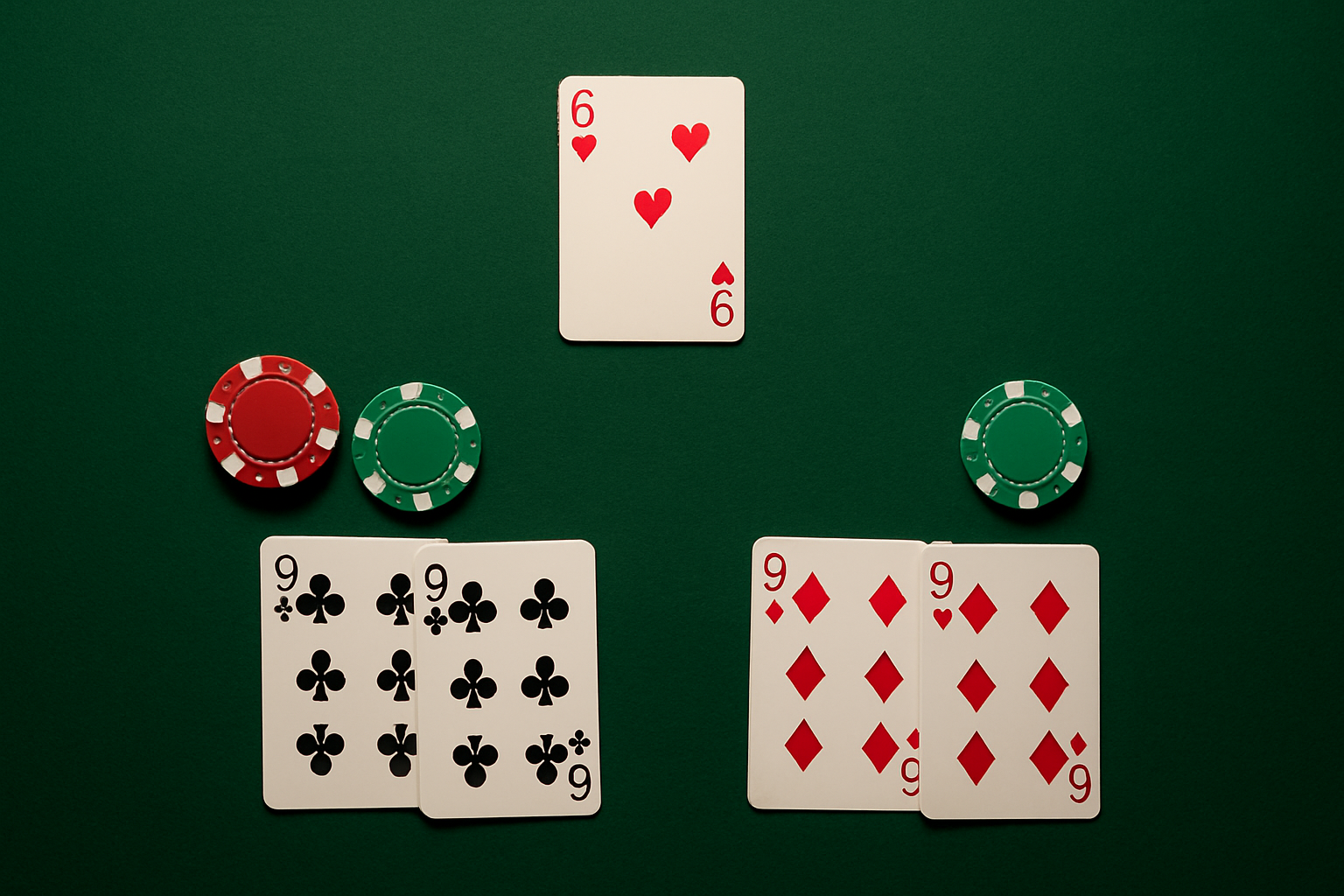
The basic rule: split 9s against most dealer upcards
Should you split 9s in blackjack? Split them against a dealer 2, 3, 4, 5, 6, 8 or 9. Stand on your 18 against a dealer 7, 10 (or any face card) and ace. That’s the whole rule, and it comes straight from basic strategy charts built by running every possible outcome through a computer simulation.
The reason the answer splits into two groups is that a pair of 9s gives you a hard 18, which is a decent hand but not a strong one. Against some dealer upcards, 18 is already winning more often than it loses, so you keep it. Against others, 18 is either a likely loser or a likely push, and two hands starting with a 9 each have better prospects than one mediocre 18.
Here’s the full picture at a glance, with the dealer’s approximate bust rate in a typical multi-deck game where the dealer stands on soft 17:
| Dealer upcard | Correct play with 9,9 | Dealer busts (approx.) | Why |
|---|---|---|---|
| 2 | Split | ~35% | Weak dealer card, two profitable hands |
| 3 | Split | ~38% | Weak dealer card |
| 4 | Split | ~40% | Weak dealer card |
| 5 | Split | ~43% | Weakest dealer range |
| 6 | Split | ~42% | Weakest dealer range |
| 7 | Stand | ~26% | Your 18 beats the dealer’s most likely total (17) |
| 8 | Split | ~24% | Standing pushes far too often |
| 9 | Split | ~23% | Standing on 18 loses to the dealer’s likely 19 |
| 10 / face | Stand | ~21% | Splitting doubles your money into a bad spot |
| Ace | Stand | ~12% | Dealer reaches 21 far too often |
Bust percentages are rounded figures from standard dealer-outcome probability tables for multi-deck shoe games; exact values shift slightly with deck count and soft-17 rules.
Understanding blackjack pair splitting rules
Splitting is only available on your first two cards when they have the same rank. You separate them into two hands, and you must post a second bet equal to your original wager. Each hand then plays out independently: you hit, stand or double on the first hand, finish it, and then move to the second.
A few details that matter for the 9s decision:
- You’re putting a second bet at risk. Splitting is only correct when the two new hands together are worth more than the one hand you gave up.
- Most casinos allow re-splitting to a total of three or four hands. If you split 9s and catch another 9, you can usually split again against the same upcards.
- Double after split (DAS) is a house rule. Where it’s offered, splitting gets slightly more valuable because you can double a resulting 9,2 or 9,3.
- Split hands are not blackjacks. A 9 plus an ace is a soft 20, not a natural, and it pays even money.
If any of that is unfamiliar, brush up on the fundamentals in our guide to blackjack rules before drilling pair strategy.
When to split 9s: dealer upcard analysis
The dealer’s upcard is the only new information you have. It shapes the entire probability distribution of the dealer’s final total, which is why the same pair of 9s calls for two completely different plays depending on what’s showing across the table.
Against dealer 2-6: split for value
These are the dealer’s worst cards. A dealer showing 4, 5 or 6 busts roughly 40% of the time, and even a 2 busts about 35% of the time. When the dealer busts, every hand you have at the table wins, so having two live hands instead of one is worth real money.
There’s a second reason. A 9 is a good starting card. Roughly 31% of the deck is a ten-value card, so each split hand has close to a one-in-three chance of turning straight into 19 on the first draw. Against a weak upcard, you’re not just doubling your exposure, you’re doubling it in a spot where both hands are individually profitable.
Standing on 18 against a 6 is already a winner, with an expected value of roughly +0.28 units per bet. Splitting does better still, because two hands that each expect to win beat one hand that expects to win. That’s the whole test for a profitable split.
Against dealer 8-9: split to avoid ties and losses
This is the pair of upcards that trips people up, because the dealer looks reasonably strong and 18 feels like enough. It isn’t.
A dealer showing 8 ends up with exactly 18 about 36% of the time. So if you stand, more than a third of your hands are pushes: no win, no loss, dead money. Standing there is barely profitable. Splitting converts a lot of those pushes into hands that reach 19 or 20 and actually win.
Against a dealer 9 it’s worse. The dealer makes 19 about 35% of the time and reaches 19 or better a little over half the time, while busting only about 23%. Standing on hard 18 against a 9 is a losing play with negative expectation. Splitting doesn’t make the spot great, but it improves the number, and improving the number is the whole job of basic strategy.
When to stand on a pair of 9s
Three upcards call for standing: 7, 10 and ace. Two of those are because your 18 is genuinely good, and one is because splitting would be throwing more money at a bad situation.
Against dealer 7: your 18 is strong
A dealer showing 7 finishes with exactly 17 about 37% of the time, more often than any other total, and busts around 26%. Add those together and your 18 wins roughly 63% of the time. Pushes are rare (about 14%). That gives standing an expected value in the neighbourhood of +0.40 units, one of the better spots you’ll get with a hard total.
Splitting against a 7 is close, which is why you’ll see players argue about it. But close doesn’t mean equal. Published expected-value tables put standing slightly ahead, and there’s no reason to risk a second bet to chase a fractionally worse result. Keep the 18.
Against dealer 10 or ace: don’t create two weak hands
Against a 10, the dealer makes 20 about 34% of the time and busts only around 21%. Standing on 18 loses more than it wins here, and that’s the best available option. Split and you’d have two hands each starting with a single 9, each needing to reach 19 or 20 to win, with double the money at stake. Two bad hands cost more than one bad hand.
The ace is the dealer’s strongest card. Counting naturals, an ace upcard reaches 21 far more often than any other card and busts only about 12% of the time. Stand, take your medicine on the hands you lose, and move on. Where late surrender is offered, it does not apply to 9,9 in standard charts.
One rules note worth checking: in games where the dealer hits soft 17, some strategy charts move 9,9 against an ace to a split. Always use a chart matched to your table’s rules, deck count and DAS policy.
The math: how expected value drives blackjack basic strategy
Every entry on a basic strategy chart is the answer to one question: which action returns the most (or loses the least) per unit wagered over the long run? Expected value is that number, expressed per bet. Positive means the play wins money over many hands; negative means it loses money, and you pick the least negative option.
Take the two headline cases side by side.
- Dealer 6, standing on 18: you win when the dealer busts (~42%) or makes 17 (~17%), push against 18 (~11%), and lose to 19, 20 or 21 (~30%). That’s roughly +0.28 per unit. Splitting produces two hands that each carry positive expectation against the same weak upcard, so the combined result beats +0.28. Split.
- Dealer 7, standing on 18: win ~63%, push ~14%, lose ~23%, for about +0.40 per unit. Two split hands against a 7 don’t add up to more than that, mostly because a lone 9 has to improve to beat the dealer’s frequent 17, while your 18 already does. Stand.
- Dealer 9, standing on 18: the dealer reaches 19 or better slightly more than half the time, so standing is negative. Splitting is the smaller loss, and over thousands of hands smaller losses are what keep the house edge down.
Playing every decision this way brings the house edge in a typical multi-deck game down to roughly half a percent. That’s the honest ceiling: correct play reduces the edge, it never removes it. Blackjack is still a negative-expectation game, and no splitting rule changes that.
Common mistakes when playing a pair of 9s
Four errors show up over and over at the tables:
- Splitting every time. Some players learn “always split aces and 8s, never split 10s” and file 9s under “always split.” Against a 7, 10 or ace that costs you money on every hand.
- Never splitting because 18 feels safe. Hard 18 is a mid-strength hand, not a fortress. Against a dealer 9 it’s a loser, and against an 8 it pushes over a third of the time. Feelings aren’t probabilities.
- Hitting the 18. Any card 4 through 9 busts you. Hitting hard 18 is one of the clearest mistakes in the game; the choice is split or stand, never hit.
- Using the wrong chart. Deck count, whether the dealer hits soft 17, and whether doubling after a split is allowed all shift a handful of borderline decisions. Match your chart to the table you’re actually sitting at, and keep our basic strategy chart handy while you learn.
One more habit worth building: know your two-bet exposure before you split. If a second wager on that hand is more than you planned to risk, the right move is a smaller base bet, not a compromised strategy decision.
FAQ
When should you split 9s in blackjack?
Split a pair of 9s against a dealer 2, 3, 4, 5, 6, 8 or 9. Those are the upcards where two hands starting with a 9 have a better expected value than standing on hard 18.
Should you split 9s against a dealer 7?
No. Stand. A dealer showing 7 most often finishes with 17, which your 18 beats, and busts about 26% of the time. Standing wins roughly 63% of the time and is the higher expected value play.
When do you stand on a pair of 9s?
Against a dealer 7, 10 or face card, and an ace. Against the 7 your 18 is a favourite; against a 10 or ace, splitting would double your money into a hand you’re likely to lose.
How does basic strategy handle pairs generally?
Each pair has its own line on the chart, based on the same expected-value comparison: always split aces and 8s, never split 10s or 5s, and split 2s, 3s, 6s, 7s and 9s only against specified upcards. Soft hands and doubling decisions follow the same logic.
Play for entertainment, set a budget and time limit before you sit down, and never gamble money you can’t afford to lose. If gambling stops feeling like a game, use the deposit limits, cool-off and self-exclusion tools your casino provides, or contact a support service such as the National Council on Problem Gambling helpline at 1-800-GAMBLER.