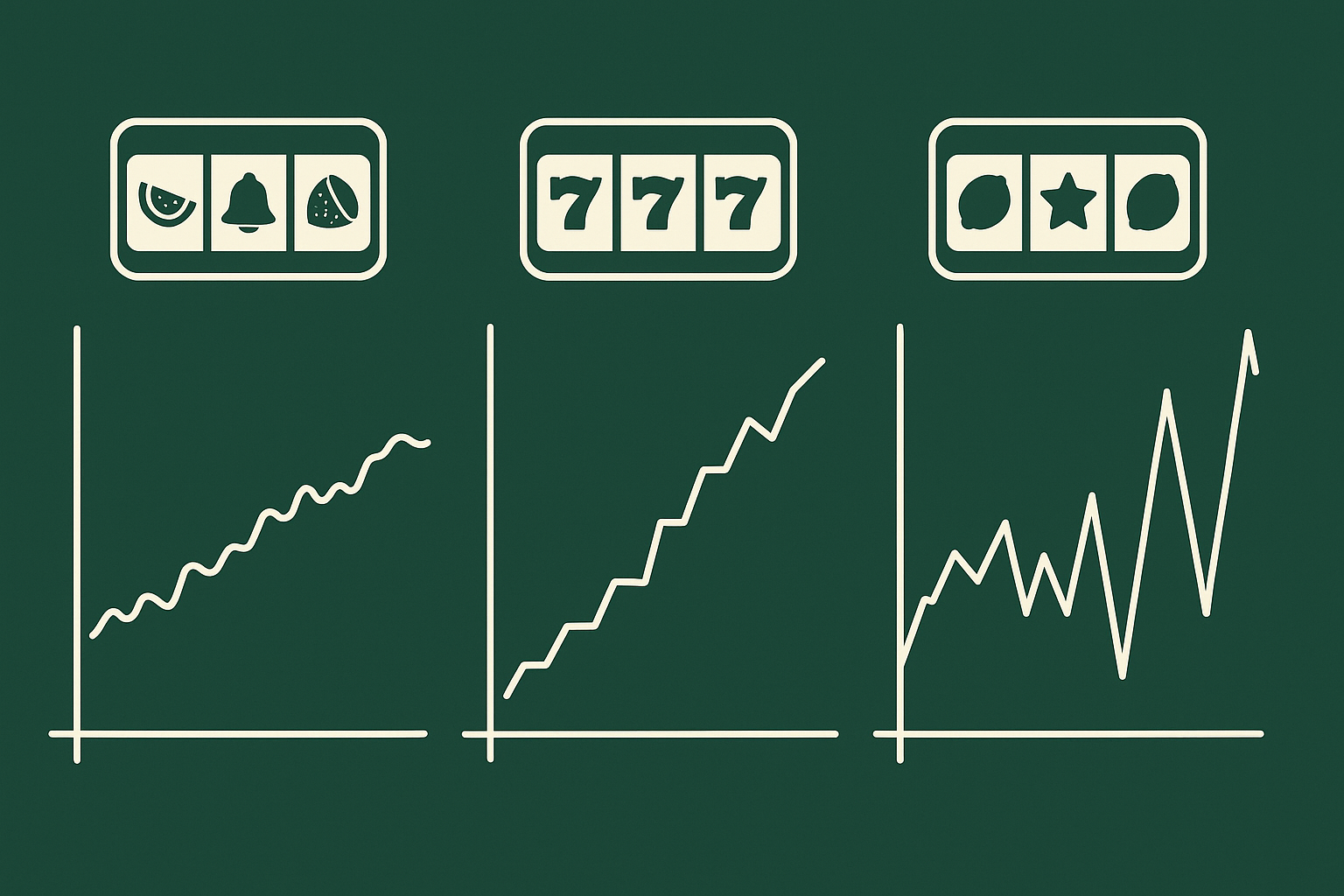
Slot paylines, ways-to-win and cluster pays are three different ways a slot decides whether a spin has produced a win. Paylines use fixed patterns across the reels. Ways-to-win ignores position and only cares that matching symbols land on adjacent reels. Cluster pays drops lines entirely and pays groups of touching symbols. None of the three is inherently more generous, and that surprises most players.
What actually changes between them is how wins feel: how often they arrive, how big they get, and how the paytable is written. Here’s how each system works, with the math spelled out.
What are slot paylines?
A payline is a predetermined pattern of reel positions. If matching symbols land on the positions that make up that pattern, usually starting from the leftmost reel, the line pays according to the paytable. If they land in the right quantity but the wrong positions, nothing happens.
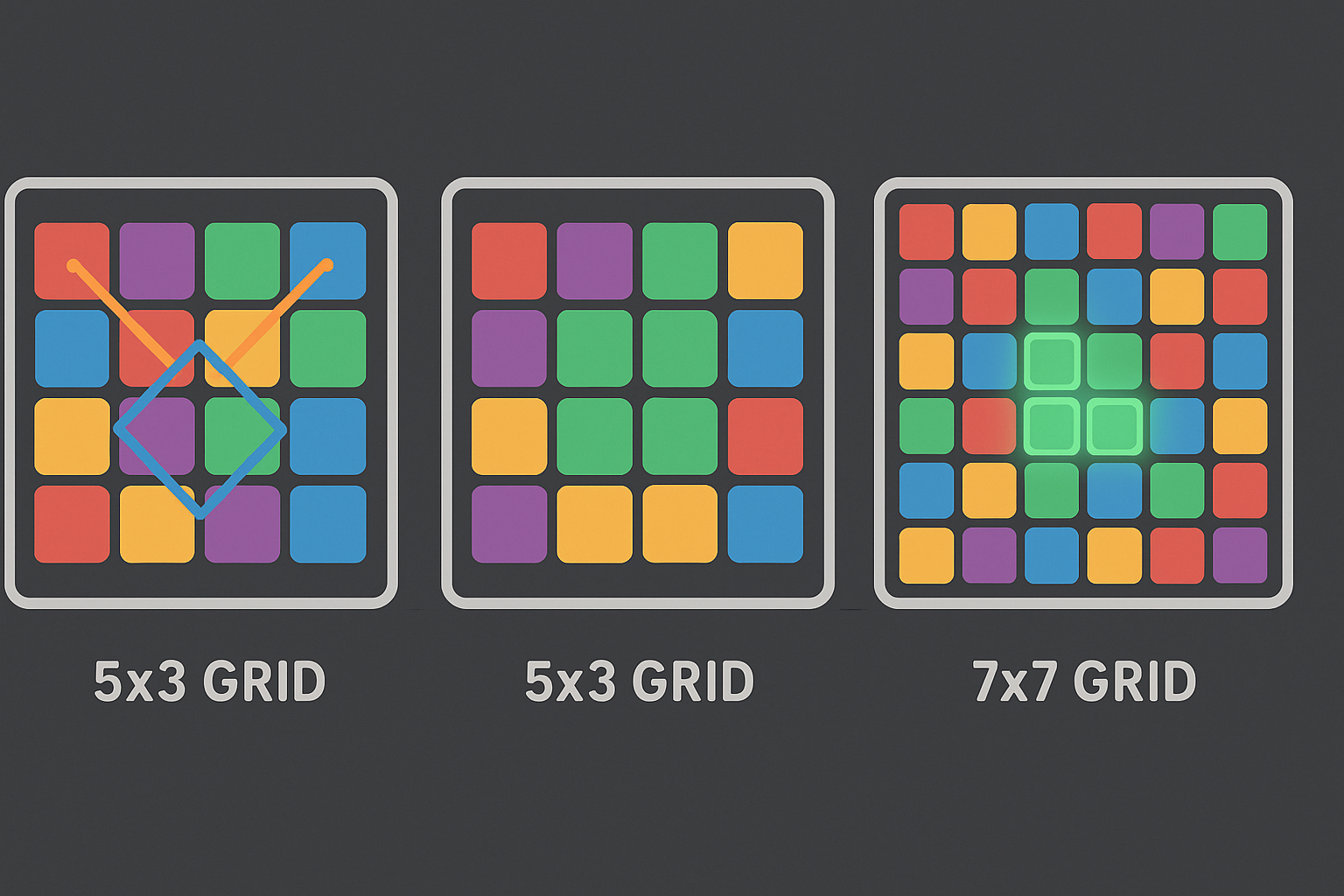
The original three-reel machines had one payline straight across the middle. Modern five-reel video slots typically run 10, 20, 25 or 40 lines that zigzag: straight rows, V shapes, W shapes, staircases. On a 5×3 grid there are 243 possible position combinations in total, so a 25-line game is only paying out on a small selected subset of them.
A quick comparison of the same three-symbol hit on two different games:
- 5-line slot, $0.20 per line = $1.00 total spin. Three matching symbols must sit on one of five specific patterns. Fewer chances to connect, but each line carries a big stake.
- 25-line slot, $0.04 per line = $1.00 total spin. The same three symbols have 25 possible patterns to land on, so hits come more often. Each hit is worth a fifth as much.
Same $1.00 stake, very different rhythm. That trade-off, frequency against size, is the thread running through this entire article.
Fixed vs adjustable paylines
Fixed paylines are always active. You choose a bet level, and the game multiplies it across every line automatically. Most newer releases work this way because it removes confusion about which lines are live.
Adjustable paylines let you switch lines off. Playing 5 of 25 lines cuts your spin cost to a fifth, but it also cuts the patterns you can win on to a fifth. It does not make the active lines pay more. One thing worth checking in the help screen: developers publish a game’s RTP with all lines active, and some games tie feature triggers or bonus symbols to specific lines. Deactivating lines in those titles can change your expected return, and the game’s own help file will say so.
Reading a paytable
The paytable is the only place the actual rules live. Open it before you spin and look for four things:
- Payout values and whether they’re expressed as coin amounts, multiples of the line bet, or multiples of the total bet. This matters enormously when comparing games.
- Direction of pay — left to right only, or both ways.
- The line diagram showing every active pattern.
- Scatter and wild rules, since scatters usually pay from anywhere on the grid and ignore the line structure completely.
Ways-to-win: beyond traditional lines
Ways-to-win slots pay for matching symbols on consecutive reels starting from reel one, regardless of which row those symbols land in. There are no line patterns to memorise. If reel 1, reel 2 and reel 3 each show at least one lion symbol, you’re paid, whether the lions sit top, middle or bottom.
You’ll see these games advertised as “243 ways”, “1,024 ways” or “all ways pays”. The number isn’t marketing; it’s a straight calculation from the grid size.
How 243 ways-to-win works
243 comes from a five-reel, three-row grid: 3 × 3 × 3 × 3 × 3 = 3⁵ = 243. That’s every possible route through the grid taking one symbol per reel. A ways-to-win game pays all of them, which is why it doesn’t need a line diagram.
The other consequence is that a single spin can produce multiple wins for the same symbol. If reel 1 shows two lions, reel 2 shows one, and reel 3 shows two, that’s 2 × 1 × 2 = 4 separate three-symbol wins paid together. Because these multiple hits are baked into the design, individual symbol payouts on ways-to-win games are usually smaller than on comparable payline slots.
1024 ways and higher variants
Add a fourth row and the math scales fast: 4⁵ = 1,024 ways. Six reels with four rows gives 4⁶ = 4,096. Five rows across five reels gives 5⁵ = 3,125.
| Grid (reels × rows) | Calculation | Ways to win |
|---|---|---|
| 5 × 3 | 3⁵ | 243 |
| 5 × 4 | 4⁵ | 1,024 |
| 5 × 5 | 5⁵ | 3,125 |
| 6 × 4 | 4⁶ | 4,096 |
A bigger number looks impressive on the game tile, but it doesn’t mean a bigger return. It means the grid is larger and the paytable has been priced accordingly.
Megaways: variable ways-to-win
Megaways is a licensed mechanic created by Big Time Gaming and used under licence by many studios. It takes the ways-to-win idea and makes the grid itself change shape on every spin, so the number of ways is different each time you press spin.
Megaways mechanics explained
A standard Megaways game has six reels, and each reel can land anywhere from two to seven symbol positions. Wins are still paid for matching symbols on consecutive reels from the left, exactly as in a fixed ways-to-win game. Many Megaways titles, including Bonanza, add a horizontal reel above the grid that feeds extra symbols into the reels beneath it, plus cascading reactions where winning symbols vanish and new ones drop in.
Why the number changes each spin
Multiply the symbol counts of the six reels together and you get that spin’s ways. Six reels showing 4, 5, 3, 6, 4 and 2 symbols produce 4 × 5 × 3 × 6 × 4 × 2 = 2,880 ways. If all six reels land at maximum height, 7 × 7 × 7 × 7 × 7 × 7 = 7⁶ = 117,649, which is the number in the marketing. At the other extreme, six reels of two symbols each gives just 2⁶ = 64 ways.
The 117,649 figure is the ceiling, not the norm, and it comes with a catch: with that many ways available, the value of each individual combination has to be low or the game’s math wouldn’t balance. Megaways slots tend to be high volatility, with long dry stretches punctuated by occasional large hits.
Cluster pays: winning without lines
Cluster pays games have no paylines and no ways. They pay when a minimum number of matching symbols land touching each other on the grid, usually horizontally and vertically but not diagonally. The typical minimum is five, six or nine symbols depending on the game, and payouts scale up as the cluster grows.
How clusters form
Cluster games run on bigger grids, commonly 6×5 or 7×7. Picture a 7×7 grid where seven matching gems form an L shape in the bottom corner: that’s a valid cluster because every symbol touches at least one other in the group. A paytable might pay one value for 5 to 8 symbols, more for 9 to 12, and a large multiple for 20 or more. Wilds can bridge two nearly-touching groups into a single larger cluster, which is where the bigger payouts usually come from. NetEnt’s Aloha! Cluster Pays, Play’n GO’s Reactoonz and Push Gaming’s Jammin’ Jars are all well-known examples of the format.
Cascading wins and multipliers
Nearly every cluster game uses cascading (also called tumbling or avalanche) reels. When a cluster pays, those symbols are removed and new symbols drop in to fill the gaps. If the new symbols form another cluster, that pays too, and the chain continues until no new cluster appears. Everything is settled on one stake.
Many cluster games attach a multiplier that climbs with each cascade in the chain: 1x on the first drop, 2x on the second, 3x on the third, and so on. That’s what produces the occasional enormous single spin, and also why the base game can feel quiet for long stretches. High volatility, again.
Do more paylines mean better odds?
No. Adding paylines, ways or grid positions does not improve your odds or your expected return. A game’s RTP is set by the developer in the game’s math model, and the payout structure is just the delivery mechanism. A 10-line slot, a 243-ways slot and a 7×7 cluster game can all be built to exactly 96% RTP, which is a 4% house edge in each case.
Two things are easy to confuse here:
- More lines active on an adjustable game means more total money wagered per spin. You get more chances to win because you paid for them, not because the odds improved. Cost per line stays the same.
- More lines built into a game’s design means the developer lowered the individual payout values to keep the return on target.
What the structure genuinely changes is distribution. Densely paying structures raise hit frequency, so you land small wins often, including plenty that return less than your stake. Sparse structures, or high-ceiling ones like Megaways, lower hit frequency and push the money into rarer, larger outcomes. Same average return over the very long run, wildly different session experience. And the RTP average only emerges across millions of spins, never across your afternoon.
Every spin is independent, produced by an RNG. Nothing in any of these systems is “due”.
Which payout system is best?
There’s no best, only a best fit for what you want a session to feel like. All three can carry identical RTPs, so the honest comparison is about volatility, clarity and pace.
| System | How wins are awarded | Typical hit frequency | Suits players who… |
|---|---|---|---|
| Paylines | Symbols on set patterns, usually left to right | Moderate, depends on line count | Want to see exactly why a spin paid |
| Ways-to-win | Matching symbols on adjacent reels, any row | Higher, with many small wins | Prefer steady action over big swings |
| Megaways | Adjacent-reel matches on a reshaping grid | Lower, very swingy | Accept long dry runs for rare large hits |
| Cluster pays | Groups of touching symbols, plus cascades | Lower in base game, chain-driven | Enjoy multiplier build-ups and reaction chains |
If you’re new to slots, fixed paylines with a clear diagram are the easiest place to learn how a paytable works. If you dislike watching a balance grind slowly downward between features, ways-to-win games generally deliver the most frequent small hits. If the appeal for you is the chance of an outlier spin and you’re comfortable with a bankroll that moves in big steps, Megaways and cluster games are built for that, with the volatility to match.
Whatever structure you pick, the house edge doesn’t move. Set a deposit or loss limit before you start, treat the money as entertainment spend rather than an investment, and use the deposit limits, cool-off periods and self-exclusion tools that licensed operators are required to offer. If a session stops being fun, close it.
Frequently asked questions
What does 243 ways to win mean?
It means every possible combination of one symbol per reel across a five-reel, three-row grid pays: 3⁵ = 243. You win whenever matching symbols land on consecutive reels from the left, whatever row they sit in.
How do Megaways slots work?
Each of the six reels lands with 2 to 7 symbols on it, and the ways for that spin equal the six reel heights multiplied together. Wins still pay for matching symbols on adjacent reels from the leftmost reel. All reels at seven symbols gives the advertised 117,649 ways.
Do paylines affect RTP?
The number of paylines a game is built with does not change its RTP; developers price the paytable around the structure. Turning lines off on an adjustable-payline game can affect the published return in some titles, so check the help screen before reducing lines.