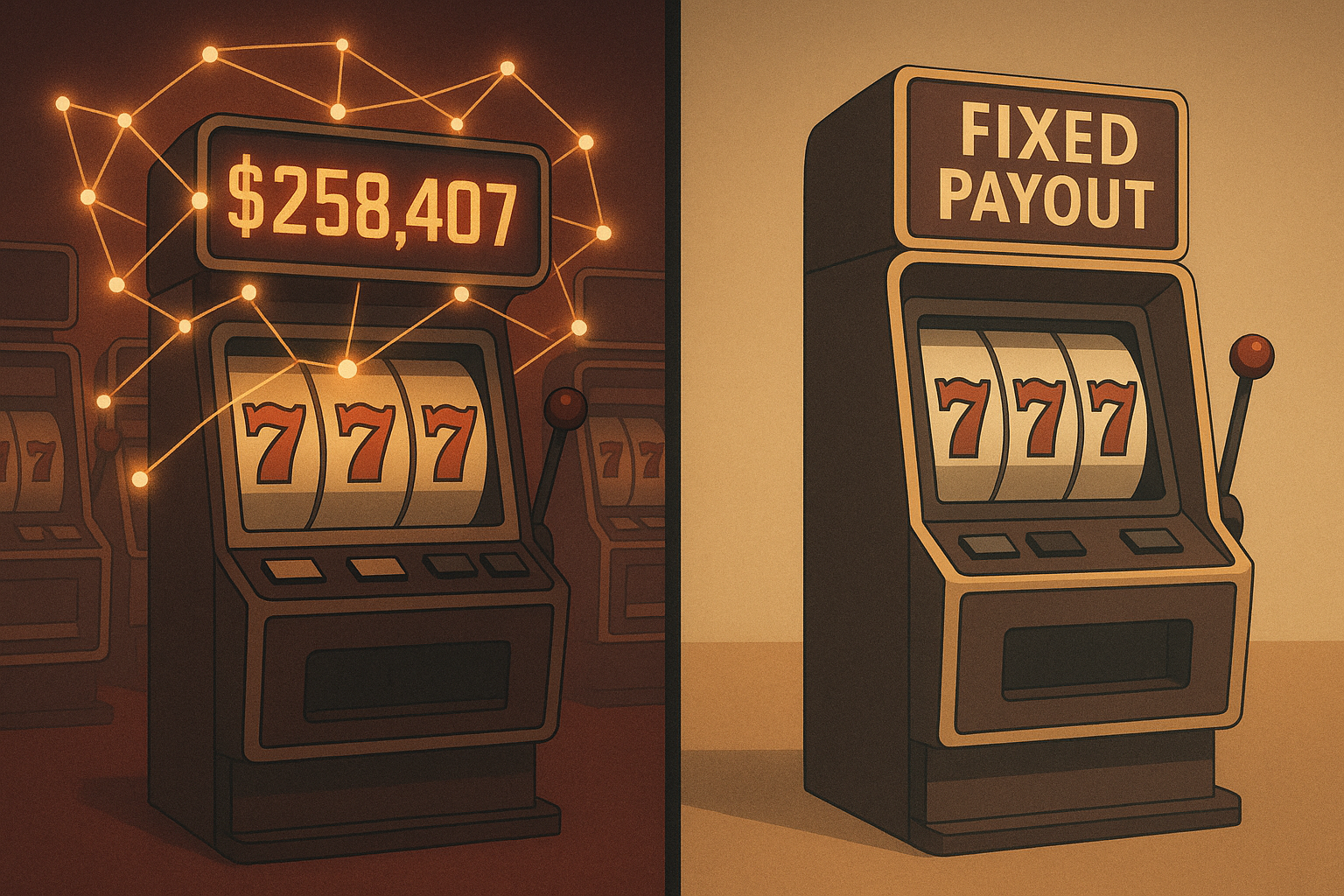
Progressive jackpot slots take a slice of every qualifying bet and add it to a prize pool that keeps growing until somebody wins it. Fixed jackpots don’t grow at all: the top prize is a set multiple of your stake, published in the paytable, and it pays the same amount whether you’re the first person to hit it today or the thousandth. That single difference in funding changes the math of the game, its volatility, and usually its base return to player.
Here’s how the pooling mechanics actually work, why progressive slots tend to have lower base RTP, and how to tell which kind of jackpot game fits the way you play.
How progressive jackpots work
A progressive jackpot is a prize funded by player wagers rather than by a fixed paytable line. Every time someone spins a qualifying bet on a linked game, a small percentage of that bet is diverted into the jackpot pool instead of being returned through normal wins. The pool climbs until the trigger condition is met, then it pays out and resets to a preset starting figure called the seed.
The contribution system
The contribution rate is a percentage of each wager, and it’s usually small: often around 1% to 2%, sometimes higher on games with several jackpot tiers. The size looks trivial per spin and enormous in aggregate.
Run the numbers. At a 1.5% contribution rate, a $1 spin sends 1.5 cents to the pool. One player spinning 600 times an hour adds about $9. Now link a few hundred casinos and put a million $1 spins through the network in a day, and the meter grows roughly $15,000 in 24 hours. That’s how online jackpots reach seven figures without any casino writing a check.
Two details matter for players. First, on multi-tier games the total contribution is split between the Mini, Minor, Major and Mega pools, so the headline prize grows slower than the total contribution suggests. Second, many progressives are bet-sensitive: either the jackpot is only reachable at a qualifying bet level, or your odds of triggering it scale with stake. Betting one cent on a game that requires a max bet for jackpot eligibility means you’re still paying into a prize you can’t win. Always read the jackpot rules screen before your first spin.
Jackpot meter display
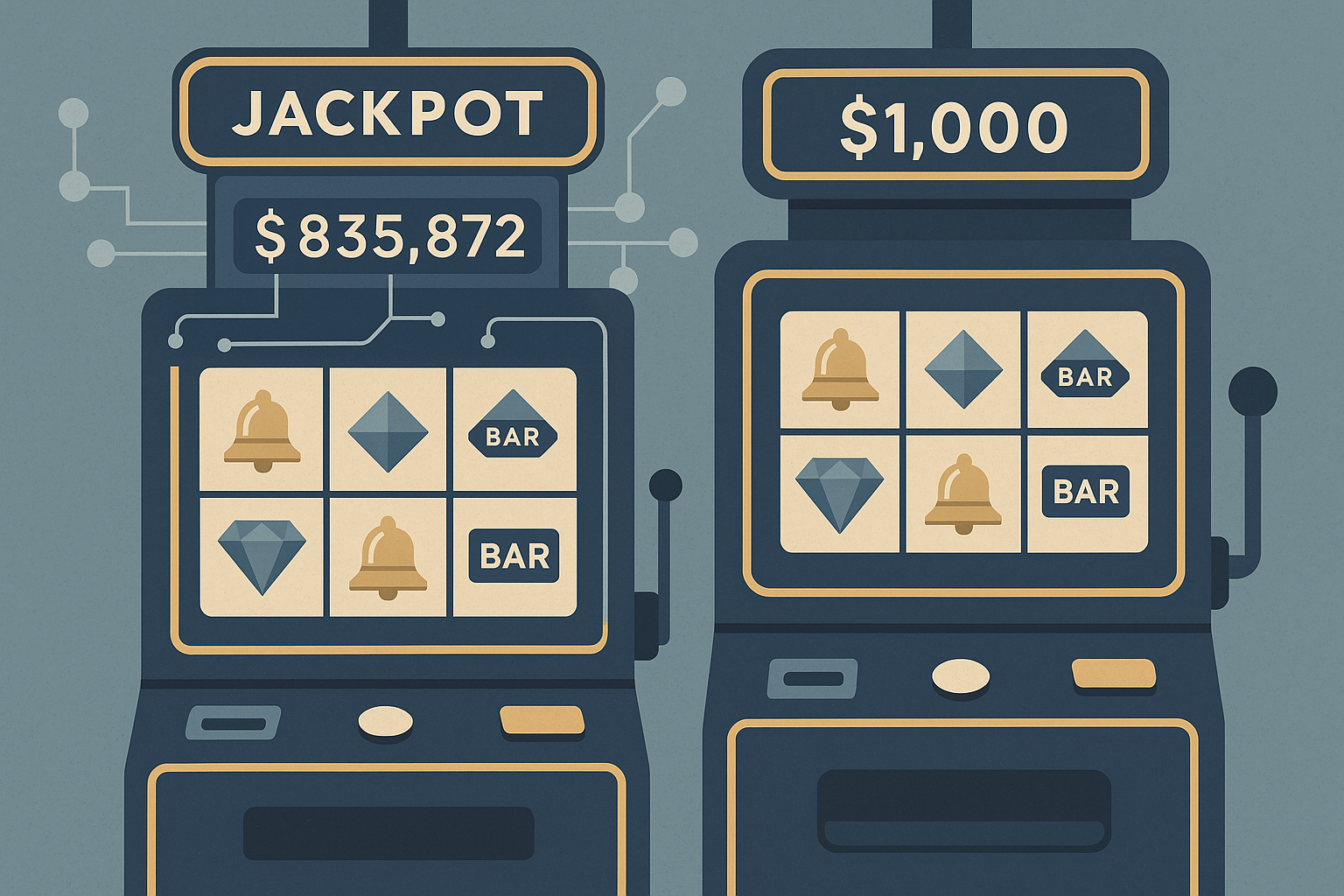
The jackpot meter is the ticking number above the reels. On networked games it updates in near real time as players anywhere on the network spin, which is why the figure jumps in irregular increments rather than counting smoothly. On a standalone machine, the meter only moves when you play.
Meters can be misleading in one respect: a big number tells you nothing about whether the game is “due”. Outcomes come from an RNG, and each spin is independent. A jackpot that has been climbing for six months has exactly the same trigger probability on the next spin as one that reset yesterday. The only thing a large meter changes is the value of a win, not the chance of it.
Fixed vs progressive jackpots: key differences
A fixed jackpot is a top prize expressed as a multiple of your bet, for example 5,000x. Bet $1 and it pays $5,000; bet $0.20 and it pays $1,000. Nothing accumulates, and there’s no network. The prize is part of the game’s ordinary paytable and is funded by the same RTP as every other win.
Payout structure comparison
| Feature | Fixed jackpot | Progressive jackpot |
|---|---|---|
| Prize size | Set multiple of stake (often 1,000x–10,000x) | Grows with play; can reach six or seven figures |
| Funding | Built into the game’s normal paytable | Percentage of each qualifying bet diverted to a pool |
| Base game RTP | Typically ~94%–96% | Often lower, roughly 88%–92% before jackpot contribution |
| Win frequency of top prize | Rare, but far more likely than a wide-area progressive | Extremely rare on large networks |
| Bet requirements | Any stake; prize scales with bet | May require max bet or a qualifying stake to be eligible |
| Volatility | High, but bounded by the paytable | Very high; a large share of return sits in one outcome |
| Payout method | Paid instantly from the balance | Sometimes shared, capped, or paid in instalments (check terms) |
Risk vs reward profile
Progressive games concentrate value. If a chunk of the game’s total return is locked inside a prize almost nobody will hit, the day-to-day experience for the average player is a thinner base game: fewer decent mid-size wins, longer dry spells, faster bankroll erosion. Fixed jackpot slots spread their return more evenly across the paytable, so sessions tend to feel less brutal even though the ceiling is much lower.
Neither structure improves your expected value. Both are negative EV over time, because the house edge is the inverse of RTP. What changes is the shape of the outcome distribution. If you want to understand that trade-off properly, it’s worth reading up on how slot volatility affects your bankroll before you commit to a progressive.
Types of progressive jackpot networks
Not all progressives pool the same way. The network type determines how fast the meter climbs, how big it can get, and how long the odds are.
- Standalone progressive: the pool is funded only by play on that one machine or one game client. Smallest prizes, quickest growth relative to your own play, and the shortest odds of the three.
- Local area progressive: a group of machines within one casino, one casino group, or one operator’s site feeds a shared pool. Mid-size prizes, often in the tens of thousands online.
- Wide area progressive: a networked jackpot linking many operators or many casinos across a state or a whole market, run by the game supplier. This is where six and seven-figure prizes come from, and where the odds are longest.
| Network type | Pool fed by | Typical prize scale | Examples |
|---|---|---|---|
| Standalone | One machine or game | Hundreds to low thousands | Single-cabinet slots; many in-house online jackpot titles |
| Local area | Machines in one venue or one operator | Thousands to tens of thousands | Bank of linked cabinets on a casino floor; operator-exclusive daily jackpots |
| Wide area | Many casinos or operators on a supplier network | Six to seven figures | IGT’s Megabucks in Nevada; Mega Moolah online, whose Mega tier seeds at $1 million |
Wide-area odds deserve blunt treatment. The chance of hitting a top-tier statewide or global jackpot is routinely quoted in the tens of millions to one, which puts it in lottery territory rather than “unlikely but achievable” territory. Treat those spins as entertainment, not as a plan.
RTP trade-offs in progressive slots
Base game vs overall RTP
Progressive slots typically list a lower base game RTP, often in the 88%–92% range, versus roughly 94%–96% for comparable non-jackpot games. The reason is arithmetic, not stinginess: the contribution taken from each bet is return that has been moved out of the base game and parked in the jackpot pool.
Suppliers often publish two numbers: base RTP and total or theoretical RTP including the jackpot contribution. A game might show 89% base and 95% total. That 95% is real, but only across all players on the network over the full life of the jackpot cycle, including the person who eventually wins it. Your personal share of that jackpot component is close to zero, so the number that describes your likely session is the base figure. If RTP labelling is new to you, our explainer on how slot RTP is calculated unpacks it further.
Long-term vs short-term returns
RTP is a long-run average measured over millions of rounds, not a session forecast. On a fixed jackpot slot with 96% RTP, the 4% house edge is spread across lots of moderate outcomes, so a few hundred spins will usually land somewhere recognisable around the average. On a progressive with 89% base RTP, short sessions almost always underperform the headline total RTP, because the outcome that would drag you above it is the one that essentially never happens.
One nuance worth knowing: because the jackpot component grows, the theoretical total return on a specific game does rise as the meter climbs. In principle a very inflated pool can push total RTP above 100% for the network as a whole. That’s a network-level statistic, not an edge you can capture, and the variance involved is far too large for any individual player to realise it.
Seed amounts and reset mechanics
Seed and reset process
When a progressive is won, the meter resets to its seed amount, the guaranteed floor the supplier or operator funds so the prize never restarts at zero. Mega Moolah’s top tier, for instance, seeds at $1 million, so the meter is never advertised below that figure.
Seeds are pre-funded from earlier contributions. Part of the money taken from bets goes to the current visible meter, and part goes into a reserve that pays for the next cycle’s seed. That’s why a jackpot can pay out on Monday and show a healthy number again on Tuesday.
Must-drop jackpots explained
A must-drop jackpot (also called a mystery or must-win jackpot) has a built-in ceiling condition: it has to pay out before a stated time or before the meter passes a stated amount. Hourly, daily and “drops before $X” formats all exist, and they’re common in online jackpot suites such as daily drop jackpots and supplier-wide must-win networks.
The winner is usually chosen by a random mechanism tied to wagers rather than by a specific reel combination, so it can land on any spin at any bet level that qualifies. Two honest caveats: bigger bets generally buy more tickets in that random draw, and the deadline shortens the wait, not the house edge. A must-drop jackpot with a $1,000 ceiling is not a better bet than a $2 million one in EV terms; it is just a smaller prize awarded more often.
Which type should you choose?
There’s no correct answer, only a fit. Decide based on bankroll, session length and what you actually want out of the game.
For casual players
If you’re playing $20 or $50 for an evening’s entertainment, fixed jackpot slots or low-tier progressives usually make more sense. A higher base RTP and steadier hit frequency mean your money lasts longer, and a 2,000x fixed prize is still a real outcome. Standalone and local area progressives are a reasonable middle ground: smaller pools, meaningfully shorter odds, and no max-bet requirement on many titles. Must-drop games can also suit small budgets, because the guaranteed drop keeps prizes in circulation.
What to avoid: grinding a max-bet wide-area progressive on a small bankroll. The stake requirement pushes your bets above your comfort level, the base RTP is lower, and the prize you’re paying for is a rounding error away from impossible.
For high-stakes players
Higher bankrolls can absorb the variance that progressives demand, and if you’re already betting at qualifying levels the max-bet rule costs you nothing extra. If you play jackpot networks seriously, the practical points are: confirm your stake qualifies for every tier, check whether the prize is capped or shared between simultaneous winners, read how payment is made, and keep the lower base RTP in mind when comparing games. Sizing sessions properly matters more than picking the right title, which is why we recommend a fixed bankroll management plan for slot sessions rather than chasing a meter.
A closing reality check: jackpot slots are entertainment with a built-in house edge, and the biggest prizes have odds long enough that no bankroll or bet size makes them a reasonable expectation. Set deposit and loss limits before you start, use session reminders, and stop when the budget is spent. If gambling stops feeling like a cost you chose to pay, use your operator’s cool-off or self-exclusion tools and talk to a support service in your state.
Common questions
How is a progressive jackpot funded?
By players. A set percentage of each qualifying wager, commonly around 1%–2%, is diverted from normal game returns into the jackpot pool. Part also funds the reserve that pays the next seed amount after a win.
Do progressive slots have lower RTP?
Lower base game RTP, yes, typically around 88%–92% against 94%–96% for many non-jackpot slots. Total theoretical RTP including the jackpot can look similar, but that figure only realises across the whole network including the eventual winner.
What is a must-drop jackpot?
A progressive that must be awarded before a set time or before the meter exceeds a set amount. The winner is usually drawn randomly from qualifying wagers rather than triggered by a reel combination.
What’s the difference between fixed and progressive jackpots?
A fixed jackpot pays a set multiple of your stake from the paytable and never grows. A progressive pools contributions from ongoing play, grows until it’s won, then resets to its seed.
Are jackpot odds better on smaller networks?
Generally yes. Standalone and local pools are fed by far fewer spins, so they’re won more often, but the prizes are correspondingly smaller. The house edge doesn’t improve either way.