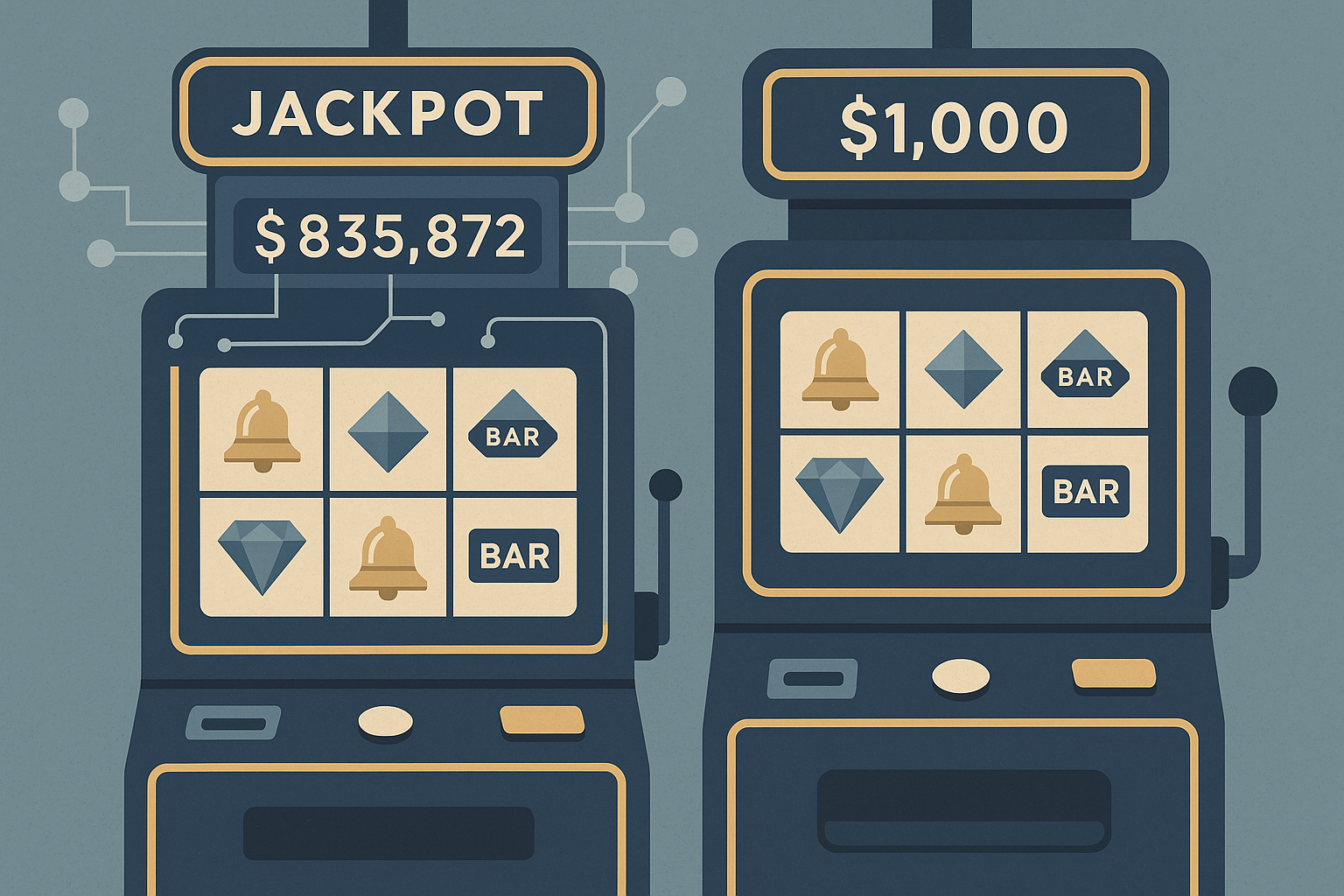
The short version: progressive jackpot slots grow their top prize by skimming a small slice of every qualifying bet placed on the game, while fixed jackpot slots pay a set amount that never changes no matter how many people play. That single difference drives everything else, including how the base game pays, how volatile the session feels, and how astronomically unlikely the headline prize is.
If you’ve ever wondered why a game advertising a seven-figure jackpot feels so stingy between features, this is the explanation. Here’s how the pooling actually works, the network types behind it, and where the return to player quietly gets shifted around.
How progressive jackpots work
A progressive jackpot is a prize pool that increases every time someone wagers on a linked game, and it keeps increasing until a player triggers it. When it’s won, the pool drops back to a preset seed amount and starts climbing again. Fixed jackpots don’t move: 5,000x your bet is 5,000x your bet, whether you’re the first spin of the day or the millionth.
The contribution system
Every qualifying bet is split. Most of it goes into the game’s normal prize pool, which funds line wins, scatters and free spins. A small percentage, commonly around 1% to 2% depending on the game, is diverted into the jackpot pool instead.
Run the arithmetic and the growth stops looking mysterious. On a $1 spin with a 1% contribution rate, one cent goes to the jackpot. That’s nothing. But a networked jackpot linked across dozens of casinos might see tens of thousands of spins per minute across all its games, and at that volume the meter climbs by hundreds of dollars an hour without any single player noticing a difference in their own play.
Some games split the contribution across a tiered set of prizes, so the same 1% might feed a Mini, Minor, Major and Grand pool at different rates. The Mini fills fast and drops often, the Grand fills slowly and drops rarely. It’s the same money, just distributed on different schedules.
One detail worth checking before you spin: eligibility. Some games only qualify you for the jackpot at max bet or with a side bet active. Others weight your chance by stake size, so a $5 spin has five times the shot of a $1 spin. If you’re betting below the qualifying threshold on a game that requires one, you’re still paying into a prize you cannot win.
Jackpot meter display
The jackpot meter is the live counter above the reels. It reads directly from the operator’s or provider’s jackpot server, not from your session, which is why it ticks upward while you sit idle. In a wide area network the same figure appears simultaneously on every casino carrying the game.
Meters are display-only. Watching one climb tells you nothing about when it will drop, because each spin’s outcome is generated independently by the RNG. A jackpot that hasn’t paid in three months is no more “due” than one that paid this morning.
Fixed vs progressive jackpots: key differences
The fixed vs progressive jackpot decision is really a decision about where you want your expected return delivered: spread across frequent, modest wins, or concentrated in an outcome you will almost certainly never hit.
Payout structure comparison
| Feature | Fixed jackpot slots | Progressive jackpot slots |
|---|---|---|
| Top prize | Set multiple of stake (e.g. 2,000x–10,000x) | Grows with play; can reach six or seven figures |
| Funding | Built into the game’s normal paytable | Percentage of each qualifying bet diverted to a pool |
| Typical advertised RTP | Often 94%–96.5% | Often 88%–95%, with part of it locked in the jackpot |
| Base game feel | More budget available for regular wins | Leaner base game; some RTP siphoned off |
| Top prize odds | Long, but usually millions-to-one or better | Frequently one in several million to tens of millions per spin |
| Bet requirements | Any stake pays the same multiplier | May require max bet, side bet or stake weighting |
| After a win | Nothing changes | Resets to a seed amount |
Note the second row carefully. A fixed jackpot pays a multiple of your stake, so a $0.20 spin and a $5 spin both have a shot at the same headline multiplier. A progressive pays a cash figure, which is why stake weighting and minimum-bet rules exist.
Risk vs reward profile
Progressives are, almost by definition, high volatility games. A meaningful chunk of the theoretical return sits in an outcome that most players will never see, which means the distribution of results you actually experience is worse than the posted RTP suggests. If 6% of a game’s RTP lives in a Grand jackpot, the other 90-odd percent is all you’re realistically playing for.
Fixed jackpot slots come in every volatility band. You can find a low variance fixed jackpot game that grinds out small wins for hours, which is simply not an option in the wide area progressive category. If you’re unclear on how variance shapes a session, our guide to slot volatility breaks down what high and low variance actually feel like at the same RTP.
Types of progressive jackpot networks
Not every progressive is a networked jackpot. The pool’s scope determines how big it gets and how often it drops.
Standalone progressives
A standalone progressive is fed only by bets placed on that single game, sometimes on a single machine in a land-based venue. Pools are small, often a few hundred to a few thousand dollars, and they reset frequently. The upside is genuine: because the pool is fed by one game’s traffic, the win frequency is far higher than any network jackpot. You just won’t retire on it.
Local area networks
A local area progressive links multiple games within one operator, one casino brand or one physical property. Think of a bank of machines on a casino floor sharing a meter, or an online operator running a house jackpot across its own slot catalogue. Pools typically sit in the thousands to low tens of thousands, and drops happen regularly enough that regular players see them.
Wide area progressives
Wide area progressives pool contributions across many operators, often every licensed casino carrying a given provider’s game, and sometimes across a family of games sharing one jackpot. This is where the headline prizes come from. Microgaming’s Mega Moolah, whose Mega jackpot seeds at 1 million, is the archetype: one pool, many games, many casinos.
The trade-off is brutal maths. Massive shared pools require correspondingly long odds, so wide area jackpot hit chances are commonly quoted in the range of one in several million to one in tens of millions per qualifying spin. That’s lottery-scale territory.
| Network type | Fed by | Typical pool size | Drop frequency |
|---|---|---|---|
| Standalone | One game or machine | Hundreds to low thousands | Relatively often |
| Local area | One operator or venue | Thousands to tens of thousands | Regularly |
| Wide area | Many operators, often many games | Six to seven figures | Rarely, sometimes months apart |
RTP trade-offs in progressive slots
Jackpot slot RTP is the part most players skip, and it’s the part that changes your session the most.
Base game vs overall RTP
Every percentage point diverted into a jackpot pool is a percentage point not being paid out through the paytable. So a progressive with a 94% overall RTP might only return around 88% through ordinary spins, with the remaining 6% sitting in the jackpot pools. Some older wide area titles publish notably low overall figures, Mega Moolah’s documented RTP of 88.12% being a well known example.
Here’s where it gets interesting: on a game with a growing pool, the overall RTP technically rises as the jackpot swells, because the same win probability is now attached to a bigger prize. Mathematically true. Practically irrelevant for one player, since the extra value is concentrated in an outcome with odds in the millions. If you want the fundamentals, see our explainer on how RTP and house edge are calculated.
Long-term vs short-term returns
RTP is a long-run average measured over millions of rounds across all players, not a session forecast. For progressives, the gap between the average and your likely experience is wider than anywhere else in the casino, because the average is propped up by rare eight-figure-frequency events. Over a realistic few hundred spins, expect the leaner base game to be what you actually feel.
Seed amounts and reset mechanics
Seed and reset process
When a progressive is won, the meter resets to a seed amount, the guaranteed starting figure for the next cycle. The seed is pre-funded, usually held back from earlier contributions or covered by the provider, so the next pool doesn’t start at zero.
Providers typically split incoming contributions three ways: topping up the visible meter, building a hidden reserve to seed the next cycle, and the operator’s or provider’s own cut. That reserve is why a jackpot can reset to 1 million within seconds of paying out 15 million.
Must-drop jackpots explained
A must-drop jackpot is a progressive with a guaranteed trigger condition, either a time deadline or a value ceiling. Red Tiger’s Daily Jackpot games are the clearest example: the prize must be awarded before a stated time each day, so if it hasn’t been won by then, it drops to whoever is playing when the clock runs out. Others are set to pay “before it reaches $10,000”, meaning the trigger point is a random value below that cap.
These are usually called mystery jackpots because the trigger isn’t tied to a reel combination. You don’t need a specific symbol pattern; the jackpot server picks a moment or a value in advance and awards the prize to a qualifying spin at that point. Must-drop pools are much smaller than wide area Grands, but they drop reliably, and stake size normally influences your share of the chance.
Which type should you choose?
Neither type is objectively better. They serve different goals, and both carry a house edge you cannot play your way around.
For casual players
If your budget is modest and you want playing time, fixed jackpot slots with a 96%-ish RTP will stretch a bankroll further than a progressive with a leaner base game. You get a lower ceiling in exchange for a session that doesn’t drain as fast.
If you do want a shot at a growing pool on a small budget, standalone, local or must-drop progressives are the sensible compromise: smaller prizes, but odds you can actually reach in a lifetime of play. And check the qualifying bet before you start, because paying into a jackpot you’re not eligible for is the worst of both worlds. A simple bankroll plan with session limits matters more here than game selection.
For high-stakes players
Larger stakes make progressives more coherent, because most weight jackpot eligibility by bet size and some require max bet outright. If you’re already betting at the qualifying level, the jackpot component costs you nothing extra in eligibility terms, though the lower base RTP still applies to every spin.
Bigger bets do not shorten the odds in any meaningful sense. Multiplying a one-in-twenty-million chance by five is still a one-in-four-million chance, and the variance that comes with it is severe. Treat the jackpot as a lottery ticket bundled with the slot, not as the reason you’re playing.
FAQ
How is a progressive jackpot funded?
By a percentage of every qualifying bet, commonly around 1% to 2%, diverted from the game’s normal payout budget into a shared pool. Part of the contribution also builds the hidden reserve that seeds the next jackpot after a win.
Do progressive slots have lower RTP?
Their base game RTP is usually lower, yes, because part of the return is locked into the jackpot pools. Overall RTP including the jackpot can look competitive, but you’ll rarely experience that portion.
What is a must-drop jackpot?
A progressive guaranteed to pay before a set time or before the meter passes a set amount. The trigger is decided by the jackpot server rather than by a reel combination.
What’s the difference between fixed and progressive jackpots?
Fixed jackpots pay a set multiple of your stake and never change. Progressives pay a cash figure that grows with player contributions and resets to a seed amount when won.
Jackpot odds are extremely long, and no betting pattern, stake size or meter reading changes the outcome of a spin. Set a deposit or loss limit before you play, treat the money as entertainment spend, and if it stops feeling that way, use your casino’s cool-off or self-exclusion tools. In the US, the National Council on Problem Gambling helpline (1-800-522-4700) is free and confidential.