
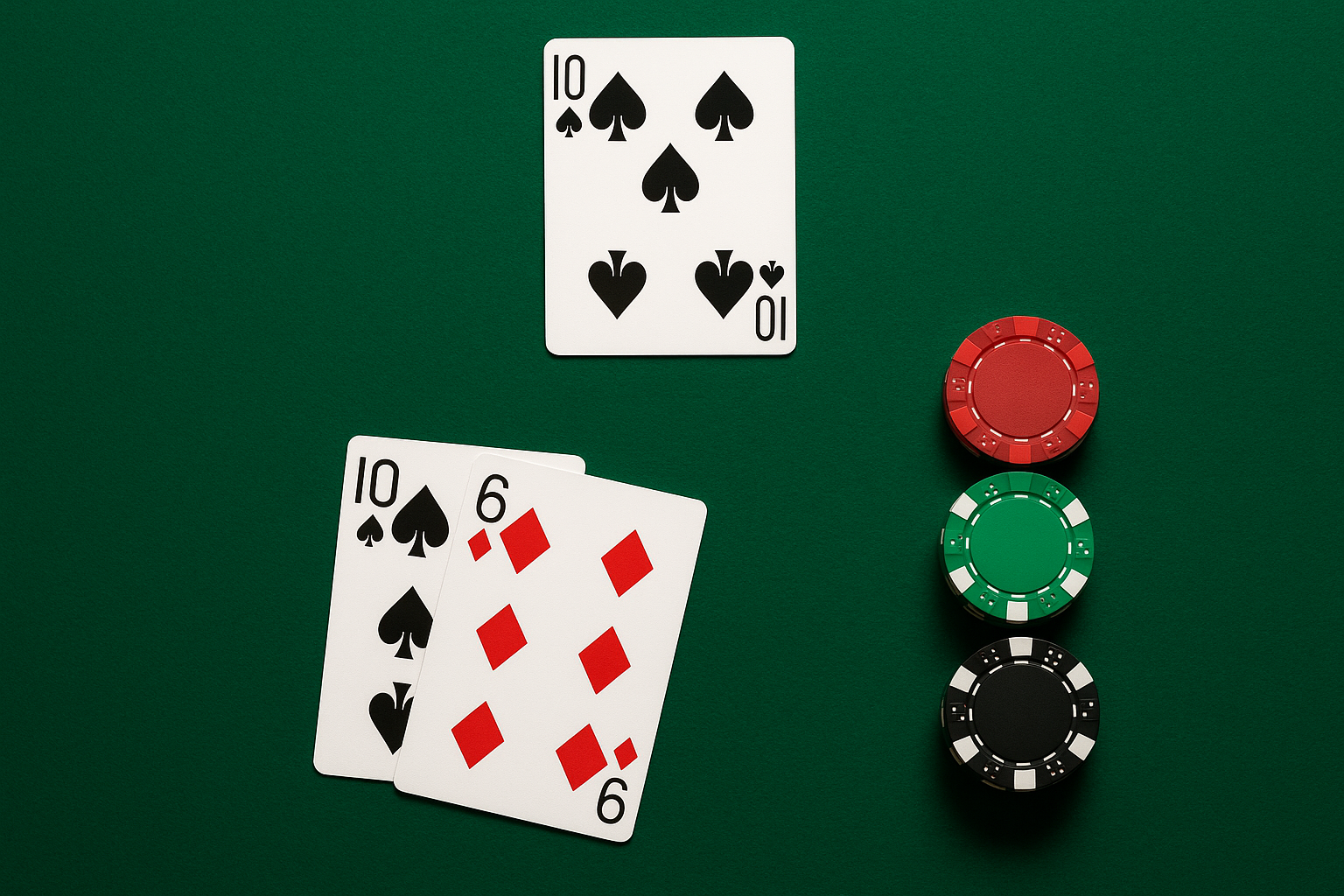
What is a stiff hand in blackjack?
A stiff in blackjack is any hard total of 12 through 16: too high to hit without a real chance of busting, too low to win by standing unless the dealer busts. That’s the whole definition. It’s the worst category of hand in the game, and how you play it has a measurable effect on your results over thousands of hands.
The word “hard” matters. A hard total contains no ace, or contains an ace that must count as 1 because counting it as 11 would bust the hand. A soft hand holds an ace valued at 11, so it can absorb any card without busting. Ace-5 is soft 16. Draw a 10 and you have hard 16, not a bust. Draw a 9 and you have 15. That flexibility is why soft 16 is never a stiff, while 10-6 very much is.
One more use of the term: players also call the dealer “stiff” when the upcard is 2 through 6, because the dealer is forced to draw to a total of at least 17 and busts more often from those cards. Same idea, other side of the table.
Why hard 12–16 are called “stiff” hands
Because both options are bad, and you have to pick one. That’s the dilemma in a sentence.
Stand, and you can only win if the dealer busts, because 12 through 16 beats nothing the dealer can legally stand on. The dealer must reach 17 or higher, so any completed dealer hand beats your 16. Hit, and you might improve, but you might also bust immediately and lose before the dealer even draws a card.
Here’s the arithmetic on a single hit. Counting a 52-card deck by rank, four of the thirteen ranks are worth 10 (ten, jack, queen, king). So from hard 12, one hit busts you roughly 4 in 13 times, about 31%. Every point higher adds one more busting rank:
| Your hard total | Cards that bust you | Approx. bust chance on one hit |
|---|---|---|
| 12 | 10, J, Q, K | ~31% |
| 13 | 9, 10, J, Q, K | ~38% |
| 14 | 8 through K | ~46% |
| 15 | 7 through K | ~54% |
| 16 | 6 through K | ~62% |
Those figures ignore the cards already visible, so real numbers shift slightly hand to hand, but the shape is right: bust risk climbs fast across the stiff range. Standing has no bust risk at all, which is exactly why so many players default to it. The problem is that standing on 16 against a dealer 9 wins only when the dealer busts, and a dealer 9 busts roughly one time in four.
How to play each stiff hand: the math behind hit vs stand
Basic strategy resolves every stiff hand with one question: is the dealer likely to bust? If yes, stand and let the dealer take the risk. If no, take the risk yourself, because you can’t win by standing on a hand that loses to every dealer total from 17 up.
Approximate dealer bust rates in a standard multi-deck game where the dealer stands on all 17s:
| Dealer upcard | Approx. bust chance | What that means for your stiff |
|---|---|---|
| 2 | ~35% | Weak, but the weakest of the weak cards |
| 3 | ~37% | Weak |
| 4 | ~40% | Weak |
| 5 | ~42% | Weak |
| 6 | ~42% | Weakest overall |
| 7 | ~26% | Strong enough that you must draw |
| 8 | ~24% | Strong |
| 9 | ~23% | Strong |
| 10, J, Q, K | ~21% | Strong |
| Ace | ~12% | Strongest |
The full grid for hard 12 to 16, assuming a six or eight deck shoe with the dealer standing on soft 17:
| Your hand | vs 2 | vs 3 | vs 4 | vs 5 | vs 6 | vs 7–A |
|---|---|---|---|---|---|---|
| Hard 12 | Hit | Hit | Stand | Stand | Stand | Hit |
| Hard 13 | Stand | Stand | Stand | Stand | Stand | Hit |
| Hard 14 | Stand | Stand | Stand | Stand | Stand | Hit |
| Hard 15 | Stand | Stand | Stand | Stand | Stand | Hit |
| Hard 16 | Stand | Stand | Stand | Stand | Stand | Hit |
Hard 12: when the dealer shows 2 or 3
Hard 12 is the odd one out. Against a dealer 4, 5 or 6 you stand, same as the rest of the stiff range. Against a 2 or a 3 you hit, and the reason is the gap between the two probabilities. A dealer 2 busts about 35% of the time, so standing on 12 makes you a clear underdog. Hitting 12 busts only about 31% of the time, and the other 69% of the time you land somewhere between 13 and 21, often turning a hopeless hand into one that can win outright.
The edge here is small. Both plays lose money in the long run; hitting just loses a bit less. That’s what basic strategy actually optimizes: the least bad option, hand by hand.
Hard 13–16: reading the dealer’s weakness
From 13 up, the bust math flips. Hitting hard 15 busts you more than half the time, and hitting 16 busts you closer to two thirds. Against a weak upcard (2 through 6) you’re better off standing and letting the dealer draw into trouble, because the dealer’s own bust chance of 35% to 42% is now the better of the two risks.
Against 7 through ace, standing is worse. A dealer showing 7 makes a standing total roughly three quarters of the time, so your 15 is dead unless you improve it. You hit, you bust often, and you still come out ahead of the player who stands, because standing here is close to conceding the hand.
The 16 vs 10 exception people get backwards
You’ll hear “never hit 16 against a 10 or an ace” at almost every table. Under standard multi-deck rules, that’s wrong. Basic strategy says hit 16 against a 9, 10-value card or ace, and if late surrender is offered, surrendering 16 against 9, 10 or ace is better still, since giving up half the bet beats losing the whole thing most of the time.
The honest caveat: 16 vs 10 is the closest decision in the entire strategy chart. Hitting and standing are separated by a fraction of a percent in expected value, and the correct answer flips with the rules and with your exact cards. If your 16 is built from three or more cards, say 5-4-7, you’ve already removed small cards from the shoe that would help you, and standing becomes the better play. If it’s a plain 10-6 in a six-deck shoe, hit it. Either way you’re a heavy underdog on that hand; nothing makes it a good spot.
Common stiff hand mistakes to avoid (hit or stand in blackjack)
- Standing on every 16. Refusing to hit 16 against a 7 through ace feels safe because you never bust. You also almost never win. The dealer completes a hand of 17 to 21 the large majority of the time from those upcards.
- Hitting 13–16 against a 4, 5 or 6. This throws away the dealer’s highest bust chances. Let the dealer draw.
- Standing on 12 against a 2 or 3. The most commonly misplayed stiff at low stakes tables, because “12 is close to 21” feels like a reason not to draw. It isn’t.
- Playing on a hunch or a streak. Each round is dealt from a shuffled shoe, and in online blackjack from a certified random number generator. The last five hands tell you nothing about the next card.
- Listening to the table. Other players’ decisions don’t change your expected value on your own hand. Your 16 against a 10 is your problem alone.
- Ignoring the rule variations. Whether the dealer hits soft 17, how many decks are in play, and whether surrender is offered all shift a handful of stiff-hand decisions. Check the rules of the specific table before you use a chart.
Stiff hands and the house edge
Playing blackjack hard hands correctly doesn’t turn the game in your favor, it just stops you giving away more than you have to. Under good rules, a player following full basic strategy faces a house edge of roughly half a percent. Guess your way through the stiff hands, misplay 12 against a 3, stand on 15 against a 9, and that edge can climb to several times higher. The house advantage is built into the rules, and no decision pattern removes it.
Stiff hands matter more than most players expect because they come up constantly. Any two cards totalling 12 to 16 puts you there, and so does every hand that starts small and draws into the range. Getting those decisions right is the biggest single chunk of value in a basic blackjack strategy chart, which is why the chart exists at all. For definitions of other terms used here, see our casino glossary.
Finally, the practical part: correct play reduces losses, it doesn’t produce income. Set a budget you’re comfortable losing before you sit down, treat blackjack as paid entertainment, and use deposit or session limits if your operator offers them. If gambling stops feeling like a game, stop and seek support.
FAQ
What is a stiff hand in blackjack?
A hard total of 12 through 16. It’s called stiff because hitting risks an immediate bust while standing loses to every total the dealer can stand on, so both options are unattractive.
Should you hit or stand on a hard 16?
Stand against a dealer 2 through 6 and hit against 7 through ace. If the table offers late surrender, surrendering 16 against a 9, 10 or ace is the better option in a multi-deck game.
Why are 12–16 called stiff hands?
Because they’re stuck in the middle. One hit busts hard 12 about 31% of the time and hard 16 about 62% of the time, yet standing wins only if the dealer busts.
How does the dealer upcard change stiff-hand play?
It sets the dealer’s bust probability, which is the whole basis of the decision. Upcards 2 through 6 bust roughly 35% to 42% of the time, so you stand and wait. Upcards 7 through ace bust only about 12% to 26% of the time, so you draw and accept the bust risk yourself.