
What is slot volatility?
Slot volatility describes how a game spreads its payouts over time: whether it pays small amounts often, large amounts rarely, or something in between. It is a measure of pacing and risk, not of how likely you are to come out ahead. Two slots with identical return percentages can feel completely different to play, and volatility is the reason why.
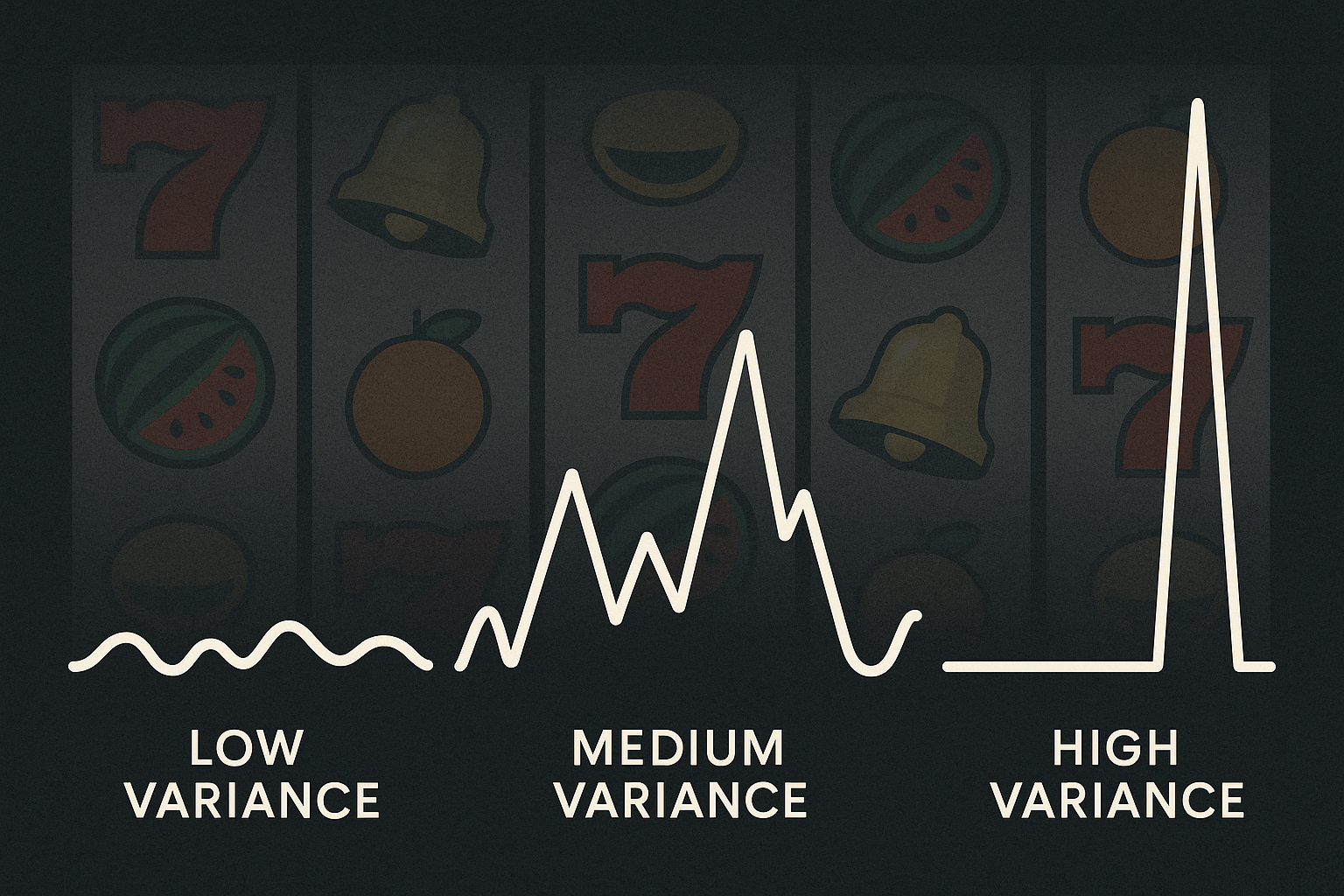
Statisticians would call this the standard deviation of a game’s results. In plain terms, volatility (used interchangeably with “variance” by most players and providers) tells you how bumpy the ride is. A low variance slot drips out modest wins; a high variance slot can sit flat for a long stretch, then hand out a payout worth hundreds of times the stake. The underlying mathematical model of the game decides that distribution, and it is fixed by the developer before the game ever reaches a casino floor or app.
One thing to be clear about from the start: no volatility level removes the house edge. Slots are negative expectation games over the long run, whichever variance profile you pick. What volatility lets you choose is how you spend your budget, quickly with big swings or slowly with small ones.
Volatility vs RTP: different measurements
RTP (return to player) is the long-run percentage of all wagers a slot returns, averaged across millions of spins. Volatility is how that return arrives. RTP is the total; volatility is the schedule.
Here’s a simple way to picture it. Imagine two games that both return 96% over the long run, giving a 4% house edge. Game A gives back a little on roughly every third spin. Game B gives back nothing on most spins but occasionally pays 500 times the stake. Over an enormous number of spins the average return is the same. Over your Tuesday evening session of 300 spins, the two experiences have almost nothing in common.
Because the two numbers measure different things, a high RTP does not imply low volatility, and a high volatility game is not “worse value” than a low volatility one. If you want the full picture on how return percentages are calculated and what they don’t promise, see our guide to slot RTP and house edge.
Low volatility slots: frequent small wins
Low volatility slots pay out often but in small amounts, usually at or below your stake on a typical winning spin. Your balance moves in small steps rather than lurches. Sessions last longer for the same budget, and the emotional swings are mild.
Hit frequency and payout patterns
Hit frequency, the share of spins that return anything at all, is separate from volatility, but the two usually track together. Low variance games tend to produce a win on a large share of spins, often somewhere around a third to nearly half, depending on the title. The catch is what a “win” means: on many of those spins you might get back less than you wagered. A 30-cent return on a 50-cent spin still counts as a hit in the paytable’s eyes.
Typical design signals of a low variance slot are modest top prizes (often a few hundred times the stake rather than thousands), small symbol pay steps, fewer multiplier layers, and free spin rounds that are easy to trigger but pay conservatively. Classic three-reel fruit machines and simple five-reel, ten-payline games often fall into this bracket. Always check the game’s own information screen rather than assuming from the theme.
Best for: small bankrolls and long sessions
Low volatility suits players with a fixed, modest budget who want entertainment time rather than a shot at a huge multiplier. If you deposit $50 and want it to last an hour or two, small frequent returns keep you spinning. It also suits players clearing a bonus with wagering requirements, since a steadier balance makes it less likely you run out before the playthrough is done. That does not make the bonus profitable, it just makes the outcome less erratic.
High volatility slots: rare big wins
High volatility slots pay less often, but when they do pay, the amounts can be many multiples of the stake. This is the profile behind most of the huge screenshots you see online, and also behind a lot of empty balances that nobody posts about.
Payout patterns and dry spells
Expect long gaps. On a high variance slot it is entirely normal to spin 100, 200 or more times without triggering the bonus round, because the game’s return is concentrated in that feature. Some modern high variance titles hold most of their theoretical return inside free spins that hit only once every few hundred spins on average. The trade-off is a maximum win that can reach thousands of times the stake.
Features that push variance upward include cascading or tumbling reels with escalating multipliers, Megaways style setups where the number of ways to win changes each spin, sticky wild multipliers in bonus rounds, and progressive jackpots. Progressives are the extreme case: a slice of every bet feeds a prize that almost nobody wins, which drags the base game’s regular payouts down and makes the swings brutal.
Best for: large bankrolls and thrill seekers
High volatility only makes sense if your bankroll can absorb long losing runs at your chosen stake, and if you accept that most sessions will end with nothing much to show. The honest framing is this: you are trading a high chance of a fast loss for a small chance of a large payout, with the same house edge working against you either way. If a 150-spin dead stretch would tempt you to raise your bet to “catch up”, this category is not for you.
Medium volatility slots: balanced risk
Medium volatility sits between the two extremes, which is exactly why it’s the most common setting for mainstream releases. Wins arrive often enough to keep a session alive, and the bonus round pays enough to feel worth waiting for. Typical top wins land in the hundreds to low thousands of times the stake.
Some providers split the middle further, using labels like low-medium or medium-high. Those are useful hints, but they are marketing shorthand rather than a standard scale, and there is no industry body defining where one band ends and the next begins. One studio’s “medium” can feel like another’s “high”.
Here is how the three slot risk levels compare in practice:
| Feature | Low volatility | Medium volatility | High volatility |
|---|---|---|---|
| Payout frequency | Often | Moderate | Infrequent |
| Typical win size | Small, often under 1× stake | Moderate, a few times stake | Large but rare |
| Typical max win | Hundreds × stake | Hundreds to low thousands × stake | Thousands × stake or progressive |
| Balance swings | Shallow | Noticeable | Severe |
| Session length per $100 | Longest | Middle | Shortest at the same stake |
| Suits | Small budgets, long play | Most casual players | Larger budgets, high risk tolerance |
Does volatility affect your chances of winning?
Not in the way most players assume. Volatility does not change a game’s RTP or its house edge, so it does not improve or worsen the long-run value you get back. What it changes is the shape of the outcomes: how often you win, how much you win when you do, and therefore how likely you are to be ahead or busted at any given point in a session.
There is a real effect worth understanding, though. On a high variance slot, the distribution of session results is wide. More sessions end at zero, and a few end with an unusually large win. On a low variance slot, most sessions end with a slow drift down toward the house edge, with fewer extremes in either direction. Same expected return, very different spread.
The misconception to bury is the idea that a game becomes “due” after a dry spell. Slot outcomes come from an RNG, and each spin is independent of every spin before it. A slot that hasn’t paid a bonus in 400 spins has exactly the same chance on spin 401 as it did on spin one. The RTP figure is an average over millions of rounds, not a debt the machine repays on a schedule. If a system promises to time a machine’s cycle, it is wrong about how the software works.
How to find a slot’s volatility
Most of the time the game tells you. Check these places, roughly in this order:
- The in-game info or paytable screen. Many developers print a volatility rating there, sometimes as a five-bar or ten-point scale next to the RTP and maximum win.
- The provider’s own game page or fact sheet. Studios publish specification sheets listing RTP, volatility, maximum win, hit frequency and bonus trigger rates.
- The casino’s game description. Regulated operators often list volatility alongside RTP in the game lobby or the review tab.
- Independent slot databases and reviews. Useful for cross-checking, though ratings differ between sites because the scales differ.
When no rating is published, read the paytable for clues. A maximum win of 5,000× the stake or more, a bonus round that needs four or five scatters, and huge gaps between the top and mid symbol payouts all point to high variance. Small top prizes and frequent low-value symbol combinations point the other way.
Demo play is the practical test. Spin a few hundred rounds in free mode at a fixed bet and watch the balance line. If it grinds gently downward with regular small hits, that’s low variance. If it drops off a cliff and then spikes, that’s high variance. A few hundred spins won’t tell you anything reliable about RTP, but it does show you the rhythm.
Choosing volatility for your bankroll
Start from two numbers: the money you have set aside for entertainment and the time you want it to last. Then divide. A $100 session bankroll spread over 400 spins means 25 cents a spin. Once you know your stake per spin, volatility decides whether that stake gives you a fighting chance of reaching your target session length.
Small bankroll strategy
With a small budget, low or low-medium volatility at the minimum practical stake gives you the most spins. As a rough guide, keep each spin at or under 1% of the money you have set aside for the session, so a run of losses doesn’t end things in five minutes. Avoid progressives and 10,000× max-win titles at a small stake; the maths behind them assumes far more spins than your budget can buy. Our bankroll management guide covers how to size stakes and set stop points before you start.
Large bankroll options
A larger bankroll gives you room to sit through the dry spells that high variance games require, but the sizing logic doesn’t change, it just scales. If you want to play a high variance slot, cut the stake rather than raise it: a smaller bet across many more spins is the only way to give a rare feature a realistic chance of appearing within your session. Plenty of experienced players mix categories, using a medium volatility game as the main session and dipping into a high variance title with a small, capped portion of the budget.
Whatever you choose, set deposit and loss limits before you spin, use session reminders if your casino offers them, and treat any win as a good result to walk away on rather than a bankroll to reinvest. Slots are entertainment with a built-in mathematical edge for the house, never a way to make money. If play stops feeling like a choice, use the cool-off or self-exclusion tools in your account, or contact a national problem gambling helpline.
FAQ
What is the difference between high and low volatility slots?
Low volatility slots pay small amounts frequently, keeping your balance relatively steady. High volatility slots pay rarely but much larger when they do, with long stretches of nothing in between. Both can share the same RTP.
Does volatility affect chances of winning?
It changes how often and how much you win, not the game’s overall return or house edge. High variance games produce more zero-return sessions and a few very large ones; low variance games produce more small, similar results.
Which volatility is best for a small bankroll?
Low to medium volatility at the smallest workable stake. It buys the most spins per dollar and reduces the chance of losing everything before you’ve had much play time.
Can I tell a slot’s volatility just by playing it?
You can get a feel for it in a few hundred demo spins by watching how jagged the balance line is. For an actual figure, check the paytable, the provider’s fact sheet, or the casino’s game information.
Do high volatility slots have higher RTP?
No. RTP and volatility are set independently. Some high variance games have below-average RTP and some low variance games have above-average RTP, so check both numbers separately.