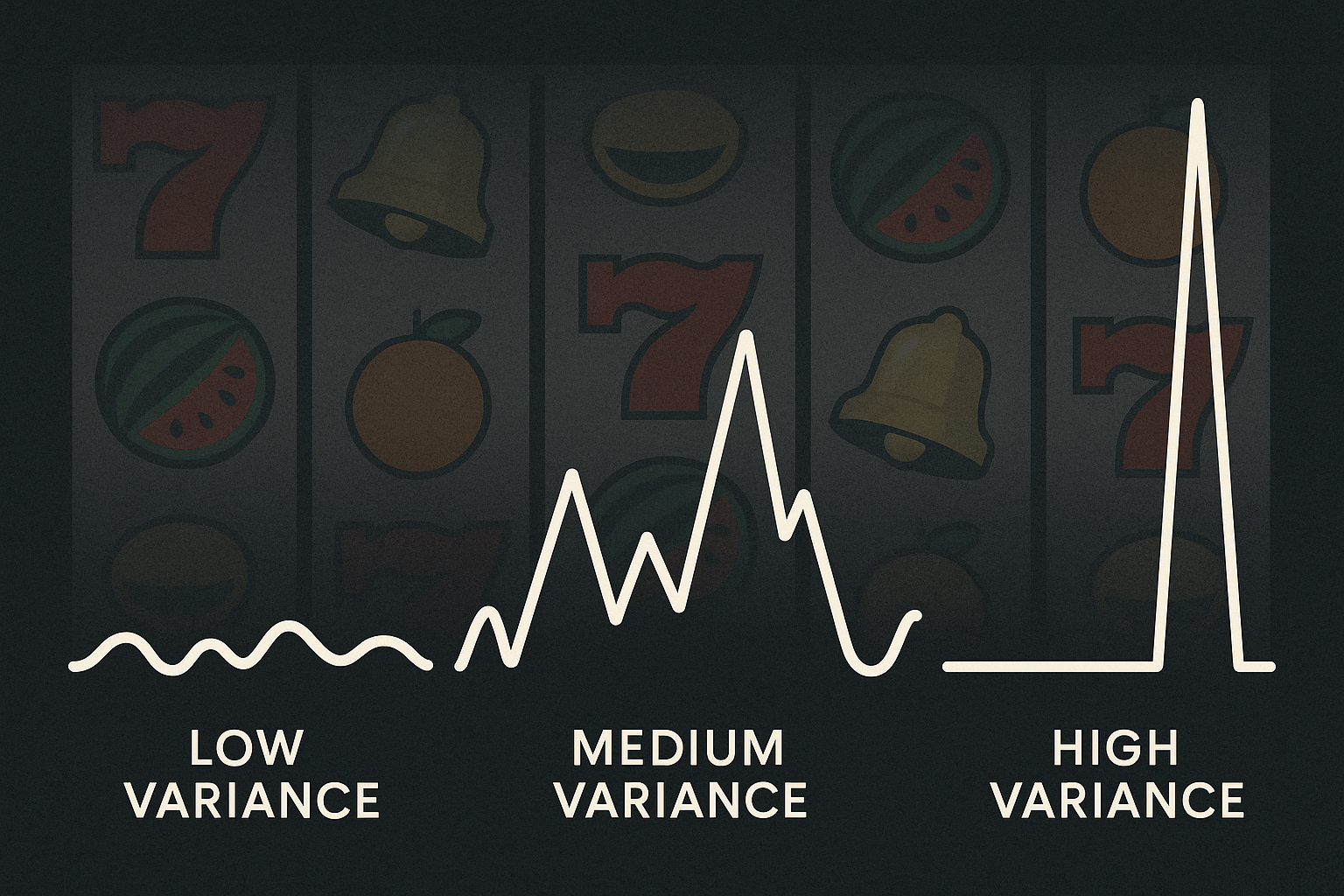
Slot volatility describes how a game spreads its payouts over time: lots of small wins, a few huge ones, or something in between. It is a pacing and risk setting, not a prediction of whether you’ll win. Two slots with identical RTP can feel completely different to play, and volatility is why.
Understanding it matters for one practical reason: it tells you how much bankroll a game realistically needs and how long your money is likely to last. That’s a planning tool, not a winning system.
What is slot volatility?
Slot volatility (also called slot variance) is a measure of how a game’s payouts are distributed. Low volatility means frequent, small wins. High volatility means long stretches of nothing punctuated by occasional large payouts. It describes the shape of the results, not the total returned.
Mathematically, it’s closely tied to standard deviation, the statistical measure of how far individual results tend to sit from the average. A game where nearly every win is worth 1x to 5x your stake has a low standard deviation. A game where the average return depends heavily on a bonus round paying 200x has a high one. Game developers build both from the same mathematical model, then tune the paytable to hit the payout profile they want.
What volatility does not tell you is your chance of walking away ahead in any given session. Nothing about a slot guarantees that, and over the long run every slot returns less than it takes in.
Volatility vs RTP: different measurements
RTP (Return to Player) is the long-run percentage of all wagers a game pays back, averaged over millions of spins. A 96% RTP slot returns about $96 per $100 wagered across that huge sample, which means a 4% house edge. Most online slots sit somewhere around 94% to 97%.
Think of RTP as the destination and volatility as the road. Two slots can both be headed to 96%, but one takes a smooth, gently rolling route and the other is all switchbacks and cliffs. Same average, wildly different ride.
Practical consequence: a 96% RTP high variance slot can drain a small bankroll faster than a 94% RTP low variance slot, even though the higher-RTP game is technically the better long-run value. Short sessions are dominated by variance, not RTP. If you want the full breakdown of the maths behind returns, see our guide to RTP and house edge.
Low volatility slots: frequent small wins
Low volatility slots pay often but modestly. You’ll land small wins regularly, many of them below your stake, and the top prizes are usually capped at a few hundred times your bet rather than several thousand. The balance moves in small increments rather than lurching.
Hit frequency and payout patterns
Hit frequency is how often a spin produces any win at all, and it’s a separate stat from volatility, though the two usually track together. Low variance games commonly land in the rough range of one win every two to three spins. Many of those “wins” return less than the stake, which is the part that surprises new players: a winning spin isn’t automatically a profitable spin.
Typical traits you’ll see in low volatility slots:
- Classic 3-reel and simple fruit machine layouts
- Modest paytables where the top symbol pays maybe 50x to 500x
- Few or no big multiplier features
- Free spins rounds that pay small, steady amounts rather than jackpot-sized hits
Best for: small bankrolls and long sessions
If your budget is tight and you want play time, low variance is the sensible match. Frequent small returns stretch a bankroll because they keep topping it back up between losses. A $50 budget at $0.20 a spin can realistically run for a long stretch on a low volatility game, whereas the same budget on a high variance slot may not survive long enough to see the bonus round it’s built around.
High volatility slots: rare big wins
High volatility slots pay rarely but larger. A big share of the game’s total return is locked inside features that trigger infrequently, so the base game can feel cold for a long time. When it does hit, the payout can be worth hundreds or thousands of times the stake.
Payout patterns and dry spells
Dry spells are the defining feature, not a malfunction. On a high variance slot it’s completely normal to go 50, 100 or more spins without a meaningful win. The maths accounts for that; your bankroll has to as well.
Features that usually signal high variance:
- Advertised max wins of 5,000x the stake or more
- Megaways or variable ways-to-win engines
- Cascading or tumbling reels with progressive multipliers
- Free spins rounds that carry most of the game’s payout potential
- Bonus buy options, which exist precisely because base-game triggers are rare
- Progressive jackpots, where a slice of every bet feeds a prize almost nobody hits
Best for: large bankrolls and thrill seekers
High variance suits players with enough bankroll to absorb long losing runs and who genuinely enjoy the swings. It also demands smaller bet sizes relative to your budget than most people expect: the whole point is surviving long enough for a feature to trigger, and there is no guarantee it will within any given session.
Medium volatility slots: balanced risk
Medium volatility sits between the two extremes, which is why most modern video slots are built there. Hit frequency is moderate, wins are big enough to feel like something happened, and dry spells are shorter than on high variance games. Top prizes commonly land in the 1,000x to 3,000x range.
For most players this is the default, and there’s nothing lazy about that choice. It’s the profile that supports a session of a few hundred spins on a mid-sized budget without either feeling flat or evaporating in ten minutes.
Here’s how the three slot risk levels compare in practice:
| Feature | Low volatility | Medium volatility | High volatility |
|---|---|---|---|
| Win frequency | High | Moderate | Low |
| Typical win size | Small, often under stake | Moderate | Occasionally very large |
| Typical max win | Up to a few hundred x | Around 1,000x–3,000x | 5,000x and above |
| Dry spells | Short | Medium | Long, 50+ spins is normal |
| Bankroll needed | Smallest | Moderate | Largest |
| Suits | Long, low-stakes sessions | General play | Swing-tolerant players |
Does volatility affect your chances of winning?
No, not in the way most people mean. Volatility does not change RTP or the house edge. A 96% RTP slot has a 4% house edge whether it’s low or high variance. What changes is when the money comes back and in what size chunks.
Volatility does shift your session outcomes, though. On a high variance game, a bigger share of sessions end at zero, and a small share end far ahead of where a low variance game could take you. Same average, wider spread. That’s a distribution difference, not an odds advantage.
The “due for a win” idea deserves killing outright. Slot outcomes come from an RNG (Random Number Generator), and every spin is independent of every spin before it. A high variance slot that has gone 300 spins without a bonus is exactly as likely to trigger on the next spin as it was on spin one. There are no hot or cold machines, and no amount of previous losses makes a payout owed to you.
How to find a slot’s volatility
Most providers publish it, so start with the game itself:
- The game info or paytable screen. Open the menu inside the slot. Many developers list volatility directly, often as a word (low/medium/high) or a 1-to-5 rating alongside RTP and max win.
- The provider’s own game page. Studios publish spec sheets for each release with RTP, volatility rating, max win and hit frequency.
- Casino lobby filters. Some operators let you sort or filter the slots library by volatility.
- Independent slot databases and reviews. Useful cross-checks, and our slot reviews list volatility alongside RTP for each game.
If it isn’t stated anywhere, read the numbers instead. Max win multiplier is the strongest clue: a 500x ceiling means low variance almost by definition, while 10,000x means the game is built around rare events. A paytable where the premium symbol pays only 20x for five of a kind points to a top-heavy bonus structure, which is another high variance signal.
Demo play helps you feel the pacing, and it’s free. A hundred spins in demo mode will tell you whether the base game trickles or starves. Be honest about the limits, though: a hundred spins is far too small a sample to say anything about a game’s actual returns, and demo results tell you nothing about what will happen with real money.
Choosing volatility for your bankroll
Match the game to two things: how much you’re willing to lose, and how long you want to play. Volatility is the dial that connects those two.
The arithmetic is simple. Divide your budget by your bet size and you get your baseline number of spins before any wins extend the session:
| Bet per spin | Spins from a $50 budget | Spins from a $200 budget |
|---|---|---|
| $0.20 | 250 | 1,000 |
| $0.50 | 100 | 400 |
| $1.00 | 50 | 200 |
| $2.00 | 25 | 100 |
Small bankroll strategy
With a small budget, the risk isn’t picking the wrong game, it’s picking a bet size that ends the session in twenty spins. Low or medium volatility at the game’s minimum stake gives you the most play time per dollar. If you want to try a high variance slot on a small bankroll, treat it as a short, deliberate experiment at the lowest possible stake and accept that the feature may never trigger. For more on sizing stakes to a budget, see our bankroll management guide.
Large bankroll options
A larger budget buys you the ability to sit through high variance dry spells without being forced out, which is the only real requirement those games have. Keeping each spin to a small fraction of the total budget is what makes 500 or more spins possible. A bigger bankroll does not improve the odds or the house edge; it only widens the range of games you can play through comfortably.
Whatever profile you choose, set a loss limit and a time limit before you start, use the deposit and session limits your casino provides, and treat the money as entertainment spend you can afford to lose. Slots are designed to return less than they take over time, and no volatility level changes that. If play stops feeling like entertainment, cool-off and self-exclusion tools are there for exactly that, and free confidential help is available through organisations such as the National Council on Problem Gambling.