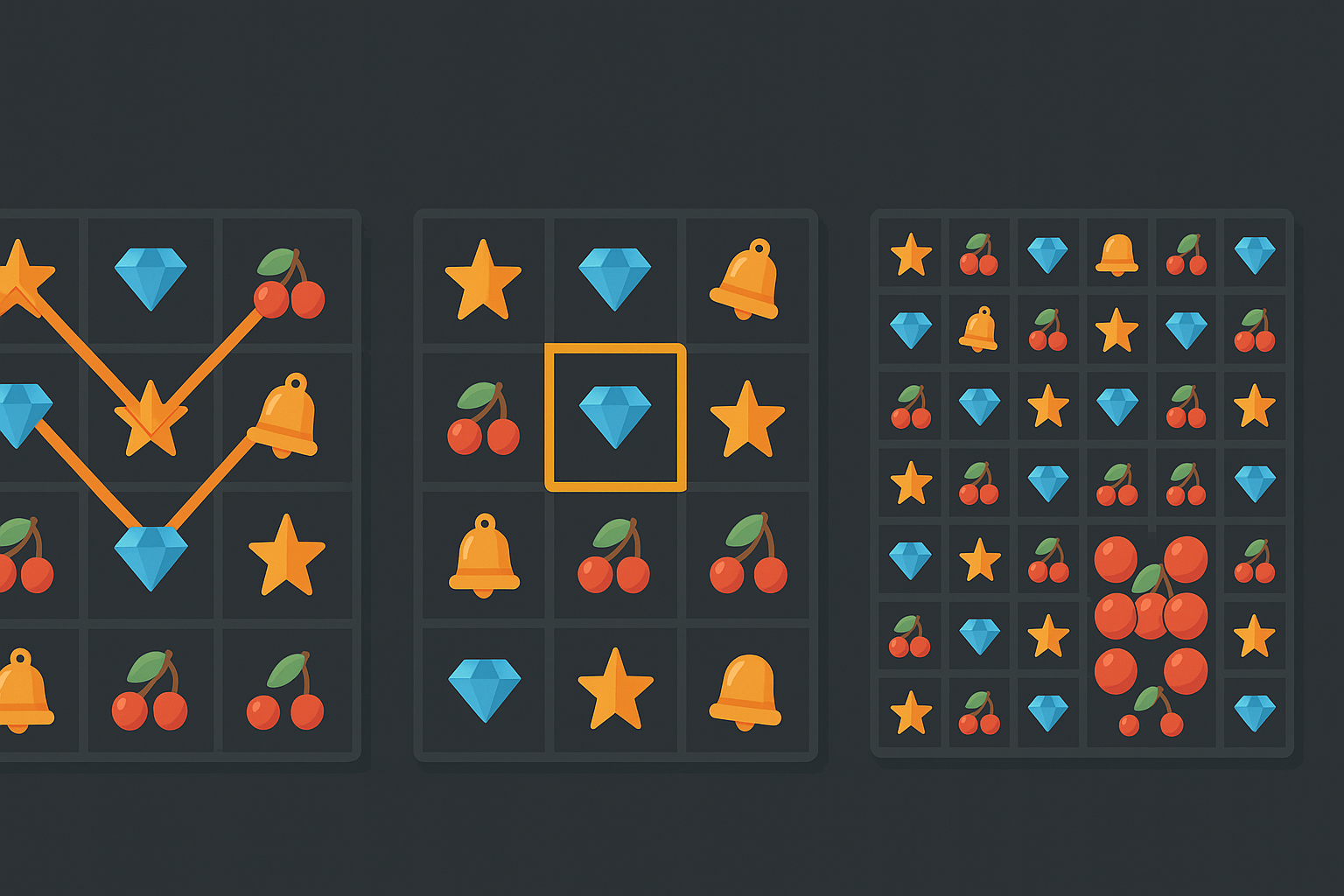
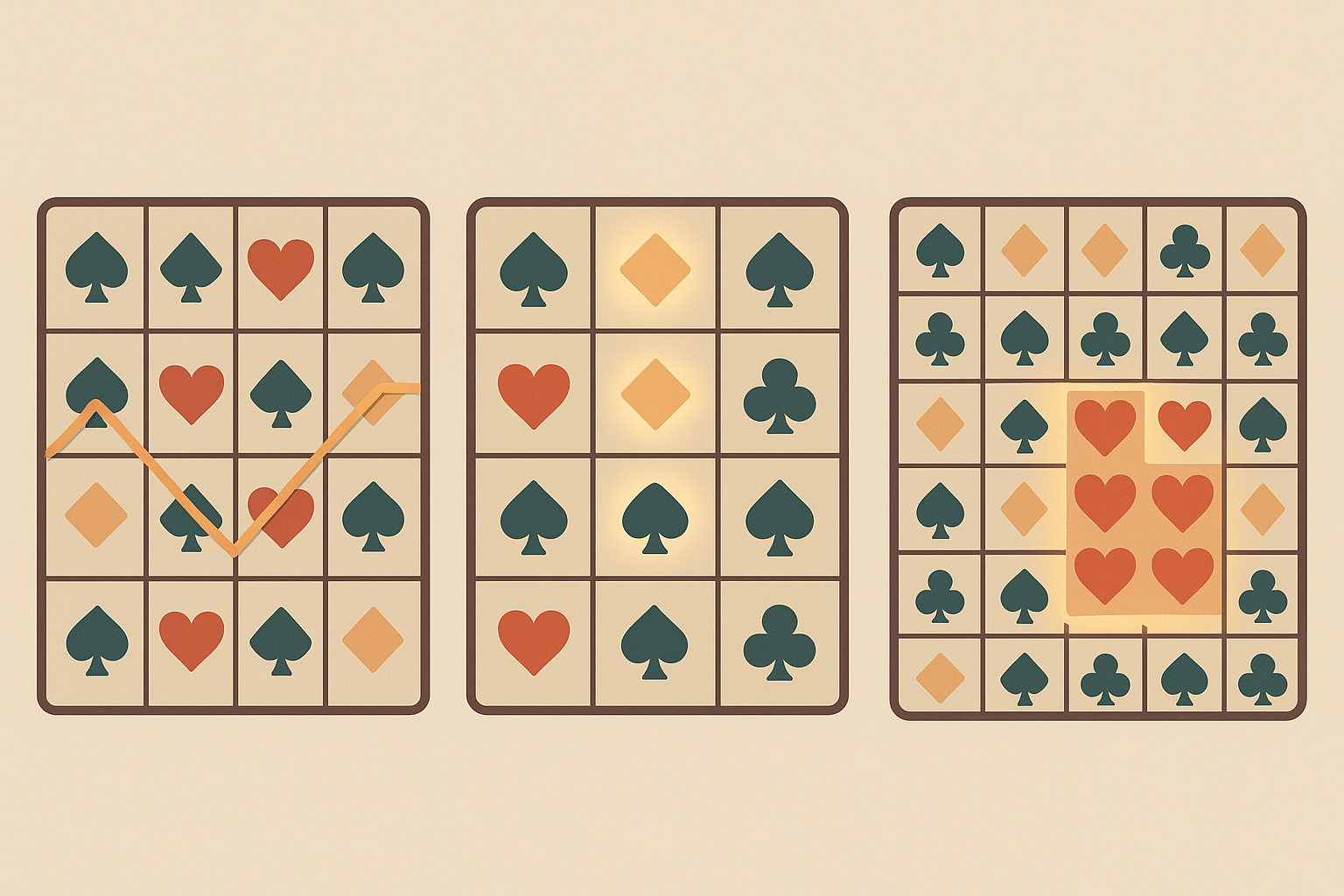
Slot paylines, ways-to-win, and cluster pays are three different ways a slot decides that you’ve made a winning combination. Paylines require symbols to land on a set pattern. Ways-to-win only cares that symbols land on consecutive reels, in any row. Cluster pays ignore reels entirely and look for groups of touching symbols. Same reels, same random number generator, three different rulebooks for reading the screen.
Understanding which system a game uses matters because it changes what a win looks like and how often small wins show up. What it doesn’t change is the game’s built-in advantage. More on that below, because it’s the part most articles skip.
What are slot paylines? (traditional system)
A payline is a specific pattern of symbol positions across the reels. If matching symbols land on the positions that make up that pattern, you get paid. If the same symbols land in a slightly different arrangement, you get nothing, even if they’re all on screen.
Picture a standard 5×3 grid: five reels, three rows, 15 symbol positions. Payline 1 is often the middle row, straight across. Payline 2 might be the top row, payline 3 the bottom row, then the zigzags start: down-up-down, V shapes, W shapes. A 20-line game has 20 of these patterns overlaid on the same 15 positions.
Almost every payline slot pays left to right, starting from reel 1. Three matching symbols on reels 1, 2 and 3 of the same payline is the minimum win in most games. A handful of slots pay both ways, meaning combinations starting from reel 5 count too, which effectively doubles the ways a line can pay.
Fixed vs adjustable paylines
Fixed paylines are always active. Your bet covers all of them, and the game’s bet levels are already priced for the full set. Most slots released in the past decade work this way, mainly because it removes a source of player confusion.
Adjustable paylines let you switch lines on and off. Total stake = number of active lines × bet per line. Play 5 lines instead of 25 and your spin costs a fifth as much, but you can only win on those 5 patterns. You’re not getting a discount on the same game, you’re buying a smaller game.
This is where the old advice “always play all the paylines” comes from, and it’s half right. Playing every line at the lowest coin value is usually better than playing a few lines at a high coin value, because some bonus features and top-symbol combinations only trigger on active lines, and jackpot ladders occasionally require a full-line bet. But it does not lower the house edge. It just means you’re covering the whole board with each spin. If the full-line minimum bet is more than you want to stake, the honest answer is to pick a cheaper slot rather than to switch lines off.
How payline wins are calculated
Each win is paid per line, using the paytable value for that symbol and that combination length, multiplied by your bet per line.
Example: a 20-line slot, $0.05 per line, $1.00 total spin. The paytable pays 10x the line bet for three of a particular symbol. Three of them land on payline 1, so the win is 10 × $0.05 = $0.50. If the same three symbols also complete payline 7, that’s a second win of $0.50, and both are added together. Wins on separate paylines stack; the longest combination on any single line is the one that pays for that line.
Ways-to-win slots: 243, 1024, and beyond
Ways-to-win slots drop the patterns. Instead, they count every combination of adjacent matching symbols on consecutive reels, starting from reel 1, regardless of which row each symbol sits in. Position stops mattering; only the reel does.
How 243 ways to win works
The number comes straight from the grid. On a 5×3 grid, each reel shows 3 symbols, and a five-symbol combination can use any one of the 3 positions on each of the 5 reels: 3 × 3 × 3 × 3 × 3 = 243 possible paths across the screen. That’s the whole “243 ways to win” claim, and it’s just arithmetic on the reel structure.
The practical difference from paylines shows up on short wins. Say the same symbol lands twice on reel 1, once on reel 2 and once on reel 3. On a payline slot, that pays only if those exact positions sit on an active pattern. On a 243-ways slot, both reel-1 symbols pair with the reel-2 and reel-3 symbols, so you’re paid two ways: 2 × 1 × 1 = 2 winning combinations.
Ways-to-win games charge a single total bet per spin rather than a bet per line, and the paytable is quoted either as a multiple of total bet or per way. Read which one before you judge whether a payout looks generous.
Common ways-to-win configurations
The maths is always rows raised to the power of reels, assuming every reel is the same height.
| Grid | Calculation | Ways to win |
|---|---|---|
| 5 reels × 3 rows | 3⁵ | 243 |
| 5 reels × 4 rows | 4⁵ | 1,024 |
| 5 reels × 5 rows | 5⁵ | 3,125 |
| 6 reels × 4 rows | 4⁶ | 4,096 |
| 6 reels × 7 rows | 7⁶ | 117,649 |
A big number on the loading screen tells you the grid size, not the generosity of the game. A 4,096-ways slot isn’t 17 times better than a 243-ways slot.
Megaways: variable ways-to-win system
Megaways takes the ways-to-win idea and makes the grid itself change on every spin. The system was created by Big Time Gaming (BTG) and is licensed to other studios, which is why you’ll see Megaways versions of slots from many different providers.
How Megaways calculates ways
A standard Megaways slot has 6 reels, and each reel can land anywhere between 2 and 7 symbols high. The ways count is recalculated after the reels stop: multiply the number of symbols on each reel together.
- All six reels at 7 symbols: 7 × 7 × 7 × 7 × 7 × 7 = 117,649 ways, the advertised maximum.
- All six reels at 2 symbols: 2⁶ = 64 ways.
- A mixed spin of 4, 7, 3, 6, 7, 2: 4 × 7 × 3 × 6 × 7 × 2 = 7,056 ways.
So the headline 117,649 is the ceiling, not the norm. Many Megaways games also add a horizontal reel above the grid that feeds extra symbols into reels 2 to 5, which is how some titles push the count beyond the base maximum.
Cascading wins feature
Megaways slots almost always include cascading wins, also called tumbling or avalanche reels. Winning symbols are removed, the symbols above drop into the gaps, and new symbols fill the top. If the new arrangement forms another win, it pays too, and the process repeats until no new win lands. Reel heights are recalculated as the cascade continues, so the ways count shifts mid-sequence.
In free spins rounds, many of these games attach a win multiplier that increases with each cascade and doesn’t reset until the round ends. That combination, huge variable ways plus climbing multipliers, is why Megaways titles tend to be high volatility: long stretches of nothing, punctuated by occasional large sequences.
Cluster pays: symbol groups create wins
Cluster pays slots pay for groups of identical symbols that touch each other, usually horizontally and vertically rather than diagonally. There are no paylines and no left-to-right rule. Where the group sits on the grid doesn’t matter, only its size.
Minimum cluster sizes
Most cluster games set the minimum at 5 touching symbols, though some use 4 or require larger groups on bigger grids. Grids tend to be square and roomy, 6×6 or 7×7, to give clusters space to form. Payouts scale with cluster size, and they scale steeply: a 5-symbol cluster might pay a small fraction of your stake, while a 15-symbol cluster of the same symbol can pay many times it.
Example on a 6×6 grid: nine matching symbols land in a connected shape, say a 3×3 block. That single cluster pays the paytable value for “9 of a kind” once. It is not treated as multiple overlapping wins the way a payline grid would handle it.
Cascading and multiplier features
Cluster pays and cascading go together almost by necessity. After the cluster pays, those symbols vanish, remaining symbols drop down, new ones fall in from above, and any new cluster pays again. A single spin can chain several times.
Common add-ons include multipliers that step up with each cascade, symbols that transform neighbours after a certain number of cascades, and features that trigger when a cluster reaches a set size. NetEnt’s Aloha! Cluster Pays helped popularise the mechanic, and games like Reactoonz and Jammin’ Jars built the cascade-plus-multiplier structure that most modern cluster slots follow.
Do more paylines mean better odds?
No. The payout structure does not change a slot’s RTP or house edge. A 10-line slot, a 117,649-ways Megaways game and a cluster pays grid can all run at 96% RTP, meaning about $96 returned per $100 wagered averaged over millions of spins across all players. The remaining 4% is the house edge. Designers set the paytable values, reel compositions and feature frequencies to hit whatever RTP they’re targeting, whatever the structure.
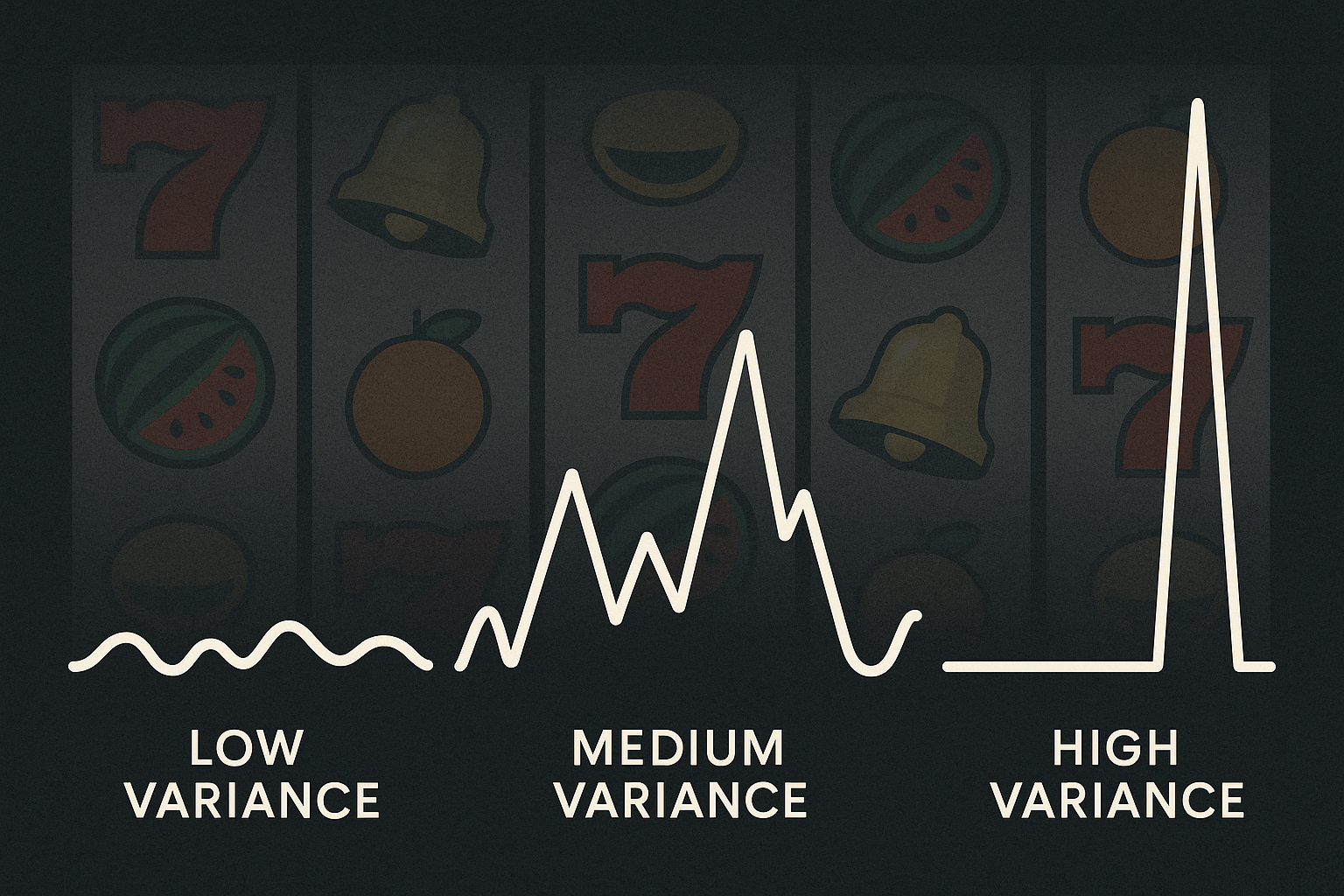
What the structure genuinely changes is hit frequency and volatility, which is how the returns are distributed rather than how large they are in total:
- More ways or lines generally means you win something more often, but those wins are smaller, and many are less than your stake. A “win” of $0.40 on a $1.00 spin is a 60-cent loss with a celebration sound attached.
- Fewer lines with bigger paytable values means longer dry runs and larger hits when they land.
- Cascading and multiplier features tend to push volatility up: more of the total return is concentrated in rare, long sequences.
The gambler’s-fallacy version of this question is worth killing off too. Each spin is generated independently by the RNG. Covering 117,649 ways doesn’t make a big win “due”, and past spins carry no information about the next one.
Which payout system should you choose?
Pick based on the experience you want, since the maths won’t be doing you any favours either way.
| System | How a win forms | Typical feel | Suits players who… |
|---|---|---|---|
| Paylines | Matching symbols on a set pattern, usually left to right | Easy to read, wins are obvious | want to see exactly why they were paid |
| Ways-to-win (243–4,096) | Adjacent symbols on consecutive reels, any row | Frequent small wins, simple total-bet staking | prefer steady action over long droughts |
| Megaways | Ways recalculated each spin from variable reel heights | Swingy, feature-driven, high volatility | accept long dry spells for occasional big sequences |
| Cluster pays | Groups of 5+ touching identical symbols | Cascade chains, multipliers, unpredictable | enjoy feature build-up over line-by-line wins |
Two numbers in the game’s info screen tell you more than the payout structure ever will: the published RTP and the volatility rating. Two Megaways slots can behave completely differently, and a plain 20-line game with a 96.5% RTP returns more over the long run than a 117,649-ways game running at 94%. Check the paytable and info panel before you spin. If you’re still getting comfortable with the basics, our guide to how slot machines work covers RNGs, reel weighting and paytables in more detail.
One last thing worth saying plainly: no payout structure removes the house edge, and slots are designed to be entertainment with a cost, not a way to make money. Set a budget before you play, use deposit and session limits, and stop when the budget’s gone rather than chasing it. If gambling stops feeling like a game, our responsible gambling resources list the tools and support services available.