What is slot volatility?
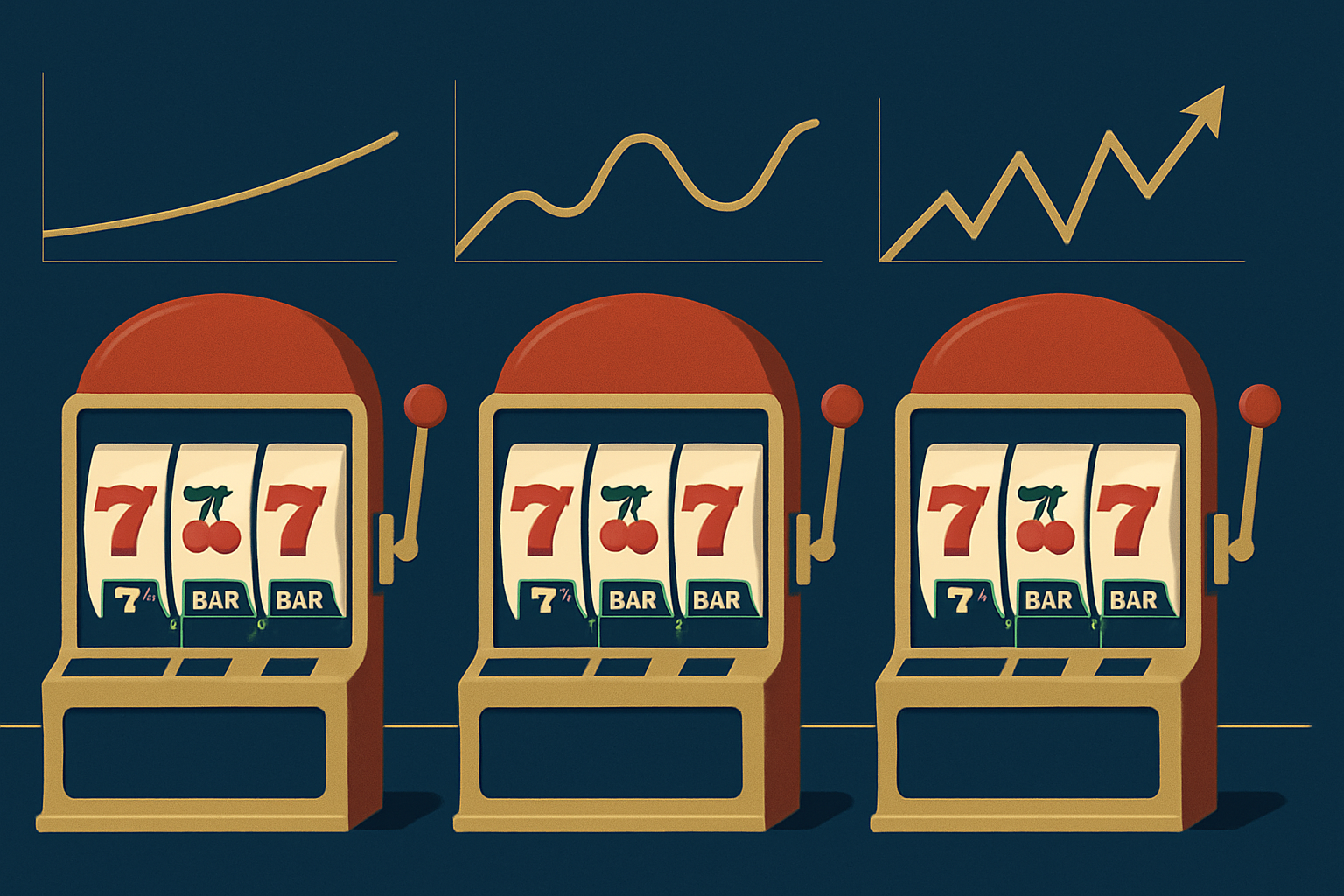
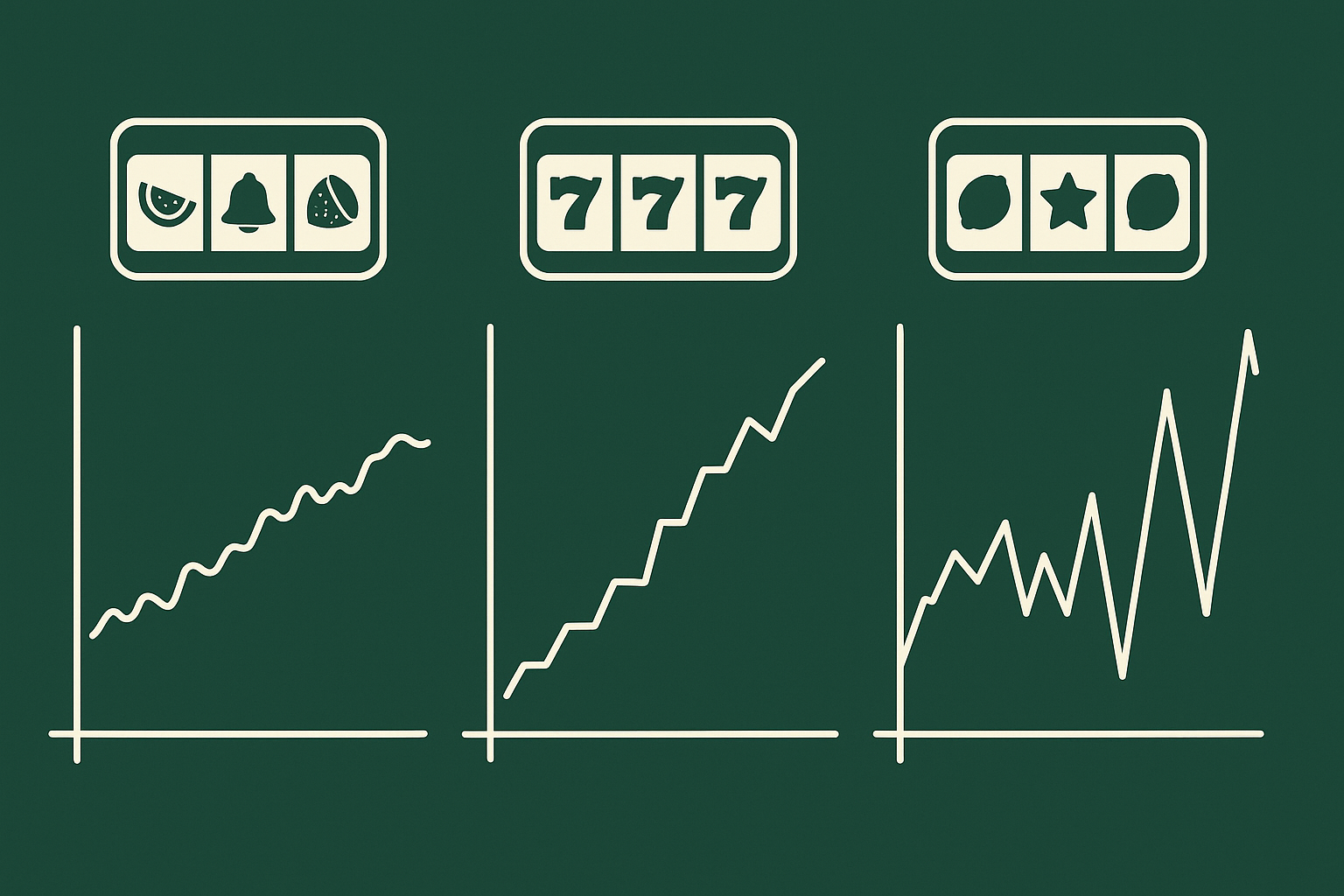
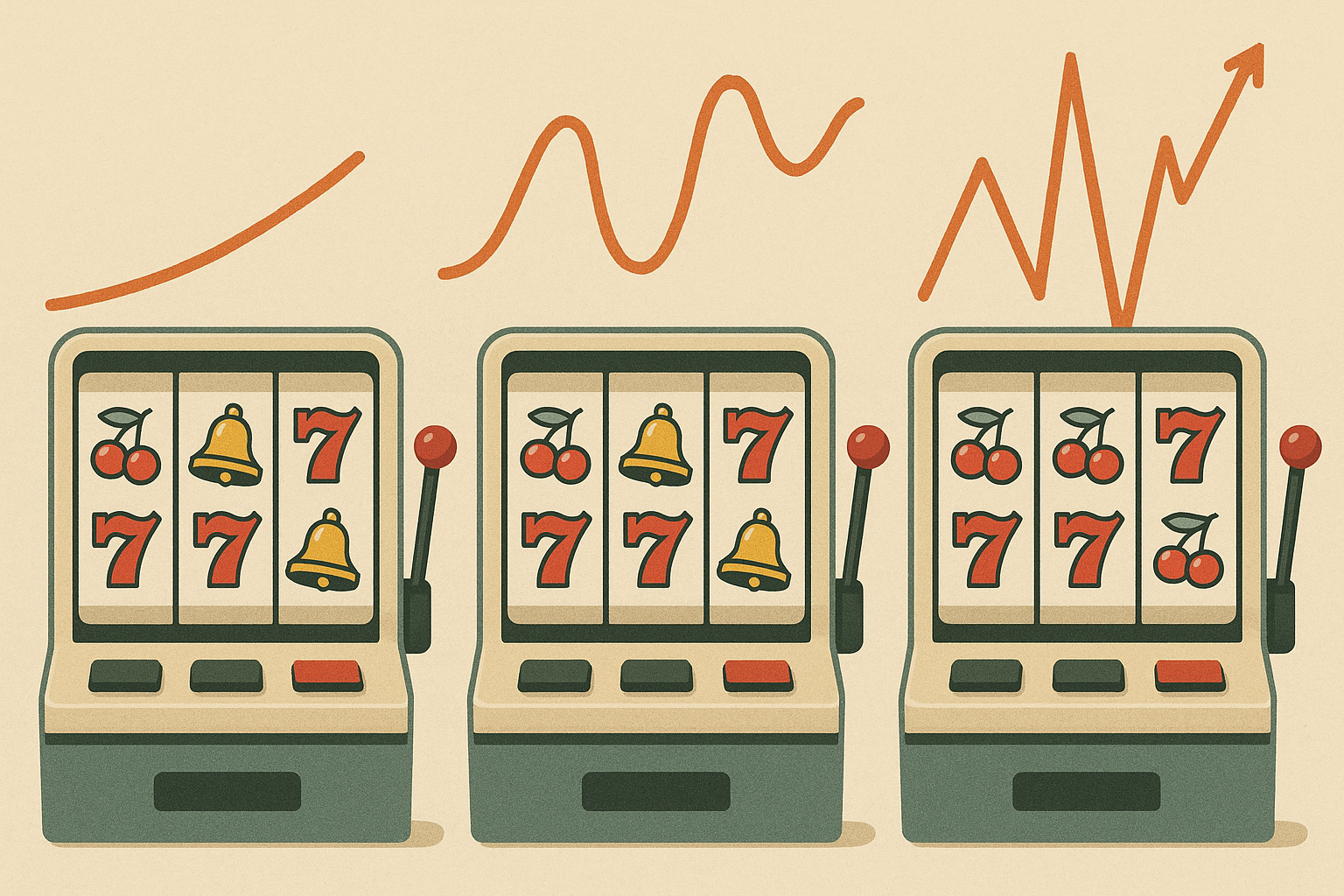
Slot volatility is how a game spreads its payouts: whether it pays small amounts often, or large amounts rarely. It’s also called variance, and the two words mean the same thing. Volatility doesn’t change how much a slot returns over the long run, only the shape of the ride you get along the way.
In practice, a low volatility slot will keep dribbling wins back at you, most of them worth less than your bet. A high volatility slot will happily take 40 spins in a row without paying anything, then hand over a bonus round that pays 80 times your stake. Same average return, wildly different sessions.
That last point is where most players get confused, so it’s worth separating the two numbers clearly.
Volatility vs RTP
RTP (return to player) is the percentage of all money wagered that a game returns on average over millions of spins. A 96% RTP means roughly $96 back per $100 wagered across that enormous sample, leaving a 4% house edge. Volatility says nothing about that percentage. It describes how the return is distributed.
Picture two slots, both set to 96% RTP:
- Game A pays out mostly in small hits of 0.5x to 3x your bet, several times a minute of play.
- Game B pays almost nothing in base play and stores most of its 96% inside a free spins feature that triggers once every 150 spins or so.
Over a million spins, both hand back about the same. Over your 200-spin session tonight, Game A will probably end somewhere near your starting balance, and Game B will either be well up or well down. Neither is a better deal mathematically. The house edge is identical, and no volatility level removes it. If you want the full picture on the return figure itself, read our guide to RTP and house edge.
Low volatility slots: frequent small wins
Low volatility slots pay often and pay small. You’ll land something on a large share of spins, but a lot of those “wins” return less than the bet you just placed, which is why your balance drifts down slowly instead of crashing. Sessions feel steady, and your money lasts longer per dollar deposited.
Characteristics of low variance games
- High hit frequency, often somewhere in the 30% to 45% range depending on the title.
- Modest top prizes, commonly a few hundred times your stake rather than thousands.
- Simpler features: expanding wilds, re-spins, small multipliers, fewer stacked bonus mechanics.
- Bonus rounds that trigger more readily but pay less when they land.
NetEnt’s Starburst is the classic example. Ten paylines paying both ways, expanding wild re-spins, no free spins round at all, and a maximum win that’s tiny by modern standards. Blood Suckers, also from NetEnt, is another low variance favourite, and it carries one of the highest published RTPs in mainstream slots at roughly 98%. Many classic three-reel fruit machines behave the same way: constant small returns, no life-changing ceiling.
Best bankroll size for low volatility
Because the swings are shallow, you don’t need a deep buffer. A rough working figure many players use is 150 to 250 times your spin bet, so a $0.20 spin is comfortable on a $30 to $50 balance for a long session. That’s a rule of thumb for pacing your own play, not a guarantee of anything, and it doesn’t change the house edge.
Low variance suits long, relaxed sessions where the point is playing time. If you want an hour of spins on a $25 budget, this is the category that gives it to you most reliably.
Medium volatility slots: balanced risk and reward
Medium slot variance sits between the two extremes, and it’s where most modern releases land. Wins come often enough that the base game doesn’t feel dead, but the bonus rounds carry real weight, so a good feature can genuinely change your session balance.
Typical traits: a hit frequency somewhere in the mid-20s to low-30s percent, free spins that trigger every 100 to 200 spins, and maximum wins in the low thousands times stake. You’ll get dry stretches of 20 or 30 spins, which is enough to notice but not enough to wipe out a sensible bankroll.
Gonzo’s Quest and Thunderstruck II are long-running examples of the balanced approach, both built around avalanche or free spin features that pay meaningfully without demanding hundreds of spins to reach. A great many licensed-brand and Megaways-adjacent titles are tuned to this middle band too.
Medium variance tends to suit players who want the possibility of a standout win but don’t enjoy watching a balance halve in ten minutes. If you’re not sure where you sit, start here.
High volatility slots: big wins, long dry spells
High volatility slots hold back most of their return for rare events. The base game is often thin on purpose, and the maths is loaded into free spins, bonus buys, multiplier trails or jackpot cells. Expect stretches of 50, 100, sometimes 200 spins with almost nothing, then a feature that pays several hundred times your bet, or fizzles at 4x.
Two things follow from that. First, short sessions on high variance games are close to a coin flip in mood: you either hit something or you don’t, with little in between. Second, the published RTP becomes almost meaningless as a session predictor, because you’d need tens of thousands of spins to get anywhere near it.
Managing bankroll for high variance
The practical answer is smaller bets, more spins. Players who take high variance seriously usually budget 500 to 1,000 times their spin bet so they can absorb the dry runs, which in real terms means dropping to the minimum stake rather than raising your deposit. On a $50 balance, that’s $0.10 or $0.20 per spin, not $1.
Set the loss limit before you open the game, and treat it as fixed. Chasing a feature that “must be due” is the single most expensive mistake in this category, and it rests on a misunderstanding: every spin is produced independently by the game’s RNG, so a long losing run makes the next bonus no more likely. Our bankroll management guide goes deeper on setting session limits.
Popular high volatility games
- Book of Dead (Play’n GO) — expanding symbol free spins, very little in the base game.
- Dead or Alive II (NetEnt) — the high noon free spins mode is famously extreme in both directions.
- Bonanza (Big Time Gaming) — the original Megaways title, with an unlimited win multiplier in free spins.
- Money Train series (Relax Gaming) — bonus-driven, with very large advertised maximum wins.
- Progressive jackpot slots such as Mega Moolah — the jackpot pool is funded by the base game, which makes ordinary play noticeably tighter.
How hit frequency relates to volatility
Hit frequency is the percentage of spins that return any win at all, regardless of size. It’s related to volatility but not the same thing: a game can pay something on 40% of spins and still be volatile if almost all those payouts are tiny and the real money sits in a rare feature.
As a general pattern, hit frequency falls as volatility rises. Published figures vary by studio and aren’t always disclosed, but the broad bands look like this:
| Volatility | Typical hit frequency | Payout pattern | Suggested bankroll (× spin bet) | Suits |
|---|---|---|---|---|
| Low | ~30–45% of spins | Frequent wins, mostly under 3× stake | 150–250× | Long sessions, small budgets |
| Medium | ~20–30% of spins | Regular small wins plus meaningful bonus rounds | 250–500× | Most recreational players |
| High | ~15–25% of spins | Long dry runs, occasional very large hits | 500–1,000× | Players comfortable with big swings |
Bankroll figures are guidance for pacing your own spend, not a strategy for winning. Ranges are indicative; individual games differ, and some operators offer the same title in more than one RTP configuration.
Matching volatility to your bankroll and goals
Pick your volatility from two inputs: how much money you’re willing to lose, and what you want out of the session. That’s it. There’s no volatility level that improves your odds, because the house edge is baked into the RTP setting, not the variance.
Small bankroll strategy
With $20 or $30, low volatility is the sensible fit. At $0.20 a spin you get well over 100 spins of playing time and a realistic chance of finishing near where you started. Put the same $20 into a high variance slot at $0.50 a spin and you’ll likely be done in five minutes without seeing a bonus round.
If you specifically want to try a high variance game on a small balance, drop to the minimum stake and accept fewer spins per dollar of excitement. Never raise your bet to “make the bonus worth it” — that just shortens the session.
Entertainment vs jackpot hunting
Be honest about which one you’re doing. If the goal is a couple of hours of low-stress play, low or medium variance delivers it, and 60 to 90 minutes on a modest budget is realistic. If the goal is the chance at a rare big multiplier and you accept that most sessions will end at zero, high variance is the category built for that, and short sessions with a hard loss limit are the only sane way to play it.
Whatever you choose, decide the loss limit and the time limit before you spin, use the deposit and session limit tools your casino provides, and stop when you hit either number. Slots are entertainment with a negative expected return over time, not a way to make money. If it stops being fun, take a break, and use self-exclusion or cool-off tools if you need them. In the US, the National Council on Problem Gambling operates a confidential 24/7 helpline at 1-800-GAMBLER.
How to find a slot’s volatility rating
Volatility isn’t standardised the way RTP is, so it shows up in a few different places:
- In-game paytable or info screen. Many studios now print a volatility rating, often as a 1-to-5 bar or a word (“high”). Open the menu before your first spin and read the same screen that lists RTP and maximum win.
- The provider’s own game page. Studios like Play’n GO, Pragmatic Play, NetEnt and Relax Gaming publish game sheets with RTP, volatility and max win. This is the most reliable source.
- The casino’s game info panel. Larger operators list volatility alongside RTP and paylines in the game description.
- Review sites and databases. Useful for cross-checking, but ratings are subjective and can disagree between sites.
When no rating is published, read the numbers instead. Two signals do most of the work: the maximum win and the free spins trigger. A max win of 500x with a bonus that lands often is low variance. A max win of 10,000x or more, especially with a bonus buy option, is high variance almost by definition. Big multiplier ladders, cascading wins and “unlimited multiplier” free spins all point the same way. So does a paytable where the lowest symbols pay under 1x for three of a kind.
You can also just watch the demo. Fifty free spins tells you plenty about whether the base game keeps ticking or sits silent, and it costs nothing. For more on how the reels and features actually produce these outcomes, see our explainer on how online slots work.
Frequently asked questions
What is slot volatility in one sentence?
It’s the measure of how a slot distributes its payouts: low volatility means frequent small wins, high volatility means rare larger ones, with the long-run return set separately by RTP.
What’s the difference between low and high variance slots?
Low variance slots pay something on roughly a third of spins with modest amounts, so your balance moves slowly. High variance slots can go 100 spins without a payout, then deliver hundreds of times your stake through a bonus feature. The house edge is unchanged either way.
Which volatility is best for a small bankroll?
Low volatility, played at a small stake. It stretches playing time and reduces the chance of losing everything in a few minutes. If you prefer a high variance game, use the minimum bet and a fixed loss limit.
Does high volatility mean a better chance of winning big?
It means the possibility of a larger payout exists, and that most sessions won’t produce one. Higher variance raises the range of outcomes in both directions; it does not improve your expected return.