What is slot volatility (variance)?
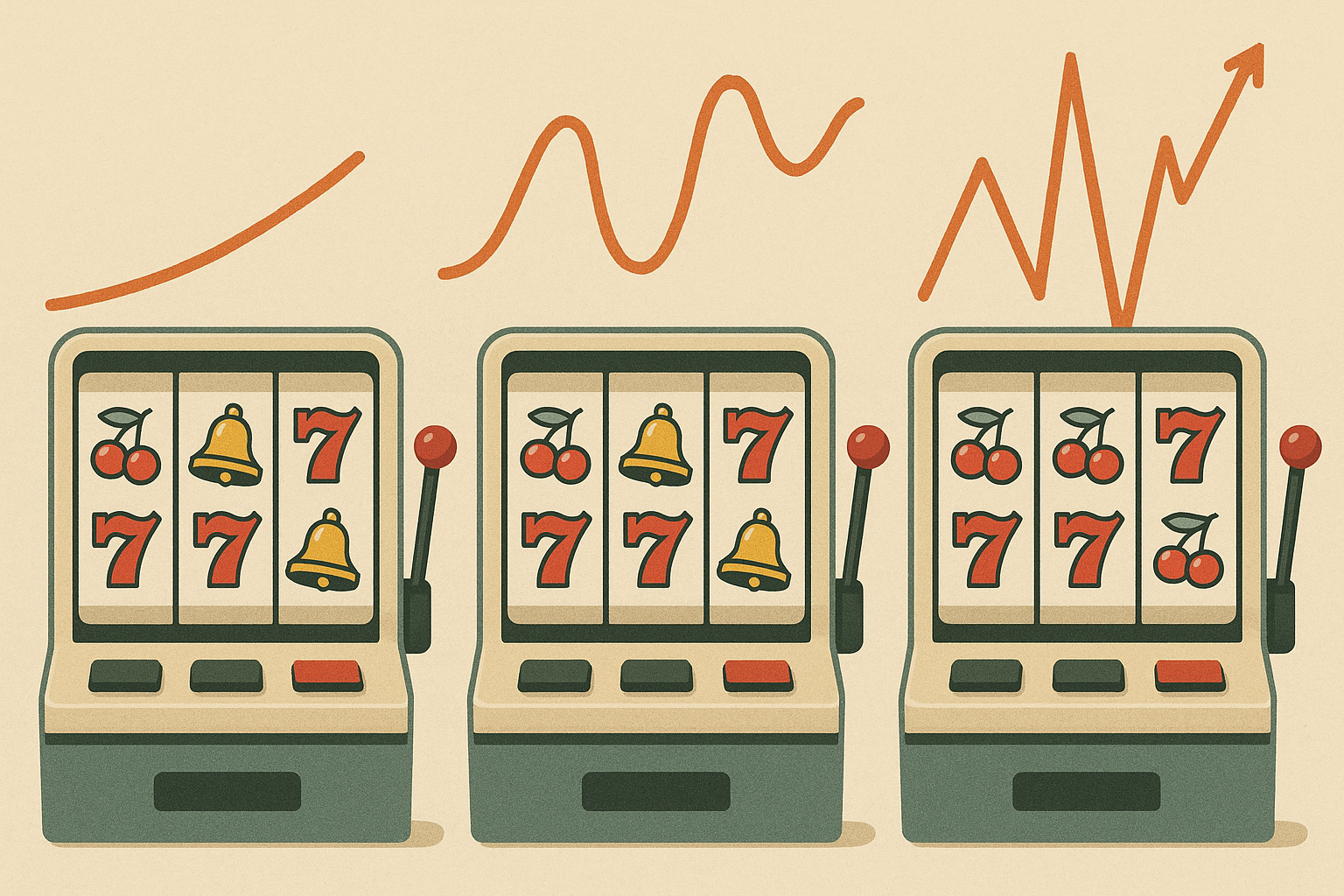
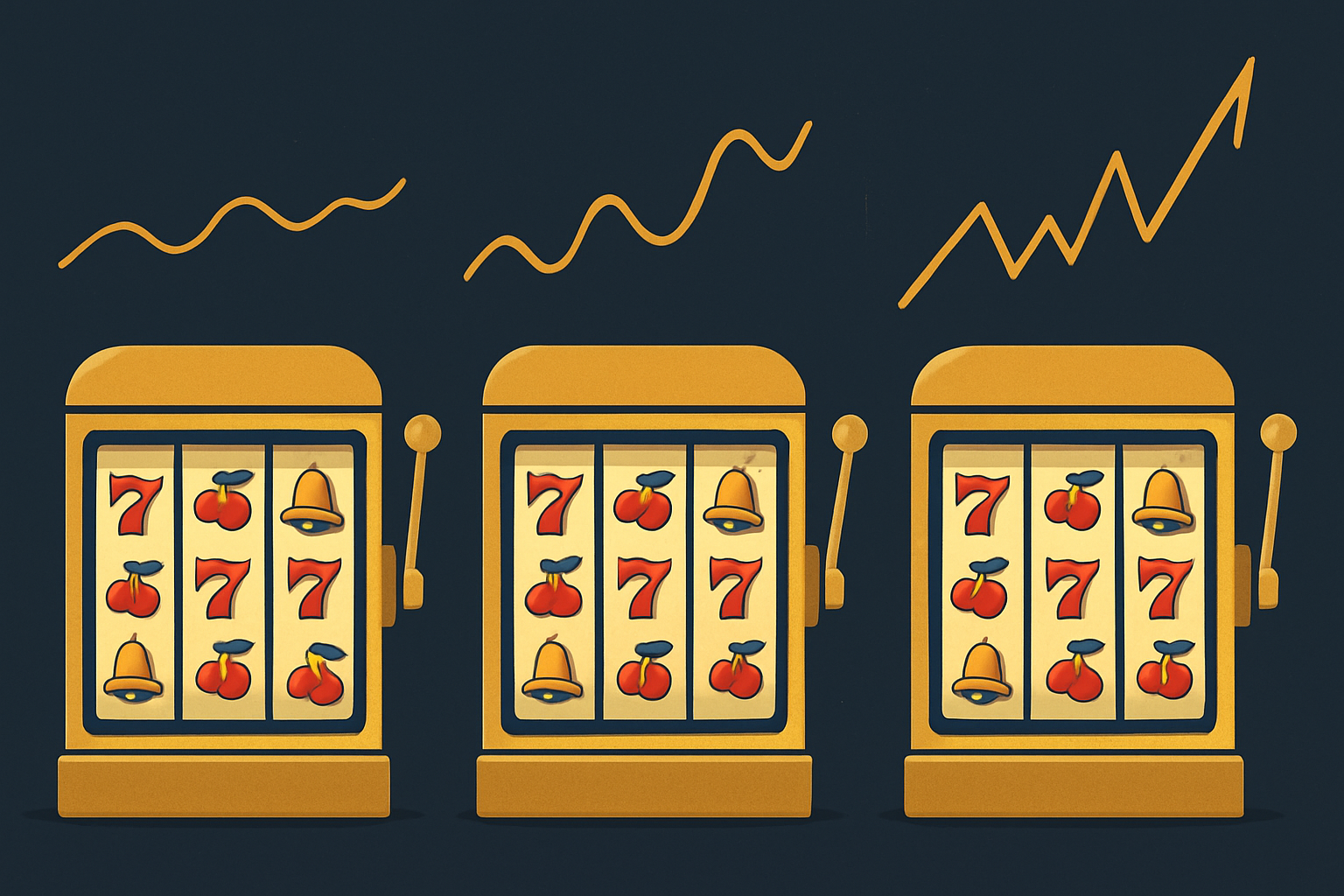
Slot volatility, also called variance, describes the pattern of a slot’s payouts: how often it pays and how big those payouts tend to be. Low volatility means frequent small wins. High volatility means rare wins that can be much larger. Volatility says nothing about how much a game returns overall, only about how bumpy the ride is getting there.
Think of two games that both return 96 cents per dollar wagered over the long run. One drips back 20 or 40 cents at a time, several times a minute. The other takes your money for 80 spins, then hands back 60x your stake in one bonus round. Same long-run return, completely different experience, and completely different demands on your bankroll.
Statisticians would call this standard deviation, which measures how far individual results scatter around the average. Slot providers translate that into something friendlier, usually a rating like “low”, “medium”, “high”, or a 1-to-5 star risk level in the game info screen.
Slot volatility vs RTP: key differences
RTP (return to player) is the percentage of all wagers a game returns over millions of spins. Slot variance is how those returns are distributed across individual spins and sessions. RTP is the destination; volatility is the road.
Here’s the concrete version. A slot with 96% RTP has a 4% house edge, meaning that across the whole population of players and an enormous number of spins, the game keeps about $4 of every $100 wagered. That average holds whether the game is Starburst-style low variance or a Megaways monster with a 5,000x top prize.
Where they diverge is your session. On a low variance game at $1 a spin, 200 spins might realistically leave you somewhere within $20 or $30 of even. On a high variance game, that same 200 spins could end with your balance gone, or with a single bonus that puts you well ahead. Neither outcome tells you anything about the RTP. It tells you about the variance.
Two more things worth knowing. First, many popular slots ship in multiple RTP versions, and operators choose which one to run, so the number in one casino’s paytable may not match another’s. Always check the paytable at the site you’re playing. Second, higher volatility does not mean higher RTP. Some of the highest RTP slots ever released are low variance games. For a fuller breakdown of the math, see our guide to RTP and house edge.
Low volatility slots: frequent small wins
Low volatility slots pay something on a large share of spins, but most of those payouts are smaller than your stake or roughly break even. They exist to stretch playing time, not to produce headline wins.
Characteristics of low variance games
- High hit frequency, often paying on something close to a third of spins or more.
- Modest top prizes, frequently in the 100x to 500x stake range rather than thousands.
- Simple mechanics: few reels modifiers, straightforward free spins, no cascading multiplier ladders.
- Slow, shallow balance movement. You lose gradually rather than in cliffs.
- Bonus rounds that trigger relatively often but pay conservatively.
Best low volatility slot examples
Two long-running examples from NetEnt make the point well. Starburst uses expanding wilds and pays both ways across five reels, with a listed RTP around 96% and a payout pattern that produces lots of small hits and no huge top prize. Blood Suckers is the other classic: an unusually high listed RTP near 98% paired with low variance, which is exactly why casinos so often exclude or restrict it in bonus wagering terms.
Low variance suits players who want a long session on a small budget, anyone clearing a bonus with a limited bankroll, and newcomers who want to learn how a game’s features work without their balance vanishing in ten minutes.
Medium volatility slots: balanced risk and reward
Medium volatility slots sit in the middle: wins arrive often enough to keep a session moving, and the bonus rounds can pay several hundred times your stake on a good run. This is where most mainstream releases land, because it suits the widest range of players.
Gonzo’s Quest is a good reference point. Its avalanche reels and increasing multipliers create real spikes, but base game hits are common enough that you are rarely sitting through 50 dead spins. Thunderstruck II is another established medium-variance title, with a four-tier free spins feature that unlocks gradually as you trigger it more often.
If you don’t have a strong preference, medium is the sensible default. You get some upside without needing the deep bankroll that high variance play honestly requires.
High volatility slots: big wins, long dry spells
High volatility slots pay rarely and pay big. Top prizes commonly run from 2,000x to 10,000x stake or more, funded by long stretches where nothing meaningful lands. Expect dozens of consecutive spins with no win at all, and expect your balance to move in steps rather than a gentle slope.
Well-known examples include Book of Dead from Play’n GO (listed RTP about 96.2%), Dead or Alive II from NetEnt, Bonanza from Big Time Gaming, and Relax Gaming’s Money Train series, which sits at the extreme end of the scale. Sweet Bonanza and most Megaways titles also belong here.
Understanding hit frequency
Hit frequency is the share of spins that produce any win, and it’s a different measurement from volatility, though the two usually move together. A low variance slot might pay on 35 to 45 spins out of 100; a high variance one might pay on 20 to 25, and many of those hits will still be less than your stake. Some providers publish hit frequency in the game info panel, and when they do, it’s the fastest way to sanity check how a slot will feel.
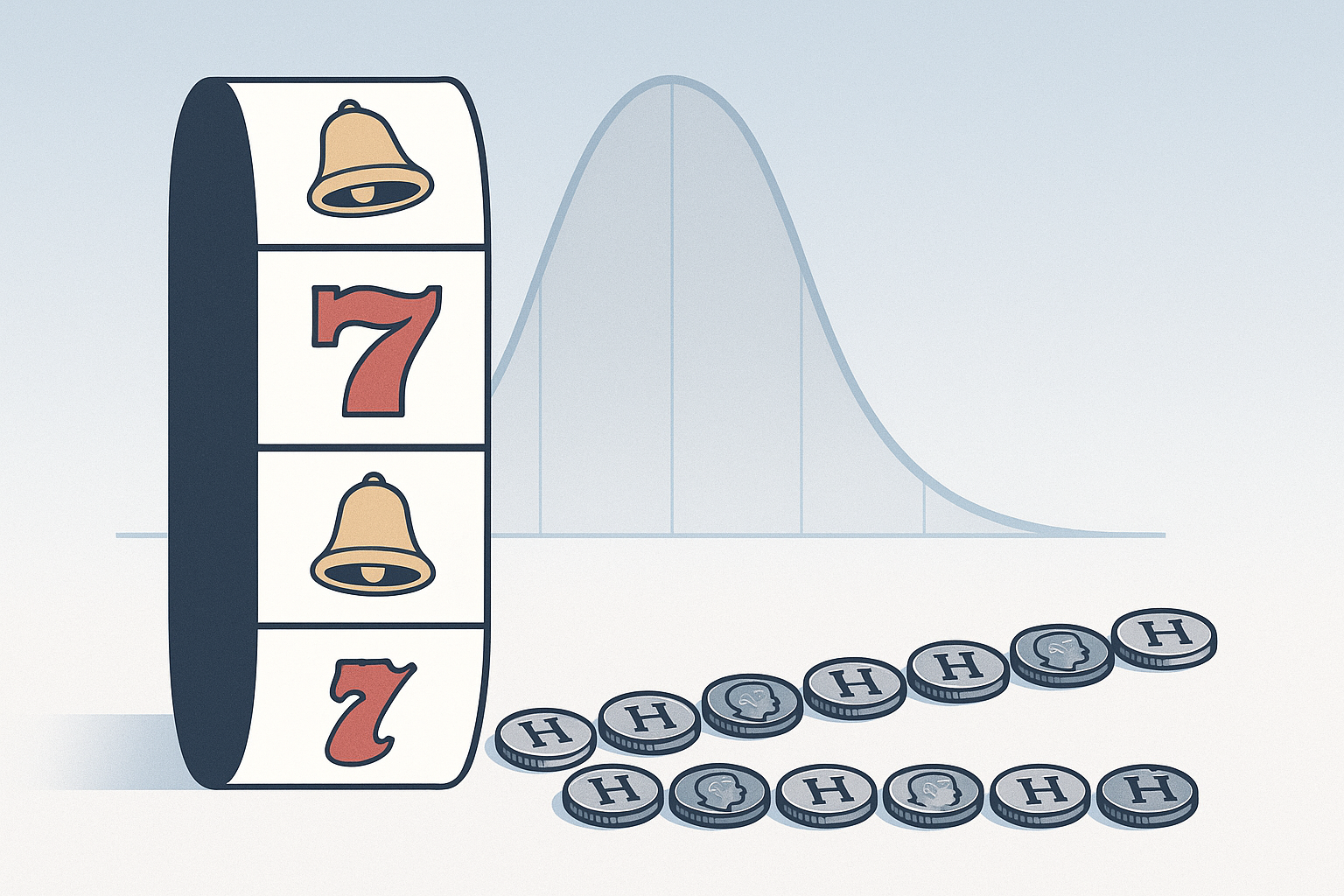
The math trap here is assuming a dry spell means a payout is “due”. It isn’t. Every spin is generated independently by the RNG, and 100 losing spins in a row changes the odds on spin 101 by exactly nothing. There are no hot or cold machines.
Managing high variance bankroll swings
The practical rule is simple: high variance games need more spins to have a realistic chance of hitting their features, so each spin has to cost less. If you want 400 to 500 spins from a session, your bet size has to be your bankroll divided by that number, not whatever the game defaults to.
Also plan for the ugly version. On a high variance slot it’s entirely normal to lose an entire session bankroll without ever triggering the bonus round. That’s not bad luck, it’s the design. If losing that amount in 20 minutes would bother you, the volatility is wrong for your budget.
Matching volatility to your bankroll
Volatility choice is really a bankroll decision. Here’s how the three levels compare on the factors that actually affect your session.
| Factor | Low volatility | Medium volatility | High volatility |
|---|---|---|---|
| Win frequency | Frequent | Moderate | Infrequent |
| Typical win size | Small (often under stake) | Moderate | Rare but large |
| Typical max win | 100x-500x stake | 500x-2,000x stake | 2,000x-10,000x+ stake |
| Bankroll needed per session | Smallest | Moderate | Largest |
| Session feel | Steady, slow decline | Mixed | Long droughts, sharp spikes |
| Suits | Long play on a small budget | Most recreational players | Players comfortable losing fast for a shot at a big hit |
Note what the table doesn’t include: expected profit. None of the three levels changes the house edge. All of them lose money over time. What you’re choosing is how that loss is distributed.
Small bankroll strategy
For a small bankroll, low or low-to-medium volatility is the better fit. With $40 and a goal of playing for an hour, betting $0.20 a spin gives you roughly 200 spins before any returns are counted, and a low variance game will typically recycle enough small wins to extend that considerably. The same $40 at $2 a spin on Money Train is a 20-spin session that most likely ends with nothing.
A practical guideline: keep each spin at or below about 0.5% of your session bankroll for low and medium variance games, and 0.2% or less for high variance. That’s a discipline tool, not a way to change the odds. Our bankroll management guide covers session limits and stop points in more depth.
Large bankroll options
A larger bankroll opens up high variance play, because you can afford the 300 to 500 spin runs those games need to have a fair shot at their bonus features, and you can absorb multiple losing sessions in a row. It doesn’t make the games better value, just survivable.
Progressive jackpot slots are the extreme case. Mega Moolah and similar titles carry very high variance and typically a lower base game RTP, because part of every wager funds the jackpot pool. You’re paying for a small chance at a very large prize.
How do I find a slot’s volatility rating?
Check the game’s own information screen first. Most modern slots include a paytable or “i” panel with the RTP, the maximum win, and a volatility or risk rating, often shown as a bar or star scale. That’s the authoritative source, because it reflects the version the operator has configured.
- In-game info panel: open the paytable and look for volatility, variance, or “risk level”, plus max win as a multiple of stake.
- The provider’s website: studios like Play’n GO, Pragmatic Play, NetEnt and Relax Gaming publish game sheets with volatility, RTP and hit frequency.
- Casino game lobbies: some regulated US operators list volatility filters or tags directly in their slot menus.
- Independent reviews: useful, but check that the RTP quoted matches your casino’s paytable, since multiple versions exist.
When volatility isn’t disclosed, read the numbers you do have. A max win of 10,000x stake with a 96% RTP can only be funded by long losing streaks, so the game is high variance almost by definition. A 200x max win points the other way. Then test it in demo mode where available: 100 to 200 free spins will tell you quickly whether hits arrive regularly or the balance drops in a straight line. In US regulated markets, demo play availability varies by state and operator, so you may need to test at minimum stakes instead.
Choosing the right volatility for your play style
Work backwards from what you want out of the session. Want to play for a long time on a set budget and treat it as entertainment spend? Low volatility. Want a mix of playing time and the occasional decent hit? Medium, which is where most players land and most games are built. Willing to lose the whole session bankroll quickly for a shot at a large multiplier? High volatility, at stakes small enough to survive the dry spells.
Two honest caveats. Volatility is a preference tool, not a strategy: no volatility level, bet-sizing pattern or game selection removes the house edge, and there’s no sequence of spins that becomes “due” for a win. And whichever level you pick, set a deposit or loss limit before you start, use the session reminders your casino provides, and treat the money as spent entertainment rather than an investment. If gambling stops feeling like a choice, the National Council on Problem Gambling runs a confidential helpline at 1-800-GAMBLER. Must be 21+ (or 18+ where permitted) and physically located in a state where online casino play is legal.
FAQ
What’s the difference between low and high variance slots?
Low variance slots pay small amounts often and keep your balance relatively stable. High variance slots pay rarely but can pay hundreds or thousands of times your stake, with long losing runs in between. Both can have the same RTP.
Which volatility is best for a small bankroll?
Low volatility, or low-to-medium. It gives you the most spins per dollar and the smallest chance of losing everything in a few minutes. High variance games need several hundred spins to have a fair shot at their features, which a small bankroll can’t fund at sensible stakes.
Does high volatility mean a better chance of winning?
No. It means a smaller chance of a much larger win. The long-run return is set by the RTP, not the variance, and every slot keeps a house edge over time.