What are paylines in slots?
A payline is a predetermined pattern of reel positions that pays out when enough matching symbols land on it. Slot paylines are set by the game’s designer, printed in the paytable, and they don’t move. If three cherries land on positions the line doesn’t cross, you get nothing, even though the cherries are on screen.
The original mechanical slots had one payline: the middle row, straight across three reels. Most modern video slots use a 5×3 grid (five reels, three symbol positions each) with somewhere between 10 and 25 lines. Wins are usually evaluated left to right, starting from reel 1, unless the game advertises “win both ways” (NetEnt’s Starburst is the best-known example of paying in both directions).
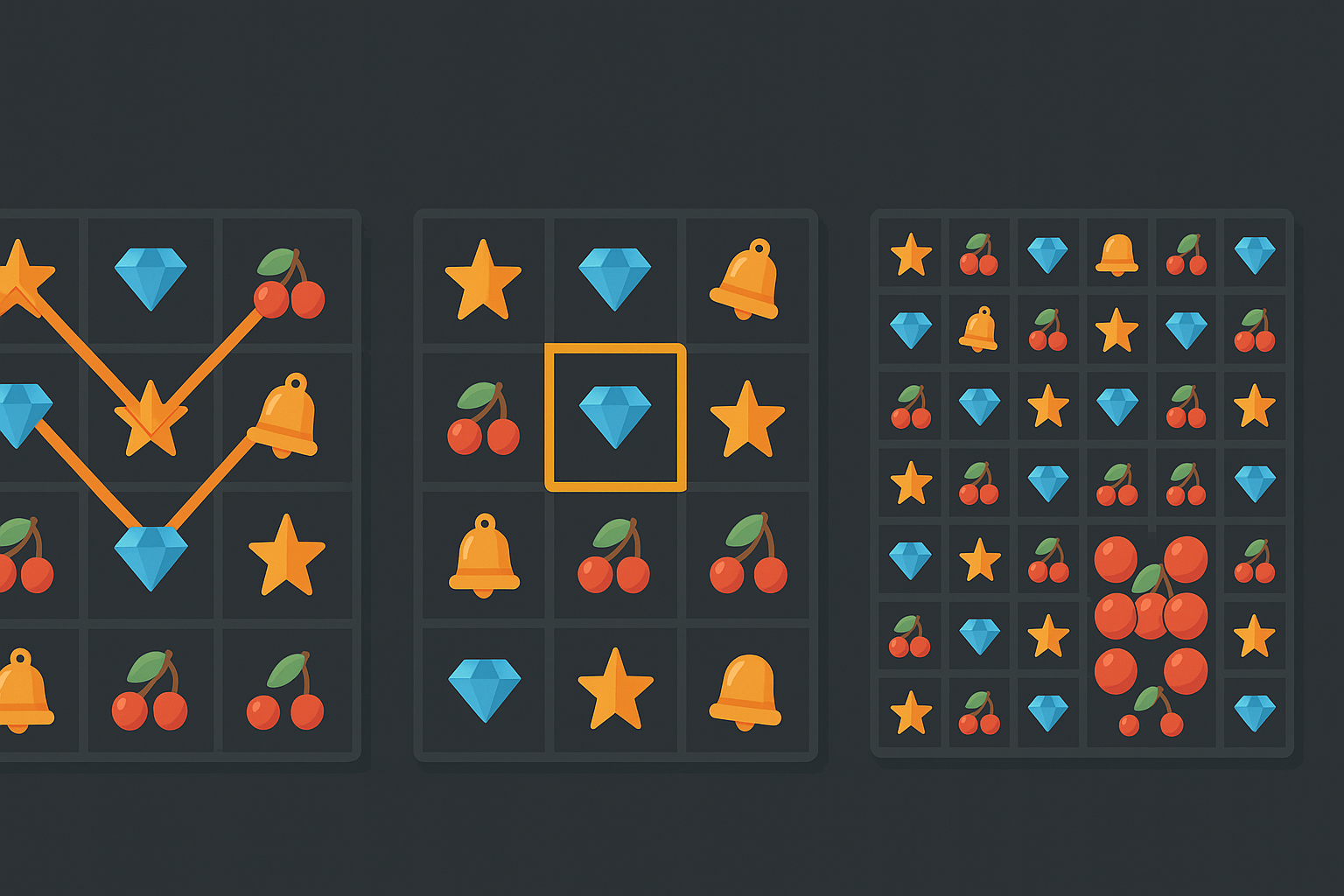
Here’s what a few common patterns look like on a 5×3 grid, where row 1 is the top and row 3 is the bottom:
| Payline pattern | Reel 1 | Reel 2 | Reel 3 | Reel 4 | Reel 5 |
|---|---|---|---|---|---|
| Straight middle line | Row 2 | Row 2 | Row 2 | Row 2 | Row 2 |
| V shape | Row 1 | Row 2 | Row 3 | Row 2 | Row 1 |
| Zigzag | Row 1 | Row 2 | Row 1 | Row 2 | Row 1 |
Three matching symbols on reels 1, 2 and 3 of an active line normally pays the smallest amount for that symbol; four pays more, five pays the most. Scatter symbols are the exception, since they pay or trigger features from anywhere on screen regardless of the lines.
Fixed vs adjustable paylines
Fixed paylines are always active. You can change the stake per line or the coin value, but you can’t switch lines off, so the minimum bet is the per-line minimum multiplied by every line in the game.
Adjustable paylines let you choose how many lines are live. Play 5 of 20 lines and your total bet drops to a quarter, but you’re only being paid on those 5 patterns. Combinations that land on the 15 inactive lines are dead.
Two things worth knowing before you start trimming lines. First, the published RTP of a game is normally calculated with all lines active, so cutting lines rarely improves your return. Second, in some games the scatter or bonus trigger interacts with active lines, which means fewer lines can mean fewer chances at the feature that carries much of the game’s payout. Read the info panel rather than assuming.
How paylines affect your bet size
On a line-based slot your total stake is simple arithmetic: stake per line × number of active lines. At $0.05 per line across 20 lines you’re betting $1.00 a spin. Bump the per-line stake to $0.10 and you’re at $2.00.
This is where a lot of players get caught out. A slot advertising “from $0.01” usually means one cent per line, so a 25-line game has a real minimum of $0.25. Always look at the total bet figure, not the coin value.
Ways-to-win: beyond traditional paylines
Ways-to-win slots drop fixed patterns entirely. Instead, any matching symbol on consecutive reels counts, no matter which row it lands in, as long as the run starts on reel 1. Position stops mattering; only the reels matter.
The practical difference: on a 25-line slot, three matching symbols on the first three reels might pay nothing because they’re on positions no line touches. On a ways-to-win slot, that same screen always pays.
How 243 ways to win works
The number comes straight out of multiplication. Five reels with three positions each gives 3 × 3 × 3 × 3 × 3 = 243 possible symbol paths across the grid. Microgaming’s Thunderstruck II is a well-known 243 ways title.
The 243 ways to win format also changes how you bet. There’s no per-line stake, just a total bet that covers all 243 combinations, which is why these games often show a bet ladder (for example $0.30, $0.60, $1.50) rather than a coin value and line selector.
1024 ways and higher configurations
Add a fourth row and the math scales fast: 4 × 4 × 4 × 4 × 4 = 1,024 ways. A five-row, five-reel grid gives 55 = 3,125. Same principle, taller grid.
Bigger numbers look impressive in the lobby, but they don’t mean bigger returns. A 1,024 ways game still has a set paytable and a set RTP; the higher ways count is offset by lower per-combination payouts. More coverage, smaller prizes per hit.
Megaways explained: variable ways per spin
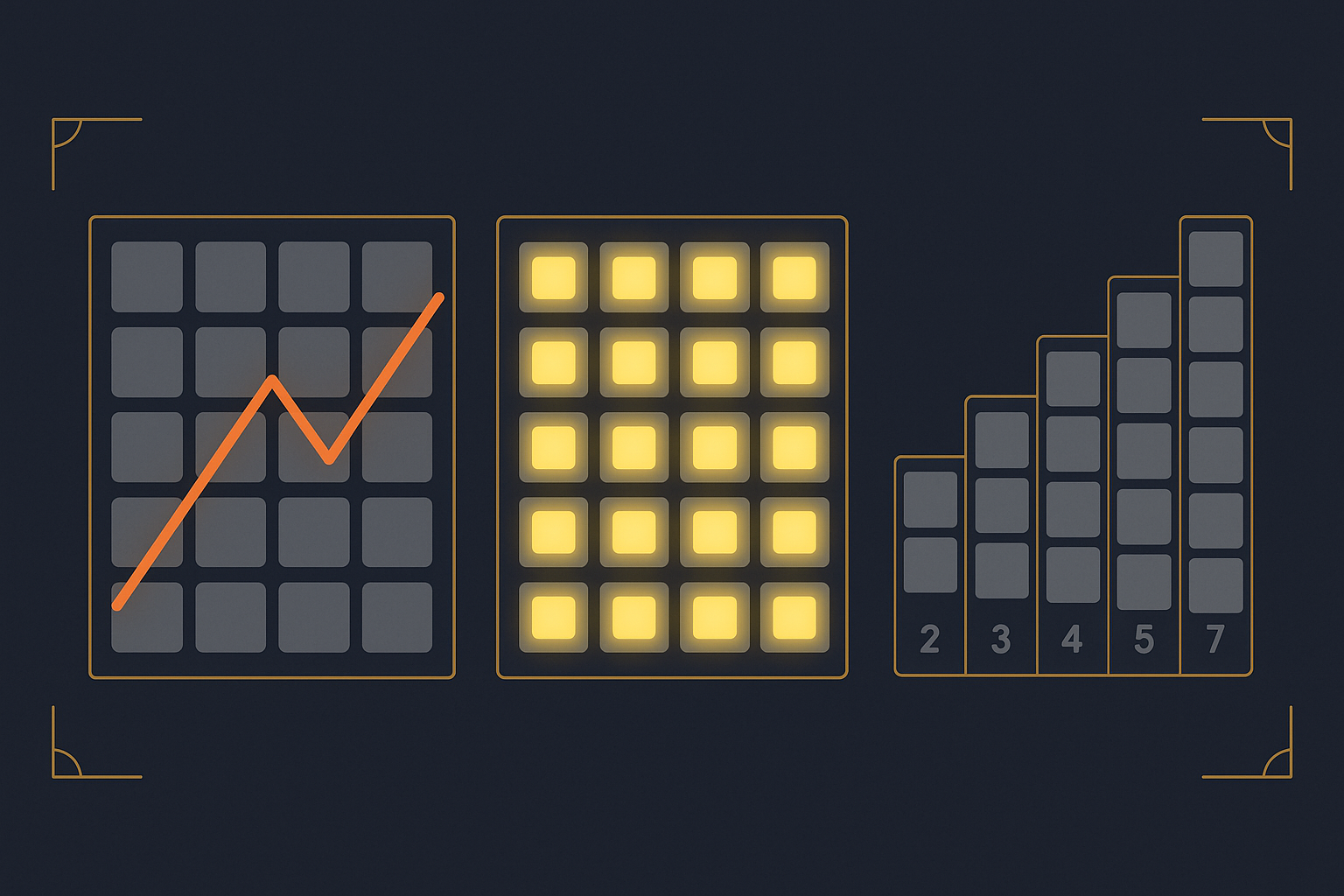
Megaways is a mechanic licensed from Big Time Gaming in which the number of symbol positions on each reel changes randomly every spin. Reels typically show between 2 and 7 symbols, so the number of ways to win is recalculated each round instead of being a fixed figure.
The Megaways math
You multiply the reel heights together. Six reels at maximum height gives 7 × 7 × 7 × 7 × 7 × 7 = 117,649 ways, which is where the headline number comes from. A more typical spin might look like this:
4 × 5 × 6 × 7 × 3 × 2 = 5,040 ways
And a poor spin can drop to 2 × 2 × 2 × 2 × 2 × 2 = 64 ways. The stake stays the same either way. Bonanza, the original Megaways slot, also adds a horizontal reel above the middle reels that feeds in extra symbols, which is how it reaches the full 117,649 figure.
One caution specific to this format: several Megaways titles are supplied to operators in more than one RTP configuration, so the same game can have a different published return at different casinos. Check the game info screen for the version you’re actually playing, and read our guide to RTP and volatility if those terms are new to you.
Cascading reels and multipliers
Megaways games almost always pair the variable reels with cascading (tumbling) reels. Winning symbols are removed, new symbols drop in to fill the gaps, and any new combination pays again from the same stake. The chain continues until no new win forms.
In many titles the free spins round adds a multiplier that climbs with each successive cascade rather than resetting, which is where the large results in these games come from. It also explains their volatility: long dry stretches punctuated by occasional big cascades. High volatility doesn’t change RTP, it changes how the same long-run return is distributed.
Cluster pays: grid-based winning
Cluster pays slots award wins for groups of touching identical symbols instead of lines or reel-by-reel runs. Symbols must be adjacent horizontally or vertically (diagonals normally don’t connect), and the game sets a minimum cluster size, commonly five or more.
Grid slots of this type are usually square or near-square rather than the classic 5×3 shape. Play’n GO’s Reactoonz uses a 7×7 grid with clusters of five or more, and Push Gaming’s Jammin’ Jars uses an 8×8 grid. NetEnt’s Aloha! Cluster Pays runs on a 6×5 grid with a larger minimum cluster.
Cluster games nearly always use cascading symbols too, so one qualifying cluster can trigger several payouts from a single spin. Betting is a flat total stake, with no lines to configure.
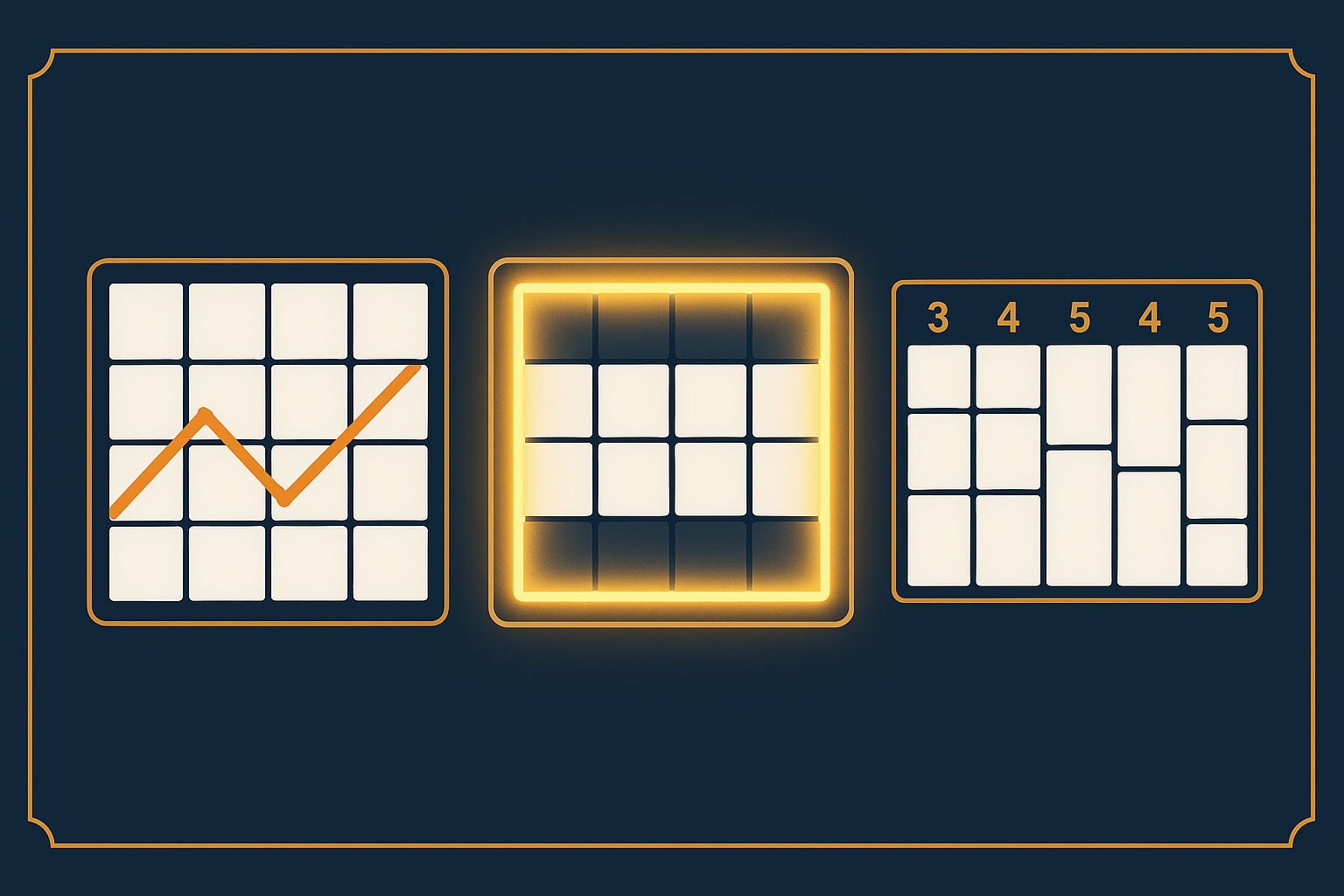
The four structures side by side:
| Structure | How a win forms | Typical bet control | Example |
|---|---|---|---|
| Paylines | Matching symbols on a set pattern | Stake per line × lines | Book of Dead (10 lines) |
| Ways to win | Matching symbols on consecutive reels, any row | Single total stake | Thunderstruck II (243 ways) |
| Megaways | Same as ways to win, with random reel heights | Single total stake | Bonanza (up to 117,649) |
| Cluster pays | Groups of touching identical symbols | Single total stake | Reactoonz (7×7 grid) |
Do more paylines mean better odds?
No. More paylines change how your stake is spread across the screen and how often you see a win, but they don’t change the game’s RTP or house edge. Those are fixed by the paytable and the reel maths, not by the number of lines.
Compare two $1.00 spins on the same 25-line slot. Play all 25 lines at $0.04 each and you’re covering every pattern, so small wins land more often, many of them worth less than the $1.00 you staked. Play 5 lines at $0.20 each and you’ll win less frequently, but each hit is worth four times as much because your per-line stake is four times bigger. Same $1.00 out, same long-run expected return, different ride.
The same logic kills the idea that a 117,649-ways game is “better value” than a 10-line game. If the Megaways title runs at 96% RTP and the 10-line classic runs at 96.5%, the classic returns more per dollar wagered over the long run despite having 11,764 times fewer ways to win. And remember what RTP means: an average across millions of spins, not a promise for your session. A 96% RTP is a 4% house edge, which is exactly why the house profits over time.
How payout structure affects your betting strategy
Structure doesn’t give you an edge, but it does tell you how to set your stake so a session lasts as long as you intended it to. Work backwards: decide the total you’re willing to lose, decide roughly how many spins you want, and divide.
Betting on fixed payline slots
With fixed lines your only lever is the per-line stake or coin value, and the game’s minimum total bet may be higher than it first appears. If a 25-line slot’s floor is $0.25 and your session budget is $20, you have around 80 spins at the minimum, which is thin for a game whose bonus round is the main event. Either accept the shorter session or pick a game with a lower total minimum.
Where lines are adjustable, treat reducing them as a way to lower your total stake, not as a tactic. You’re buying fewer chances for less money, and in games where line count affects feature triggers you may be giving up more than you save.
Ways-to-win betting strategy
Ways-to-win games remove the decision entirely: you pick a total stake from a preset ladder and every one of the 243 or 1,024 ways is live. That makes budgeting cleaner, since the number on the bet button is the number leaving your balance.
Watch the step sizes on the ladder. Some titles jump from $0.30 straight to $0.60, so the “one step up” you take is a doubling of your risk per spin, not a nudge.
Megaways bet sizing
Megaways stakes are also flat totals, and the ways count moving between 64 and 117,649 costs you nothing extra. What matters is volatility. These games are built around cascades and free spins multipliers, which means most spins return nothing and the paytable’s top end is reachable only rarely.
Practically, that argues for a smaller stake per spin than you’d use on a low volatility line game with the same bankroll, simply so you can absorb the dry stretches. Cutting your bet in half doubles your spin count for the same money. It doesn’t improve your odds, and nothing you do with bet sizing can, but it does keep the session inside the budget you chose.
Quick answers
What is the difference between paylines and ways to win? Paylines pay only on set patterns of positions. Ways-to-win systems pay whenever matching symbols land on consecutive reels, whatever row they’re in, so position doesn’t matter.
How do Megaways slots work? Each reel randomly shows 2 to 7 symbols per spin, and the ways to win equal the reel heights multiplied together, up to 117,649 on a six-reel game.
What are cluster pays? Wins formed by groups of touching identical symbols on a grid, usually five or more, instead of lines or reels.
If you’re still getting comfortable with reel structure, symbol types and bet configuration, start with our beginner’s guide to how slot machines work.
Every format described here is designed with a house edge, and outcomes are produced by an RNG that treats each spin independently. Play with money you can afford to lose, set deposit and session limits before you start, and use the responsible gambling tools your casino offers if play stops feeling like entertainment.