The short answer: no, slots don’t get hot or cold
If you’re wondering whether slots are due to hit after twenty dead spins, the answer is no. A slot machine has no memory. Every spin is generated independently, so the machine cannot know it “owes” you anything, and it cannot decide to tighten up because you just won. A cold streak of 200 spins changes the odds of the next spin by exactly zero.
When players say a machine is “hot,” they usually mean it has paid several wins in a short window. “Cold” means it has swallowed money without much back. Both are descriptions of what already happened, not predictions. The pattern is real in the sense that it happened; it’s meaningless in the sense that it tells you nothing about spin number 201.
That’s the whole myth in one line. But the reason so many experienced players still believe it is more interesting than the myth itself, and worth understanding if you want to keep your slot budget under control.
What is the gambler’s fallacy?
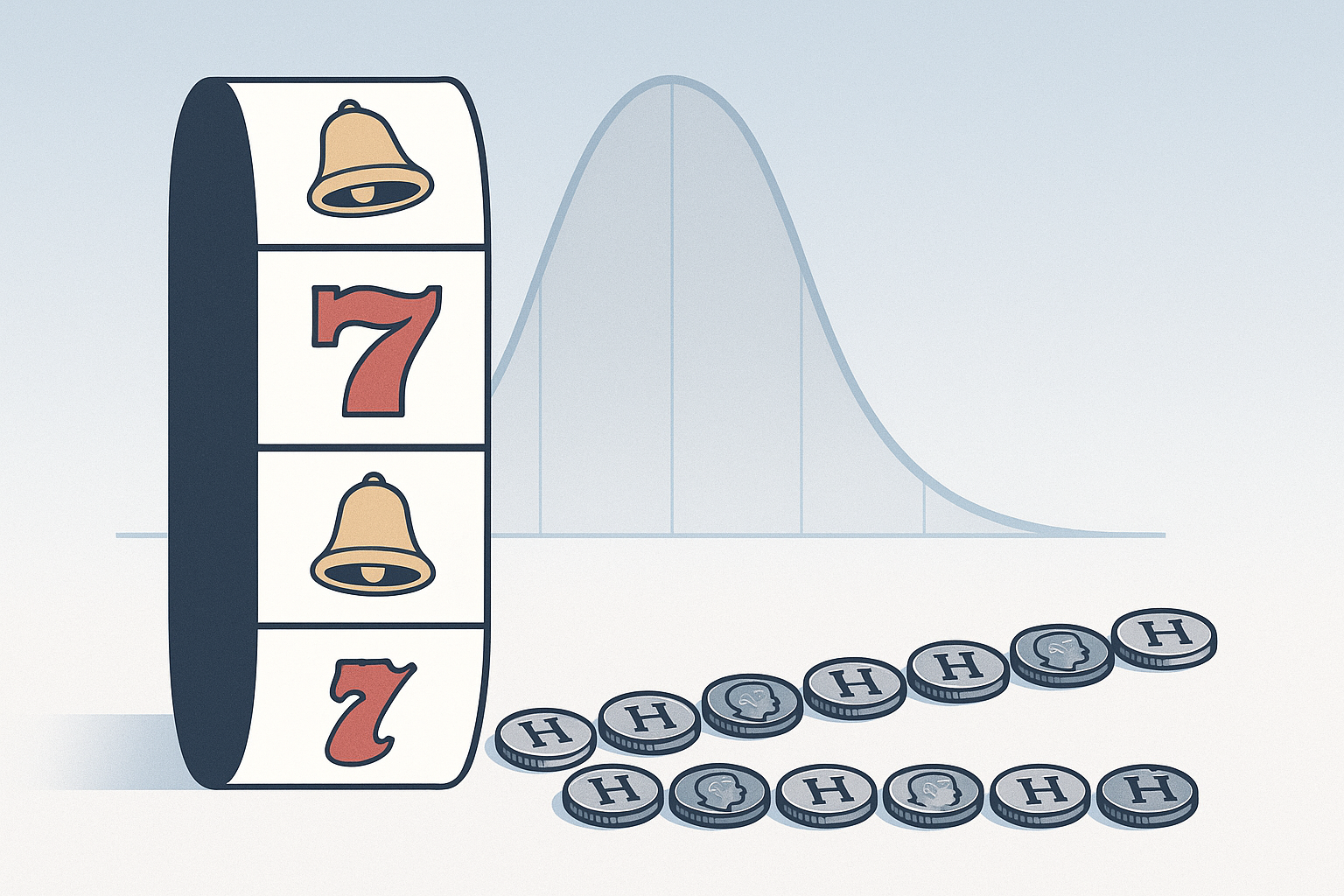
The gambler’s fallacy is the belief that a random outcome becomes more or less likely because of what happened before it. Flip a fair coin five times and get five heads. Most people feel tails is now “overdue.” It isn’t. The sixth flip is still 50/50, because the coin doesn’t know about the first five.
The five-heads run does feel unlikely, and it is: a specific run of five heads has a probability of 1 in 32. But that probability applied before you started flipping. Once those flips are in the past, they’re fixed history. They don’t get rebalanced by future flips.
Slots work the same way, just with worse odds and more moving parts. If a bonus round triggers on average once every 200 spins, it triggers with roughly a 0.5% chance on every single spin, whether your last trigger was three spins ago or 900 spins ago. There is no counter quietly filling up.
The psychology behind pattern-seeking
Humans are extremely good at spotting patterns, and that skill kept our ancestors alive. Rustling grass might be wind or might be a predator, and the brain that assumes “predator” survives more often. The cost of this wiring is that we also detect patterns that aren’t there, especially in sequences of random events.
Slot machines feed this wiring on purpose, though not dishonestly. Rapid rounds, near misses, sounds and animations for small wins, and celebratory audio for a payout smaller than your stake all give your brain a stream of “signals” to interpret. Sit at a machine for an hour and you’ll naturally build a story: it was warming up, then it went cold after that guy sat down.
Why our brains create false patterns
True randomness looks clumpy, not evenly spread. Genuine random sequences produce streaks far more often than people expect. Ask someone to write a “random” list of 50 coin flips from imagination and they’ll alternate too much and avoid long runs, because long runs feel non-random. Real randomness is full of them.
So when a slot pays three decent wins in six spins, that isn’t evidence of a hot cycle. It’s the ordinary clumpiness of random data. The same machine will also produce 80-spin droughts, and both are consistent with the same fixed math.
How slot machines actually work
Every legitimate slot, online or in a casino, uses a random number generator to determine outcomes. The reels you watch are a display layer. They’re the animation of a result the software already selected.
Random number generators (RNG) explained
An RNG is an algorithm producing a continuous stream of numbers with no predictable relationship to each other. In a physical slot, that stream keeps running whether anyone is playing or not, cycling thousands of times per second. When you press spin, the machine takes the number available at that instant and maps it to a reel outcome.
Those mappings are set by the game’s math model, which fixes the odds of each symbol landing in each position. Regulators in licensed US markets require RNG testing by independent labs before a game goes live, along with checks that the machine’s actual payback matches its certified design. (Publisher note: link to your state regulator’s testing requirements or a testing lab such as GLI here.)
One nuance worth knowing: in some US jurisdictions, machines that look like slots are Class II bingo-based games, where the outcome comes from an electronic bingo draw and the reels only display the result. Different mechanism, same conclusion for players. The result is random and unaffected by your play history.
Why each spin is completely independent
Statistical independence means the probability of an event doesn’t change based on other events. Suppose a jackpot has a 1 in 10,000 chance per spin. Here’s what independence actually implies over a long session, using that single fixed probability:
| Spins played | Chance of at least one jackpot | Chance of the very next spin hitting |
|---|---|---|
| 1,000 | About 9.5% | 1 in 10,000 |
| 5,000 | About 39% | 1 in 10,000 |
| 10,000 | About 63% | 1 in 10,000 |
| 20,000 | About 86.5% | 1 in 10,000 |
Look at the right-hand column. It never moves. Your cumulative chance of having seen a jackpot grows as you play more spins, which is why people confuse the two ideas. But the odds facing the next spin are frozen. Play 10,000 spins with nothing, and spin 10,001 is still 1 in 10,000.
Debunking common ‘hot’ and ‘cold’ slot myths
Myth: “this machine is due for a big win”
The “slot machine due” idea is the gambler’s fallacy in its purest form. Nothing in the software tracks how much a specific machine has taken from a specific player. Payout percentages are long-run averages measured over millions of spins across all players, not debts settled session by session.
The practical danger here is real: believing a machine owes you is how a planned $60 session turns into $300. That’s chasing, and it’s the single most expensive belief in slot play.
Myth: “I can time when a slot will hit”
You can’t time a jackpot. The RNG cycles far too quickly for human reaction to matter, and there’s no meaningful difference between pressing the button, using autoplay, or letting a machine sit idle. Stopping the reels early with a button doesn’t change the outcome either; it just shortens the animation of a result already chosen.
The same goes for bet size timing, switching machines after a win, or playing at “quiet hours.” Bet size changes what a given outcome pays, not which outcome occurs. There’s no clock on randomness.
Myth: “slots run in hot and cold cycles”
Games don’t cycle between loose and tight modes. What players experience as cycles is volatility, which is a legitimate concept, just not a predictive one. High volatility games pay less often but bigger; low volatility games pay small amounts more frequently. Volatility describes the shape of the distribution, not a schedule.
One genuine exception to note carefully: some online games offer more than one certified RTP setting, and the operator chooses which version to run. That’s a fixed configuration you can usually check in the game info panel, not a machine that heats up mid-session.
Where these beliefs come from
Several cognitive habits stack up, and together they’re persuasive:
- Confirmation bias. Once you believe a machine is hot, you notice the wins that fit and mentally discount the losses that don’t.
- Selective memory. The $400 hit is a story you retell for years. The eleven forgettable sessions before it fade.
- Near misses. Two jackpot symbols plus a third just above the line feels like almost winning. Statistically it’s just a loss, but research on gambling behavior has repeatedly found near misses increase the urge to keep playing.
- Losses disguised as wins. A 25-cent return on a $1 spin comes with the same cheerful sound as a real win, inflating how often you feel you’re ahead.
- Illusion of control. Buttons, bet sizing and stop features create a sense of influence over an outcome you can’t affect.
None of this means players are foolish. These are standard features of human cognition running into a game engineered around fast, random feedback.
The real factors that matter in slots
Ditch the streak reading and focus on the things that genuinely differ between games and sessions:
- RTP. Return to player is the long-run percentage of wagers a game returns, typically around 94% to 97% for slots. It’s an average over millions of spins, not a session guarantee.
- House edge. The flip side of RTP. A 96% RTP game carries a 4% house edge, meaning the expected cost of every $100 wagered is about $4 over the long run. Every slot has a negative expected value, and no pattern reading changes that.
- Volatility. High variance means longer dry spells and bigger swings, so it needs a larger bankroll for the same playing time. Low variance is steadier. Neither changes RTP.
- Bet size and session length. Wagered amount times house edge is your expected cost. This is the one lever you fully control.
- Bonus terms. If you play with a casino bonus, the wagering requirement matters more than the headline amount. A 30x requirement on a $100 bonus means $3,000 wagered before withdrawal.
Notice what’s missing from that list: anything about when to play or which machine is warm. If you want the mechanics in more depth, our guide to how RNGs work and our beginner’s guide to playing slots cover the underlying math.
Responsible gambling takeaway
Slots are entertainment with a price attached, and that price is the house edge. Treat the money you put in as the cost of the time you spend, decide the amount before you sit down, and stop when it’s gone. The players who get hurt are usually the ones who believed a machine was due and kept feeding it to collect.
Set deposit and loss limits, use session reminders where your casino offers them, and never gamble with money meant for something else. Our responsible gambling resources list the tools worth turning on before you play. In the US, the National Council on Problem Gambling operates the National Problem Gambling Helpline at 1-800-GAMBLER, available 24/7 and confidential; more information is at ncpgambling.org. You must be of legal gambling age in your jurisdiction to play.
FAQ
Do slot machines get hot or cold?
No. Outcomes are generated independently, so a machine that just paid out is no more or less likely to pay on the next spin than one that hasn’t paid in an hour. Hot and cold describe past results only.
Is a slot ever due for a big win?
Never. If a jackpot’s probability is 1 in 10,000 per spin, it stays 1 in 10,000 whether the last hit was yesterday or a year ago. Machines don’t track debts to players.
Can you time a slot to hit a jackpot?
No. The RNG cycles thousands of times per second, and the result is selected the instant you press spin. Timing, stop buttons and autoplay make no difference to which outcome you get.
Are slot outcomes truly random?
On licensed games, yes, within the limits of certified RNG software tested by independent labs. Random doesn’t mean fair odds, though. Randomness sits on top of a fixed house edge, so the operator profits over time.